
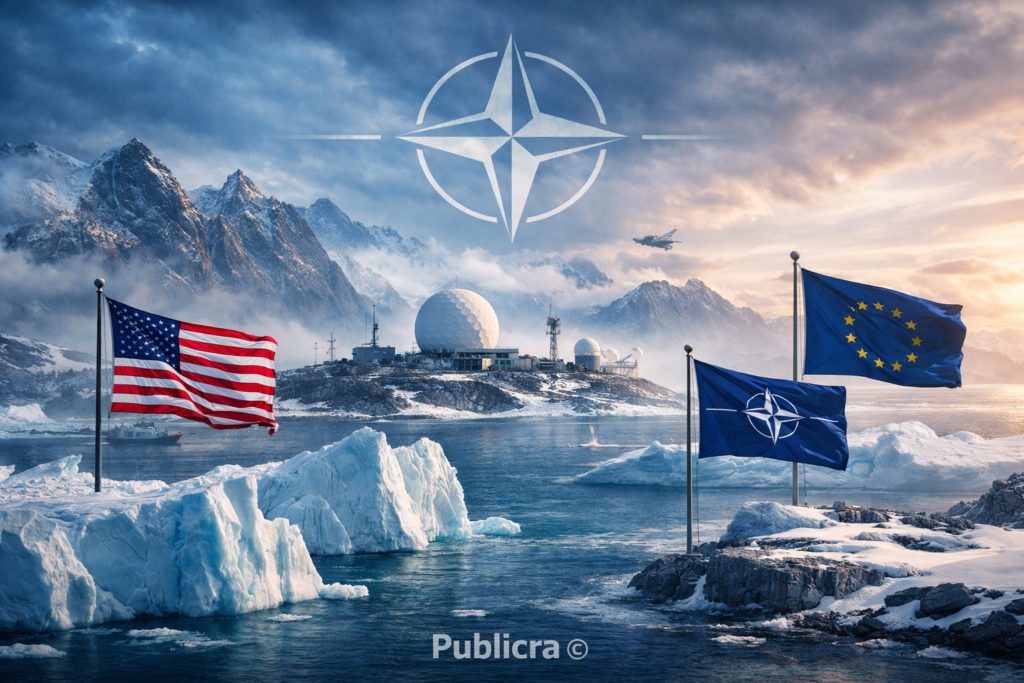
A strategic view of Greenland’s Arctic environment, highlighting its role in NATO defense planning, U.S. military access, and global geopolitical competition.
The Arctic has quietly transformed from a frozen frontier into one of the most contested geopolitical arenas of the 21st century. Nowhere is that shift more visible than in Greenland, a vast, ice-covered island whose strategic value has surged amid rising tensions between the United States, Russia, and China.
Following President Donald Trump’s renewed ultimatum over Greenland, diplomatic talks among the United States, Denmark, Greenlandic leaders, and NATO allies have intensified. These negotiations go far beyond symbolism. They touch on sovereignty, military basing rights, missile defense, rare-earth minerals, and the future of NATO’s Arctic posture.
While Washington has stopped short of demanding full ownership of Greenland, discussions now reportedly include proposals for sovereign U.S. military bases, expanded NATO missions, and restrictions on Russian and Chinese economic access—ideas that have sparked both cautious optimism and fierce resistance across Europe.
Why Greenland Matters More Than Ever
Greenland’s importance lies not in its population—just over 56,000—but in its location and resources.
Situated between North America and Europe, Greenland sits astride vital Arctic air and sea routes. As climate change melts ice caps and opens new shipping lanes, control over the Arctic increasingly means control over future global trade, surveillance corridors, and military early-warning systems.
At the same time, Greenland holds vast untapped reserves of rare-earth minerals, essential for electric vehicles, renewable energy systems, advanced electronics, and defense technologies. These minerals are currently dominated by China, giving Beijing enormous leverage in global supply chains.
For Washington, Greenland represents both a defensive shield and a strategic hedge against rival powers.
Trump’s Arctic Strategy: Pressure Without Annexation
Since returning to office in 2025, President Trump has revived his long-standing interest in Greenland, at times openly expressing a desire for U.S. ownership of the island. That rhetoric triggered a sharp backlash from Denmark and Greenlandic leaders, who insisted that the territory is not for sale.
Yet recent talks suggest a pivot in strategy.
Rather than outright annexation, U.S. negotiators are exploring arrangements that would grant Washington expanded, near-permanent military control over specific areas, while stopping short of formal territorial transfer. In public remarks at the World Economic Forum in Davos, Mr. Trump ruled out using military force but hinted at economic pressure if U.S. security demands were ignored.
Behind closed doors, however, the tone has shifted toward compromise.
“Arctic Sentry”: NATO’s New Northern Mission
One of the most significant ideas under discussion is the creation of a new NATO mission tentatively dubbed “Arctic Sentry.”
Modeled on NATO’s enhanced presence in Eastern Europe and the Baltic Sea, Arctic Sentry would aim to:
- Increase surveillance and early-warning capabilities in the High North
- Deter Russian military expansion in Arctic waters
- Coordinate allied air, naval, and space-based assets
- Protect critical infrastructure and emerging shipping routes
NATO officials emphasize that this mission would reinforce collective defense without altering borders—an important distinction for European governments wary of setting precedents on sovereignty.
Sovereign U.S. Bases: A Red Line for Denmark and Greenland
The most controversial proposal involves transforming existing U.S. military facilities in Greenland into sovereign base areas, similar to Britain’s bases in Cyprus.
Under such an arrangement, specific parcels of land would legally function as U.S. territory, granting Washington greater operational freedom and long-term security guarantees. American officials argue this would protect U.S. access even if Greenland were to pursue full independence from Denmark in the future.
But Denmark and Greenlandic leaders have been unequivocal.
“We can negotiate on security, investments, and cooperation,” Danish Prime Minister Mette Frederiksen said, “but sovereignty is not negotiable.”
Greenland’s prime minister echoed that stance, calling sovereignty a “red line” despite openness to broader security cooperation.
Blocking Russia and China from Arctic Minerals
Another pillar of the talks focuses on economic security.
Western officials are increasingly concerned that Russian and Chinese companies could gain mining rights in Greenland, giving rival powers strategic leverage over critical resources. Proposed measures include:
- Restricting mining licenses to NATO and allied nations
- Increasing Western investment to reduce Greenland’s economic dependence on China
- Creating joint oversight mechanisms for Arctic resource development
For Europe, this approach aligns with efforts to diversify supply chains and reduce reliance on authoritarian states for key materials.
The Golden Dome and Missile Defense Ambitions
Greenland also features prominently in U.S. plans for a next-generation missile defense system, sometimes referred to as the “Golden Dome.”
Given its location, Greenland could host radar systems, interceptors, or tracking stations designed to detect and neutralize long-range missile threats. Such deployments would significantly enhance North American and European defense—but also risk provoking Moscow, which has warned against further militarization of the Arctic.
Europe’s Delicate Balancing Act
European leaders have reacted with a mix of relief and caution. The immediate threat of tariffs against Denmark and allied states has receded, easing trans-Atlantic tensions. Yet concerns remain that excessive U.S. demands could undermine international norms on sovereignty.
German Chancellor Friedrich Merz summed up Europe’s position succinctly:
“We will protect the north from Russian threats while upholding sovereignty and territorial integrity.”
For NATO, the challenge is to strengthen Arctic defense without fracturing alliance unity.
What Comes Next for Greenland and the Arctic
Despite the flurry of diplomacy, officials stress that negotiations remain at an early stage. No formal agreement has been finalized, and political approval would be required in Washington, Copenhagen, Nuuk, and across NATO capitals.
Still, one reality is clear: Greenland is no longer a peripheral issue. It has become a strategic crossroads where climate change, great-power rivalry, and alliance politics converge.
Whether these talks produce a lasting compromise—or reopen deeper trans-Atlantic rifts—may shape Arctic security for decades to come.