
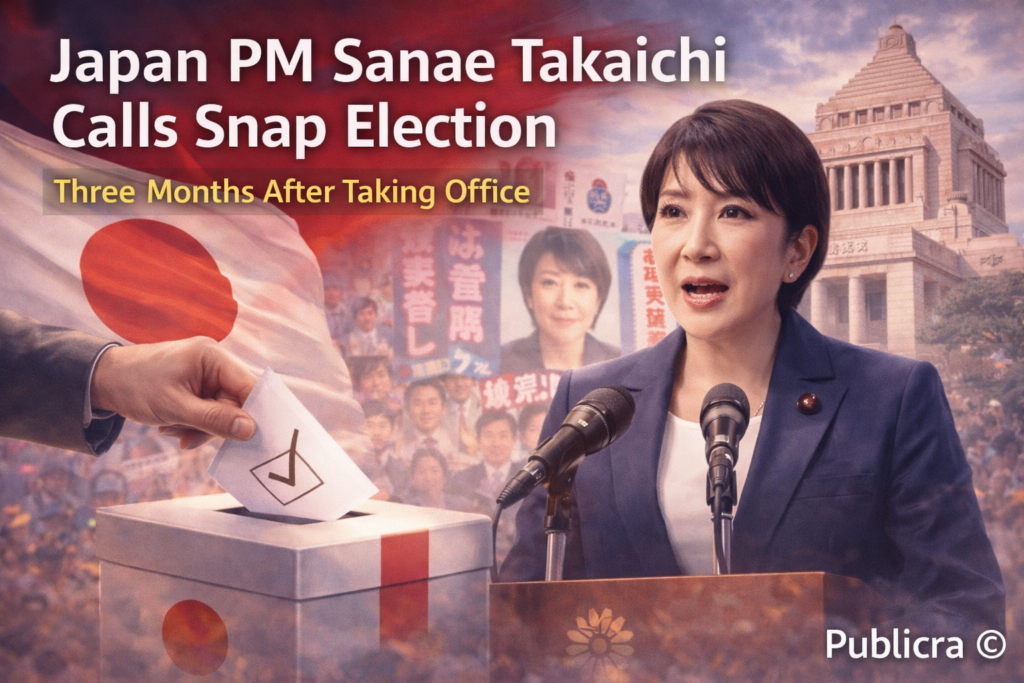
New leader seeks fresh mandate as high approval ratings clash with party weakness
Japan’s Prime Minister Sanae Takaichi has announced a snap general election just three months after taking office, dissolving parliament in a high-stakes move aimed at securing a stronger political mandate amid strong personal popularity but fragile party support.
Speaking at a news conference in Tokyo, Takaichi said the decision was a “serious and weighty” one that would allow voters to decide the country’s direction. Parliament will be dissolved on Friday, with elections scheduled for 8 February, and campaigning set to begin later this month.
Takaichi, Japan’s first female prime minister, assumed office in October after being elected by lawmakers. While her government has enjoyed strong public approval, her ruling Liberal Democratic Party (LDP) continues to trail in opinion polls, making the early election a calculated risk.
She said she wanted voters to directly judge whether her leadership deserved public backing, noting that her administration had not yet faced an election since she took office. “I wanted the people themselves to decide,” she said.
The LDP has governed Japan for most of the post-war period and currently holds the largest number of seats in the lower house. However, its coalition majority is narrow, relying on support from smaller parties to remain in power.
Known as Japan’s “Iron Lady,” Takaichi is a close political ally of former prime minister Shinzo Abe and has promoted an agenda centered on government-led economic stimulus. She has pledged to revive growth after years of stagnation, echoing policies associated with the Abenomics era.
Her government has also taken a firmer stance on national security. In December, Japan approved a record defense budget amid growing concerns over China’s military activity. Takaichi’s comments on Taiwan have strained relations with Beijing, while ties with Washington have strengthened, including new agreements on strategic resources.
Despite approval ratings estimated between 60 and 80 percent, political analysts warn that snap elections carry risks. Japan has seen frequent leadership changes in recent years, and previous early elections have backfired for LDP leaders.
A newly unified opposition bloc has also emerged, increasing uncertainty ahead of the vote. Still, analysts say Takaichi may be seeking to capitalize on her political “honeymoon” before public support begins to fade.