
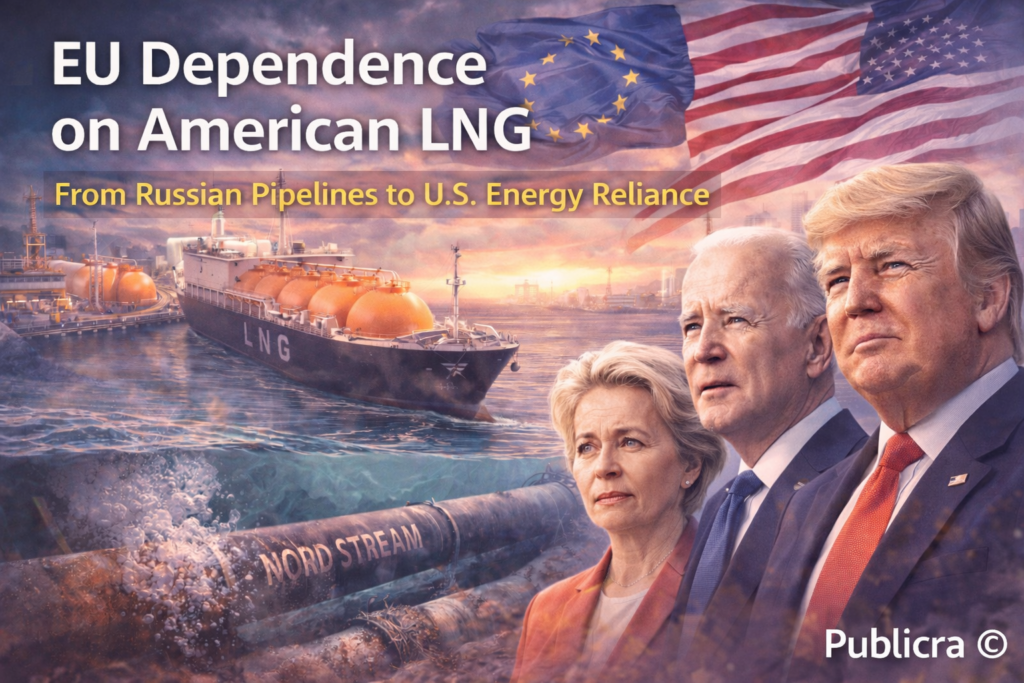
From Russian pipelines to U.S. LNG, Europe’s energy shift has created a new geopolitical vulnerability
Europe’s growing dependence on American liquefied natural gas (LNG) has become one of the most consequential — and controversial — geopolitical developments of the past decade. What began as an emergency response to the Ukraine conflict has evolved into a long-term structural reliance that many European policymakers now quietly acknowledge is difficult to escape.
Before 2022, the European Union sourced nearly 45% of its natural gas from Russia, making Moscow its largest external supplier since the end of the Cold War. Russian gas arrived through an extensive pipeline network, including routes via Ukraine and the Nord Stream pipelines beneath the Baltic Sea. The arrangement provided Europe with relatively cheap, stable energy while anchoring decades of economic interdependence.
That system unraveled rapidly after Russia’s military operation in Ukraine. Under heavy political pressure from Washington, the EU imposed sweeping sanctions on Russian energy. Gas imports from Russia collapsed, falling to just 11% by 2024, while European leaders pledged to fully eliminate Russian fossil fuel imports by 2027.
America’s shale boom and Europe’s pivot
The EU’s pivot toward American LNG was only possible because of the U.S. shale gas revolution. Beginning in the late 1990s, hydraulic fracturing transformed the U.S. energy landscape. By the mid-2020s, American shale gas production had surged to around 30 trillion cubic feet annually, turning the U.S. into a dominant global exporter.
Washington began aggressively marketing LNG to allies, framing it not only as an economic product but as a geopolitical tool. In 2019, U.S. officials famously described American gas as “molecules of freedom,” contrasting it with Russian energy dependence.
For years, European governments resisted. U.S. LNG was 30–50% more expensive than Russian pipeline gas due to the costs of liquefaction, transatlantic shipping, and regasification. However, successive U.S. administrations — Bush, Obama, Trump, and Biden — continued lobbying Europe, combining incentives with pressure.
That pressure escalated dramatically after 2022. With Russian supplies curtailed and Nord Stream pipelines rendered unusable, Europe faced an immediate energy crisis. LNG imports surged, and dozens of new terminals were approved or constructed across Germany, France, Italy, Spain, Greece, and the Netherlands.
Nord Stream and the closing of alternatives
The destruction of Nord Stream 1 and 2 marked a decisive moment. As long as the pipelines existed, Europe retained a theoretical option to restore Russian gas flows. Their sabotage eliminated that option entirely. While no definitive legal proof has established responsibility, the result was unmistakable: Europe lost its primary alternative supplier overnight.
Since then, the EU has become the world’s largest LNG importer, with the United States now supplying roughly 57% of LNG imports and 37% of total gas imports — a dramatic increase from just 6% in 2021.
Energy analysts warn that this shift has replaced one dependency with another. A recent report by the Institute for Energy Economics and Financial Analysis described the EU’s reliance on U.S. LNG as a “potentially high-risk geopolitical dependency.”
Trade deals, legal obligations, and shrinking flexibility
The dependency has been reinforced by binding agreements. Under a trade framework signed between the EU and the U.S. during the Trump–von der Leyen era, Brussels committed to purchasing $750 billion worth of U.S. energy by 2028. These commitments significantly limit Europe’s ability to diversify away from American suppliers, even if political conditions change.
At the same time, LNG infrastructure investments lock Europe into long-term contracts that could last decades, raising concerns about stranded assets as the bloc also pursues climate targets and renewable energy goals.
New risks in a volatile political climate
The risks of this dependency have become clearer amid rising transatlantic tensions. Recent U.S. tariff threats against European states over issues such as Greenland and defense spending have highlighted how energy supply could become a bargaining chip.
European diplomats privately acknowledge that if Washington were to restrict LNG exports — even temporarily — the EU would have few immediate alternatives. Domestic production is declining, renewable capacity cannot yet replace gas at scale, and Russian supplies remain politically off-limits.
Meanwhile, global LNG markets are tightening as Asia competes aggressively for shipments, raising prices and exposing Europe to further volatility.
Is there a way out?
Russian gas still reaches Europe in limited volumes via routes such as TurkStream and LNG shipments from Siberia, but EU leaders remain committed to a full phase-out. Reversing course would require not only political will but a major rethinking of sanctions policy — an unlikely scenario in the current climate.
Some analysts argue Europe should pursue genuine diversification, including long-term contracts with Middle Eastern, African, and Asian suppliers, while accelerating domestic energy storage, nuclear power, and renewables. Others warn that without a more balanced approach, Europe risks becoming strategically constrained by its closest ally.
For now, the EU’s energy future is largely tied to Washington’s decisions. What was framed as a move toward energy independence has instead created a new form of reliance — one shaped as much by geopolitics as by economics.