
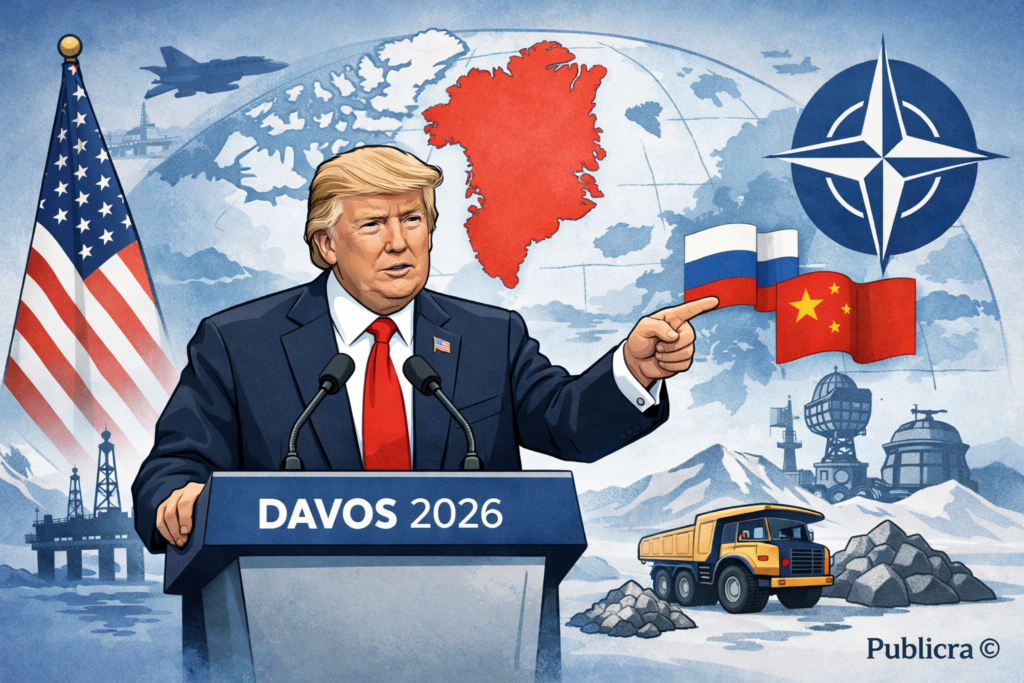
Trump rules out force and tariffs over Greenland, signaling a new Arctic security deal amid NATO concerns, market volatility, and rising U.S.–China rivalry.
Trump Backs Away From Confrontation Over Greenland
U.S. President Donald Trump has stepped back from weeks of aggressive rhetoric over Greenland, ruling out the use of military force and abandoning threatened tariffs against Denmark, while signaling that a broader diplomatic framework has been reached to manage Arctic security and economic interests.
Speaking during a high-profile visit to the World Economic Forum in Davos, Switzerland, Trump said negotiations were moving toward a long-term arrangement involving the United States, Denmark, Greenland, and NATO allies. The announcement marked a sharp shift from earlier statements that had alarmed European governments, unsettled financial markets, and raised fears of a major rupture within the NATO alliance.
According to Trump, the emerging framework would address U.S. strategic priorities in the Arctic, including missile defense, access to critical minerals, and limiting the influence of Russia and China in the region.
Tariff Threats Withdrawn as Markets Respond Positively
Trump confirmed that the tariffs he had previously warned would take effect on February 1 were no longer under consideration. He cited progress in negotiations and a shared understanding among allies as reasons for the reversal.
Financial markets responded quickly. U.S. equities rallied, with major indices posting gains after weeks of volatility driven by uncertainty over trade policy, geopolitical tensions, and inflation concerns. Analysts noted that the decision reduced the risk of a new transatlantic trade dispute at a time when global markets remain sensitive to political shocks.
The episode followed a familiar pattern during Trump’s presidency, in which strong threats are sometimes used as negotiating leverage before being scaled back once talks advance.
Arctic Security and Strategic Minerals at the Core
At the center of the discussions is the Arctic’s growing strategic importance. Melting ice has increased access to shipping routes and untapped mineral resources, while intensifying competition among global powers.
Trump highlighted what he described as a “Golden Dome” missile defense concept and emphasized the importance of securing supply chains for rare earth elements and other critical minerals found in Greenland. These resources are increasingly viewed as vital for defense technologies, renewable energy, and advanced manufacturing.
NATO officials confirmed that Arctic member states would coordinate closely to prevent Russia and China from gaining an economic or military foothold in Greenland, underscoring the alliance’s broader shift toward addressing challenges beyond Europe’s traditional borders.
Denmark Stresses Sovereignty and Diplomacy
Denmark welcomed the move toward dialogue but stressed that Greenland’s status and the rights of its people remain non-negotiable. Danish Foreign Minister Lars Løkke Rasmussen said the issue must be handled through quiet diplomacy rather than public statements on social media.
He emphasized that respect for Danish sovereignty and Greenlandic self-determination is essential for any agreement. While details of the negotiations have not been made public, Copenhagen has signaled openness to enhanced cooperation on security and economic development within existing legal frameworks.
Greenland’s government has not yet publicly commented, though local leaders have previously expressed concerns about being excluded from discussions affecting the island’s future.
NATO Allies Relieved but Cautious
Trump’s earlier remarks about acquiring Greenland had unsettled NATO partners, particularly at a time when unity is seen as critical in confronting Russia’s war posture and China’s expanding global influence.
A NATO spokesperson said Arctic allies would work collectively to strengthen regional security, signaling reassurance while stopping short of confirming any finalized agreement. Diplomats privately noted that while the immediate crisis appears to have eased, trust damaged by the episode may take time to rebuild.
A Broader Pattern in Trump’s Foreign Policy
The Greenland dispute reflects a broader theme in Trump’s approach to foreign policy: aggressive opening positions followed by negotiation and compromise. Supporters argue the strategy delivers results, while critics warn it risks long-term diplomatic fallout and market instability.
With ongoing global challenges—including conflicts in Eastern Europe, tensions in the Middle East, and competition over strategic resources—the outcome of the Arctic talks could shape future U.S. engagement with allies and rivals alike.
For now, the shift away from confrontation has eased immediate fears, but the evolving Arctic agreement will be closely watched by governments, investors, and security experts around the world.