
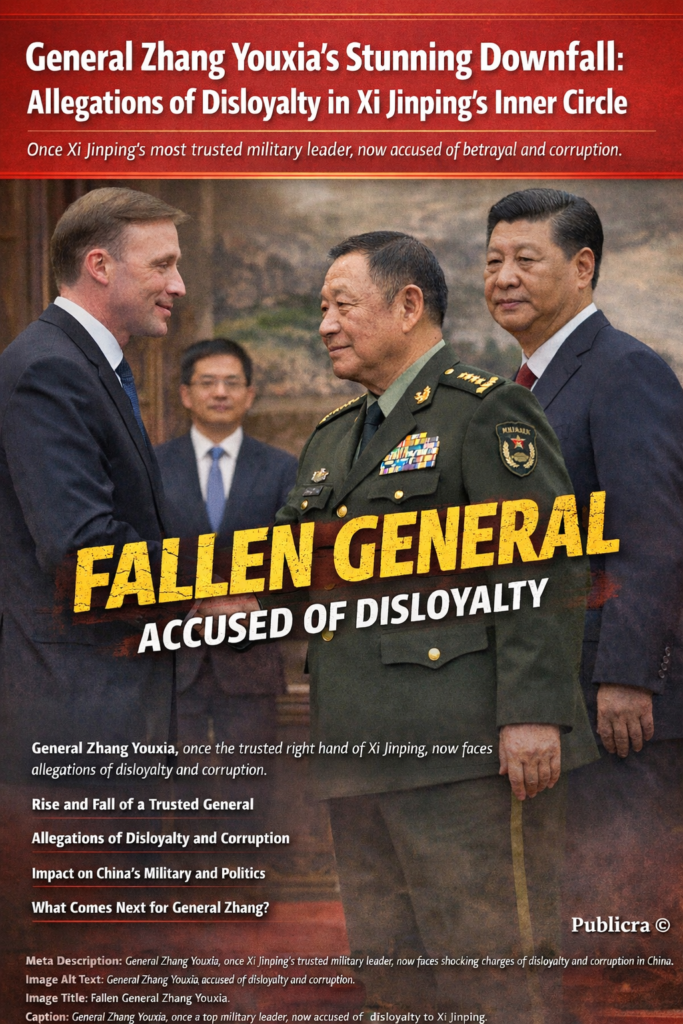
Once the most trusted architect of China’s military reforms, combat veteran Zhang Youxia now faces accusations of disloyalty—raising deep questions about power, paranoia, and stability under Xi Jinping.
A Trusted General Becomes a Warning Sign
In modern China, loyalty to President Xi Jinping has long been seen as the ultimate shield. But the sudden downfall of General Zhang Youxia, one of the most powerful and trusted figures in the People’s Liberation Army (PLA), has shattered that belief.
For years, Zhang was viewed as untouchable—a war-tested commander, a “princeling” with revolutionary roots, and the vice chairman of China’s powerful Central Military Commission (CMC). He helped design Xi’s sweeping military reforms and acted as the chairman’s eyes and ears inside the armed forces.
Now, Zhang stands accused of violating political discipline and undermining the Communist Party’s control over the military. His investigation marks one of the most significant purges in Xi Jinping’s rule and sends a chilling message across China’s political and military elite: no one is beyond reach.
Who Is Zhang Youxia? From Battlefield Commander to Power Broker
General Zhang Youxia’s career spans more than five decades, beginning with his enlistment in 1968 during China’s Cultural Revolution. Unlike many senior PLA leaders today, Zhang experienced real combat.
He earned distinction during China’s brutal border war with Vietnam in 1979, where he developed a reputation as a bold and tactical commander. That battlefield experience later became one of his greatest assets in Beijing, where few top officers had faced live combat conditions.
Zhang’s revolutionary pedigree also mattered. His father served alongside Xi Zhongxun, the father of Xi Jinping. This shared “princeling” background—children of Communist revolutionaries—helped build trust in a system where family lineage still carries political weight.
Xi Jinping’s Military Reforms and Zhang’s Central Role
After Xi Jinping took power in 2012, he launched the most ambitious military overhaul since Mao Zedong. The PLA was plagued by corruption, outdated command structures, and internal rivalries that weakened combat readiness.
Zhang Youxia became one of the key enforcers of Xi’s vision:
- Oversaw weapons procurement and modernization
- Helped dismantle old regional command systems
- Supported tighter Party control over the military
- Played a major role in the 2015–2016 PLA restructuring
By serving as CMC vice chairman, Zhang effectively managed day-to-day military affairs, making him one of the most influential men in China’s defense establishment.
A Sudden Collapse: From Confidence to Investigation
As recently as 2024, Zhang appeared confident and secure. During meetings with U.S. officials in Beijing, including then–National Security Adviser Jake Sullivan, he spoke openly and without visible caution—an unusual trait in China’s rigid political culture.
That confidence proved misleading.
In January 2026, China’s defense ministry announced that Zhang was under investigation for serious violations of law and political discipline. Soon after, state media hinted that his alleged crimes went beyond corruption and struck at something far more dangerous in Xi’s China: disloyalty.
Why Disloyalty Matters More Than Corruption
Corruption has long been the public justification for Xi Jinping’s purges. Hundreds of senior officers have fallen under anti-graft campaigns over the past decade.
But the language used in Zhang’s case was different.
Official military editorials accused him of:
- Undermining the authority of the CMC chairman (Xi Jinping)
- Weakening the Communist Party’s absolute leadership over the PLA
- Damaging political discipline and combat readiness
For analysts, this suggests a political breach rather than simple financial misconduct.
“This looks like a personal betrayal,” noted military experts, adding that corruption appears secondary to concerns about loyalty and power.
The Fear Factor: Why Xi May Have Turned on a Trusted Ally
Zhang’s fall has sparked intense speculation inside and outside China. Several theories dominate expert analysis:
1. Too Powerful to Tolerate
As rival generals were removed in earlier purges, Zhang’s influence only grew. Xi may have begun to see him as an independent power center—something no authoritarian leader can tolerate.
2. Deepening Paranoia at the Top
Xi Jinping has centralized authority to an unprecedented degree. In such systems, even long-time allies become potential threats once trust erodes.
3. Systemic Corruption Panic
Zhang previously oversaw weapons procurement—an area notoriously vulnerable to bribery. Xi may have concluded that reform required eliminating even his closest collaborators.
Allegations of Espionage and International Implications
Adding to the controversy, unconfirmed reports have suggested that Zhang may have leaked sensitive information to foreign powers. While U.S. officials have denied receiving any classified intelligence, the mere allegation underscores the gravity of the case.
Even without espionage charges, Zhang’s removal carries serious consequences for China’s global posture.
Impact on China’s Taiwan Strategy
One of the most important implications concerns Taiwan.
Zhang Youxia was widely regarded as a cautious realist—someone who understood the true costs of war. Analysts believe he was capable of giving Xi unvarnished military assessments, including risks of a cross-strait invasion.
With Zhang gone, concerns are growing that:
- Xi may receive more ideologically driven advice
- Military planning could become less grounded in battlefield realities
- The risk of miscalculation over Taiwan could increase
In authoritarian systems, the loss of honest advisers often leads to dangerous overconfidence.
A Message to China’s Elite: No One Is Safe
Beyond military strategy, Zhang’s purge sends a powerful signal to China’s political class.
If a lifelong revolutionary, combat hero, and trusted confidant can be publicly disgraced, then loyalty offers no permanent protection. This atmosphere may produce short-term obedience—but at the cost of long-term stability.
Former party insiders argue that fear now defines elite politics in Beijing, replacing institutional trust with personal survival.
What Happens Next for Zhang Youxia?
If formal charges are filed, Zhang is likely to face:
- A closed military trial
- Conviction within the PLA justice system
- Long-term imprisonment
Public rehabilitation is almost unheard of in cases framed as political betrayal.
A Turning Point in Xi’s China
The fall of General Zhang Youxia marks more than the end of a military career. It represents a turning point in Xi Jinping’s China, where power is increasingly concentrated, suspicion outweighs loyalty, and fear governs decision-making.
For China’s military, the loss of an experienced, battle-tested commander raises questions about competence and restraint. For the world, it underscores the growing unpredictability of a system where even the mightiest figures can fall overnight.