
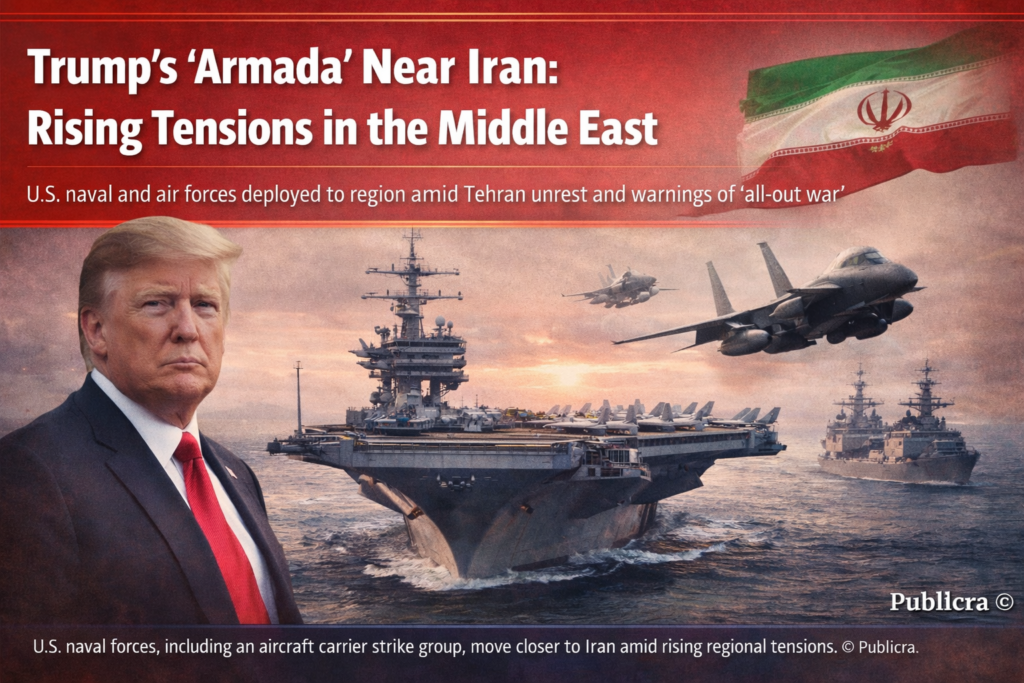
A growing US naval and air deployment near Iran is raising fears of escalation, as Washington signals support for unrest inside the country and Tehran warns of all-out war.
Rising Tensions at Iran’s Doorstep
A rapidly expanding US military presence near Iran has intensified fears of a major regional escalation in the Middle East. President Donald Trump has confirmed that a large American naval force—described by him as a “big armada”—is now approaching Iran’s vicinity, following weeks of unrest inside the country and increasingly sharp rhetoric from Washington.
The buildup comes at a volatile moment. Iran has been rocked by widespread protests driven by economic hardship, soaring inflation, currency collapse, and power shortages. Iranian authorities accuse foreign powers, particularly the US and Israel, of exploiting the unrest, while warning that any direct military attack would be treated as an act of war.
As regional allies prepare for potential retaliation and global markets watch nervously, the situation raises urgent questions about whether deterrence—or confrontation—lies ahead.
What Trump Has Said So Far
President Trump has framed the military deployment as both a warning and a signal of support for demonstrators in Iran. In recent statements, he claimed that “help is on its way,” while emphasizing that the United States is prepared to defend its interests and allies.
While Trump has stopped short of announcing imminent strikes, multiple reports suggest that military options have been actively reviewed within the administration. According to US media, some Middle Eastern partners urged restraint earlier this month, warning that a direct conflict with Iran could spiral beyond control.
Despite that caution, Trump’s language has grown more assertive, underscoring a broader strategy of pressure rather than diplomacy.
The “Armada”: US Naval Power in Motion
Aircraft Carrier Strike Group
At the core of the deployment is the USS Abraham Lincoln aircraft carrier strike group, redeployed from the Asia-Pacific region. The carrier is capable of launching up to 90 aircraft, including:
- F-35 stealth fighters
- F/A-18 Super Hornets
- EA-18G Growler electronic warfare jets
Accompanying the carrier are multiple guided-missile destroyers armed with long-range Tomahawk cruise missiles, providing strike capabilities deep inside the region if ordered.
Air Power Reinforcements
The US has also shifted F-15E Strike Eagle squadrons to the Middle East, reportedly operating from bases in Jordan and other regional locations. These aircraft are designed for long-range precision strikes and close air support.
To sustain operations, Washington has repositioned aerial refueling tankers and heavy cargo aircraft, enabling rapid force projection if the situation escalates.
Defensive Measures: Preparing for Retaliation
Beyond offensive assets, the US is reinforcing its defensive posture across the region. Patriot and THAAD (Terminal High Altitude Area Defense) missile defense systems are being deployed to protect:
- US military bases
- Diplomatic facilities
- Key regional allies
These systems are specifically designed to intercept ballistic and cruise missiles—an acknowledgment of Iran’s extensive missile arsenal and drone capabilities.
Why Iran Matters: Protests, Pressure, and Power
Iran is currently facing one of its most serious internal crises in years. Persistent economic decline, sanctions pressure, and infrastructure failures have fueled widespread demonstrations across multiple cities.
Iranian officials claim more than 3,000 people have been killed during unrest, including hundreds they describe as “armed militants” or “terrorists.” Western governments dispute these figures, calling for independent investigations.
Tehran insists that foreign intelligence agencies are manipulating the protests—a claim the US and Israel deny.
Tehran’s Warning: “All-Out War”
Iran’s leadership has responded to the US buildup with stark warnings. Senior officials have declared that any American attack would trigger an “all-out war,” with Iran’s forces placed on high alert.
Iran’s military capabilities include:
- Long-range ballistic missiles
- Cruise missiles
- Large armed drone fleets
- Regional proxy forces across Iraq, Syria, Lebanon, and Yemen
These assets give Tehran the ability to strike US bases and allied infrastructure across the Middle East, raising fears of a multi-front conflict.
Israel on High Alert
Israel, Washington’s closest regional ally, has raised its readiness level in response to the situation. Israeli defense officials say they are prepared for missile or drone attacks originating from Iran or its allied groups.
Israel’s layered air defense network includes:
- Iron Dome
- David’s Sling
- Arrow missile defense systems
In addition, Israel operates F-35 stealth fighters capable of rapid response strikes.
Who Could Be Targeted?
According to regional media reports, US planners have discussed options involving “high-value” Iranian military and political figures. These scenarios remain unconfirmed, but analysts warn that targeted strikes could trigger immediate retaliation.
The memory of the brief but intense conflicts of recent years—where air defense systems, missile facilities, and senior commanders were targeted—continues to shape strategic thinking on all sides.
The Risk of Escalation
Experts warn that the current standoff is dangerously unstable. With large military forces operating in close proximity, the risk of miscalculation is high.
Potential flashpoints include:
- Accidental naval encounters
- Missile launches by regional proxy forces
- Cyberattacks or sabotage operations
- Rapid retaliation cycles
Even limited strikes could quickly expand into a broader regional war involving multiple countries.
Global Implications
The crisis is already affecting global energy markets, shipping routes, and diplomatic relations. Iran sits near key maritime chokepoints critical to oil exports, and any conflict could disrupt global supply chains.
Major powers, including Russia and China, have called for restraint, warning that a war with Iran would destabilize the entire region.
What Happens Next?
For now, the US military buildup appears designed to apply pressure rather than initiate immediate conflict. However, the combination of internal unrest in Iran, political rhetoric from Washington, and regional rivalries makes the situation highly unpredictable.
Whether diplomacy can re-emerge—or whether the region slides toward confrontation—remains uncertain.
One thing is clear: the presence of a US “armada” near Iran marks one of the most serious moments of tension in the Middle East in recent years.