
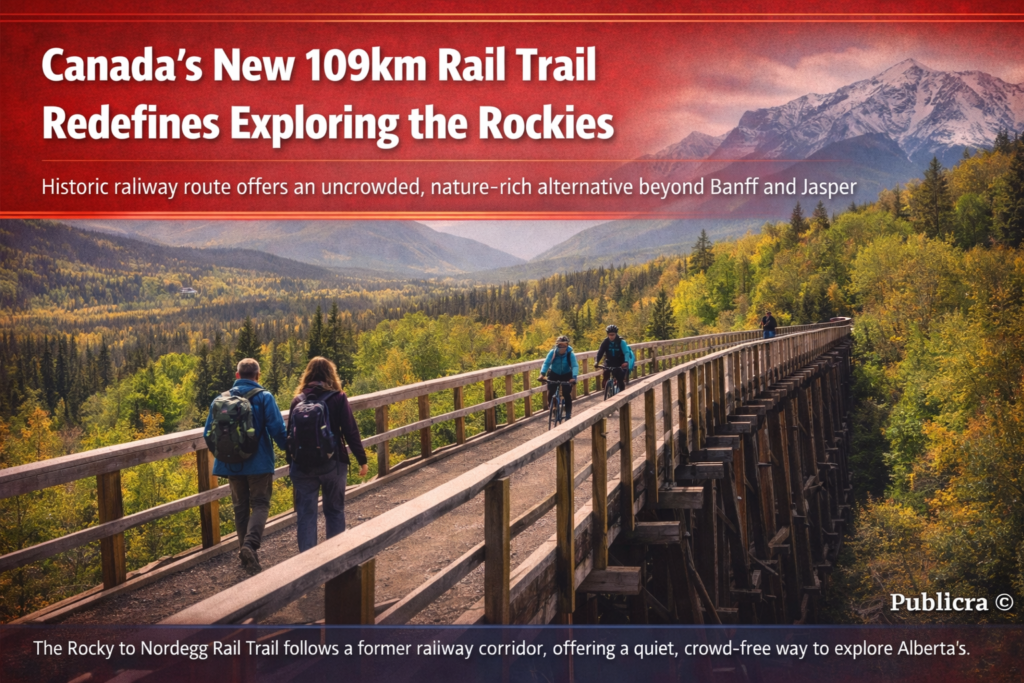
Far from Banff’s crowds, a newly opened rail trail is unlocking a forgotten stretch of Alberta’s wilderness—while reconnecting travelers with Canada’s industrial and cultural past.
A Different Kind of Rockies Experience
When most travelers picture the Canadian Rockies, they imagine packed viewpoints in Banff or Jasper, glacier-fed lakes lined with tour buses, and shoulder-to-shoulder hiking trails. But hundreds of kilometers away from those iconic hotspots, a quieter transformation is unfolding.
The Rocky to Nordegg Rail Trail, a 109km multi-use route in central Alberta, is opening access to a previously overlooked corridor of the Rockies. Built on the bones of an abandoned railway, the trail offers something increasingly rare in popular outdoor destinations: solitude, history, and space to slow down.
As outdoor tourism continues to grow worldwide, this new trail reflects a broader shift toward low-impact, experience-driven travel—one that values connection over crowds.
What Is the Rocky to Nordegg Rail Trail?
The Rocky to Nordegg Rail Trail follows the former Canadian Northern Railway (CNoR) line, built in the early 20th century to serve coal mines and remote homesteads. Stretching from Rocky Mountain House to the historic coal town of Nordegg, the route cuts through boreal forests, wetlands, river valleys, and rolling foothills.
Designed as a year-round, multi-use trail, it accommodates:
- Walkers and hikers
- Cyclists and bikepackers
- Equestrians
- Cross-country skiers and snowshoers
- Dog sledders
- Off-highway vehicles (in designated sections)
More than 50km is already open, with the remainder under active development—making it one of Alberta’s most ambitious outdoor infrastructure projects in decades.
Why This Trail Matters Now
1. A Response to Overtourism
Banff and Jasper are among Canada’s most visited destinations, but their popularity comes with strain—crowded trails, environmental pressure, and rising costs for visitors.
The Rocky to Nordegg Rail Trail offers an alternative:
- Fewer people
- Gentler terrain
- A slower pace of exploration
Tourism officials see it as a way to redistribute visitor traffic while preserving natural spaces.
2. Reclaiming Forgotten Landscapes
For decades after rail service ended in the 1980s, this corridor sat largely unused. Nature slowly reclaimed the tracks, bridges, and embankments.
Today, travelers walk and ride through a living museum—where forests grow over steel history and wetlands replace industrial scars. The trail demonstrates how former industrial infrastructure can be repurposed into sustainable recreation.
A Railway That Built Communities
Historically, railways like the CNoR were not just transportation routes—they were lifelines.
Coal mines, farming settlements, and trading posts grew wherever tracks reached. Towns such as Nordegg, Alexo, Saunders, and Harlech existed because trains brought fuel, supplies, and people.
When coal demand declined after World War II, the mines closed. Rail traffic slowed, then stopped entirely by 1985. What remained was a physical record of how western Canada was built.
Interpretive signs along the trail now tell those stories—turning a hike or bike ride into a moving history lesson.
Nature at a Human Pace
Unlike steep alpine routes, rail trails follow gentle grades designed for trains. This makes the Rocky to Nordegg route accessible to a wide range of travelers, including families and casual outdoor enthusiasts.
Along the way, visitors encounter:
- Wetlands rich in birdlife
- Dense spruce and pine forests
- Wide river valleys
- Open viewpoints with mountain backdrops
Wildlife sightings may include elk, deer, foxes, and—less commonly—mountain goats.
Outdoor Activities Beyond the Trail
The rail trail is not just a linear experience—it’s a gateway to the region.
Water Adventures
Sections near the North Saskatchewan River allow access to Class II–III rapids for paddlers, as well as fishing spots known for bull trout, mountain whitefish, and brown trout.
Camping and Photography
Designated campgrounds and informal pull-offs let travelers extend their stay. The lack of light pollution makes the area especially appealing for night photography and stargazing.
Seasonal Variety
In winter, the flat terrain becomes ideal for cross-country skiing and snowshoeing, transforming the trail into a four-season destination.
The Taunton Trestle: A New Landmark
One of the trail’s standout features is the Taunton Trestle Bridge, a 220m-long iron structure that once supported coal trains serving the Brazeau Collieries mine.
After decades of disuse, the bridge was restored and reopened in 2025, complete with a viewing platform. It now offers sweeping views of the gorge below and has quickly become a signature photo stop.
For many visitors, the bridge symbolizes the trail’s larger mission: preserving history while inviting new experiences.
Nordegg: Where the Past Still Lives
At the western end of the trail, the former coal town of Nordegg provides a tangible connection to Alberta’s industrial heritage.
Visitors can explore:
- The Nordegg Discovery Centre
- The Brazeau Collieries Mine National Historic Site, including guided underground tours
- Local cafés and lodges that preserve the town’s character
For travelers, Nordegg offers more than scenery—it offers context.
Economic and Community Impact
Local tourism operators see the trail as a long-term investment rather than a quick attraction. By encouraging longer stays, it supports:
- Small businesses
- Guiding services
- Campgrounds and lodges
- Community-led tourism initiatives
Rather than overwhelming the region, the trail is designed to grow gradually, aligning with sustainable tourism goals.
A New Way to See the Rockies
The Rocky to Nordegg Rail Trail doesn’t compete with Banff or Jasper—it complements them. It offers a different Rockies story: one shaped by coal, steel, and resilience, now softened by moss, rivers, and silence.
For travelers seeking space, reflection, and a deeper understanding of Canada’s past, this trail represents something rare—a chance to walk history while escaping the noise of modern tourism.