
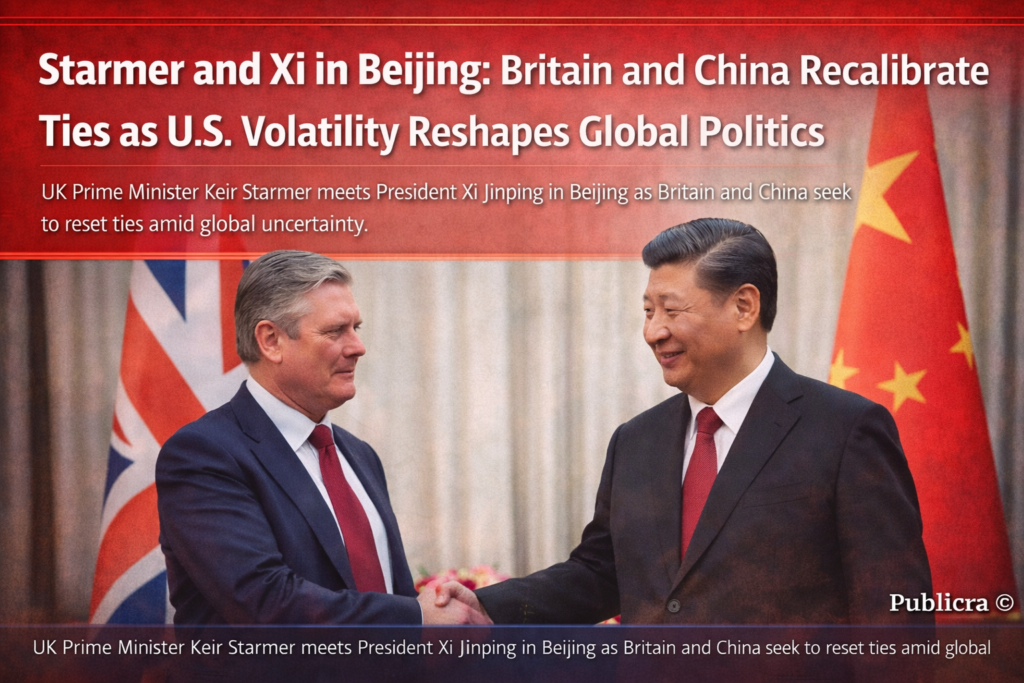
Facing economic pressure at home and uncertainty from Washington, UK Prime Minister Keir Starmer and China’s Xi Jinping are cautiously reopening channels once frozen by mistrust.
A Carefully Calculated Reset
When Prime Minister Keir Starmer arrived in Beijing, the visit was framed not as a grand diplomatic pivot, but as a calculated adjustment to a rapidly shifting global order. Britain’s economy is struggling to regain momentum, while the international system—long anchored by predictable US leadership—has become increasingly volatile.
For China’s leader, Xi Jinping, the meeting offered an opportunity to showcase Beijing as a stable, indispensable partner to Western economies at a moment when Washington’s policies have grown more unpredictable.
The result was a cautious thaw in a relationship that had spent years in what officials quietly called an “ice age.”
Why This Meeting Matters Now
Starmer is the first British prime minister to visit China since 2018, and the timing is anything but accidental.
- Britain is seeking new growth engines amid sluggish productivity
- China is navigating economic headwinds and trade barriers
- Both are adjusting to an unpredictable United States under President Donald Trump
Together, these pressures have pushed London and Beijing to explore cooperation without formally abandoning their red lines.
Britain’s Economic Imperative
For Starmer, the trip to Beijing was rooted in pragmatism rather than ideology. Britain’s post-Brexit economy has struggled to deliver strong growth, and global investment remains cautious.
China, despite its own slowdown, remains:
- The world’s second-largest economy
- A critical market for financial services
- A major player in electric vehicles, green energy, and advanced manufacturing
Starmer arrived with a delegation of senior business leaders from banking, pharmaceuticals, and automotive sectors—signaling that trade and investment were central to the visit.
Xi Jinping’s Strategic Opportunity
For Xi, Britain represents more than just another trading partner. It is:
- A close US ally
- Europe’s leading financial hub
- A symbolic bridge between China and the West
By warming ties with London, Beijing sends a broader message: China remains open for business, regardless of Washington’s efforts to contain its influence.
During the meeting, Xi emphasized stability, warning against “unilateralism and protectionism” and portraying China as a responsible global power.
From “Golden Age” to Ice Age—and Back?
UK–China relations have swung dramatically over the past decade.
- Once hailed as a “Golden Age” of cooperation
- Later derailed by concerns over espionage, human rights, and political interference
- Frozen by disputes over Hong Kong and national security
Starmer acknowledged this inconsistency, calling for a “more sophisticated relationship” that allows economic cooperation while managing strategic differences.
This marks a clear shift from previous UK governments that increasingly prioritized security concerns over trade engagement.
Visa Easing: A Symbolic but Strategic Step
One of the immediate outcomes of the visit was China’s decision to relax visa rules for British citizens traveling for short stays.
While largely symbolic, the move:
- Aligns Britain with other European nations
- Encourages tourism and business travel
- Signals goodwill at a politically sensitive moment
Such gestures help create momentum without committing either side to sweeping policy changes.
Navigating Washington’s Shadow
Starmer’s outreach to Beijing comes with clear risks. President Trump has repeatedly warned allies against deepening economic ties with China, threatening tariffs and trade retaliation.
Recent tensions between Washington and European capitals—over trade, NATO commitments, and even territorial disputes—have reinforced concerns that US policy can shift abruptly.
For Britain, engaging China is less about choosing sides and more about hedging against uncertainty.
A Broader European Trend
Starmer’s visit fits into a wider pattern. In recent months:
- France’s president visited Beijing
- Finland’s prime minister held talks with Xi
- Germany’s chancellor is expected to follow
These visits reflect a growing desire among Western middle powers to diversify economic relationships and reduce overreliance on any single global partner.
Business Cooperation: What’s on the Table?
Xi urged deeper collaboration in:
- Finance and currency exchange
- Health care and biosciences
- Artificial intelligence
- Renewable energy and climate technology
China is particularly eager to expand export markets for high-value goods such as electric vehicles and batteries, as domestic demand softens.
For London, increased yuan trading and financial services cooperation could reinforce its role as Europe’s financial capital.
The Unspoken Tensions
Despite the positive tone, significant issues remain unresolved.
Espionage and Security
Concerns about Chinese intelligence activity in Britain have not disappeared. Previous controversies, including delays over a new Chinese embassy in London, continue to fuel suspicion.
Human Rights
Human rights groups have pressed Starmer to address:
- The imprisonment of Hong Kong dissidents
- The erosion of civil liberties in Hong Kong
- The treatment of Uyghurs in Xinjiang
Starmer confirmed he raised these issues privately, though China’s official account made no reference to them.
Hong Kong: A Delicate Bridge
Xi’s government continues to portray Hong Kong as a vital link between China and the global economy. Starmer echoed this language, calling the city an important bridge between Britain and China.
However, critics argue that political freedoms in Hong Kong have been dramatically curtailed, making engagement increasingly controversial at home.
Domestic Pressure on Starmer
Back in the UK, Starmer faces scrutiny from:
- Opposition parties
- Human rights organizations
- Security officials
Balancing economic engagement with political values will remain a delicate task, especially as public trust in China remains low among British voters.
The Bigger Picture: A World in Transition
This meeting highlights a deeper global shift. As US leadership becomes less predictable, middle powers are reassessing how they engage with major rivals.
Rather than choosing between Washington and Beijing, countries like Britain are experimenting with strategic flexibility—seeking growth and stability without full alignment.
What Comes Next?
The Beijing meeting is unlikely to transform UK–China relations overnight. But it marks a clear attempt to stabilize ties and keep dialogue open.
Future cooperation will depend on:
- How far economic engagement can proceed without political backlash
- Whether US pressure intensifies
- How China manages internal political and economic challenges
For now, both sides appear content to test a cautious thaw.