
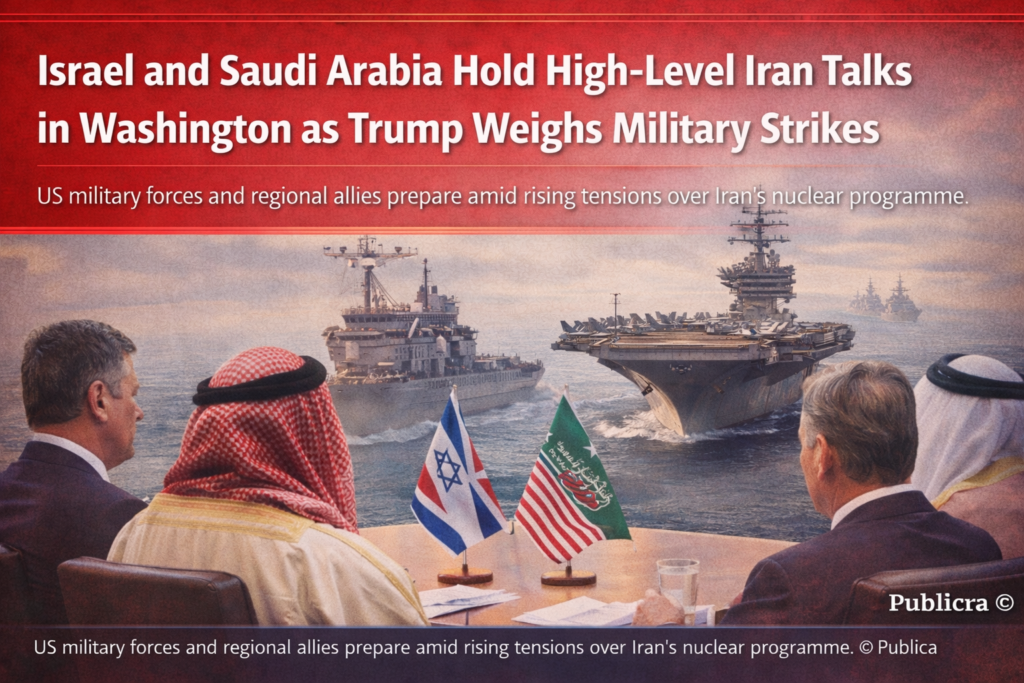
With US forces massing in the Middle East, Israeli and Saudi officials are engaging Washington behind closed doors as President Trump considers options ranging from renewed diplomacy to targeted attacks on Iran.
A Critical Week for Middle East Stability
Washington has become the focal point of intense diplomatic and military deliberations this week as senior defense and intelligence officials from Israel and Saudi Arabia arrived separately in the US capital to discuss Iran with the Trump administration.
The meetings come amid a rapid US military buildup across the Middle East and increasingly sharp rhetoric from President Donald Trump, who has warned Tehran that it must accept a nuclear deal or face potential military action.
With regional tensions already high, these talks underscore the gravity of the moment—and the possibility that the next phase of US-Iran relations could shift dramatically from pressure to confrontation.
Why Israeli and Saudi Officials Are in Washington
According to sources familiar with the discussions, the visits were not symbolic. They were driven by urgent concerns over Iran’s nuclear program, internal unrest, and the risk of a broader regional war.
Israel’s Objectives
Israel’s leadership views Iran as its most significant long-term security threat. Israeli officials have consistently argued that Tehran’s nuclear ambitions and regional influence cannot be contained through diplomacy alone.
During meetings at the Pentagon, CIA, and White House, Israel’s military intelligence chief reportedly shared updated intelligence assessments on:
- Iranian military infrastructure
- Nuclear-related facilities
- Command and security leadership
Israel’s position remains that time is running out to stop Iran from achieving irreversible nuclear capabilities.
Saudi Arabia’s Balancing Act
Saudi Arabia’s role is more complex. While Riyadh remains deeply wary of Iran’s regional ambitions, it is equally concerned about the consequences of open conflict.
Saudi officials have emphasized:
- The need to avoid a wider regional war
- Protecting Gulf infrastructure and energy routes
- Preventing Saudi territory from becoming a launchpad for attacks
Saudi Crown Prince Mohammed bin Salman has reportedly assured Iran that Saudi airspace and territory will not be used for strikes against Tehran—an indication of Riyadh’s desire to de-escalate even as it consults closely with Washington.
Trump’s Warning to Iran: “Make a Deal or Face Consequences”
President Trump has intensified pressure on Iran in recent days, publicly urging Tehran to return to negotiations over its nuclear program.
In statements and social media posts, Trump warned that:
- US military forces are “ready, willing, and able” to act
- The current deployment exceeds previous regional buildups
- Any future strikes would be more severe than past operations
Trump’s language has revived fears that diplomacy may soon give way to force, even as officials insist no final decision has been made.
US Military Buildup Signals Preparedness
The diplomatic activity in Washington is unfolding alongside one of the most significant US military deployments to the Middle East in years.
Naval Power
A carrier strike group led by the USS Abraham Lincoln has moved into regional waters, supported by guided-missile destroyers and other combat vessels capable of launching long-range precision strikes.
Air and Intelligence Assets
Satellite imagery and flight-tracking data show increased US activity at bases in:
- Qatar
- Jordan
- Diego Garcia in the Indian Ocean
Cargo planes, refueling tankers, surveillance aircraft, and drones have been observed operating near Iranian airspace, suggesting preparations for sustained operations if required.
What Options Is Trump Considering?
Sources familiar with internal discussions say the White House is weighing multiple scenarios, including:
1. Targeted Military Strikes
These would focus on:
- Iranian security forces
- Senior military or intelligence leaders
- Infrastructure linked to repression or missile programs
The aim would be to weaken Iran’s internal control and potentially encourage renewed protests.
2. Expanded Pressure on Nuclear Facilities
Some proposals reportedly include renewed strikes on uranium enrichment sites and related facilities—an escalation from last year’s limited attacks.
3. Continued Coercive Diplomacy
Despite the rhetoric, some advisors argue that military pressure is designed to force Iran back to negotiations rather than trigger immediate conflict.
Trump has emphasized that he prefers a deal—but only one that permanently blocks Iran’s path to nuclear weapons.
Iran’s Reaction: Dialogue With Red Lines
Iran has responded with a mix of caution and defiance.
Tehran’s mission to the United Nations stated that Iran:
- Remains open to dialogue based on mutual respect
- Rejects negotiations under threat
- Will respond forcefully to any attack
Senior Iranian officials warned that retaliation would not be “proportionate” but decisive, potentially targeting US bases and allies across the region.
The Role of Protests Inside Iran
The current crisis is deeply intertwined with unrest inside Iran.
Weeks of protests—sparked by economic hardship, inflation, power shortages, and currency collapse—have reportedly led to thousands of deaths, according to human rights groups. Iranian authorities dispute these figures and accuse foreign governments of stoking unrest.
US officials have openly discussed whether military pressure could weaken Iran’s leadership and embolden demonstrators—a strategy fraught with risks and unpredictable outcomes.
Why Israel and Gulf States Are Cautious
While Israel supports aggressive action against Iran, Gulf states are far more cautious.
Their concerns include:
- Missile attacks on energy facilities
- Disruption of global oil markets
- Civilian casualties and infrastructure damage
- Escalation involving proxy groups
Even officials aligned with Washington acknowledge that air power alone is unlikely to topple Iran’s leadership, raising questions about long-term strategy.
The Nuclear Issue Remains Central
At the heart of the crisis lies Iran’s nuclear program.
The US and its allies argue Iran’s enrichment levels exceed civilian needs. Tehran insists its program is peaceful and legal under international law.
Last year’s US strikes on nuclear facilities temporarily set back Iran’s capabilities, but officials concede they did not eliminate the program—making the current standoff even more consequential.
Global Implications of a US–Iran Clash
Any US military action would have ripple effects far beyond the region:
- Disruption to oil and gas markets
- Heightened global inflation risks
- Strained relations among major powers
- Increased instability across the Middle East
International actors have urged restraint, warning that escalation could spiral quickly beyond control.
What Happens Next?
For now, Trump has not made a final decision. Israeli and Saudi consultations highlight the urgency—and complexity—of the moment.
The coming days will determine whether:
- Iran returns to negotiations
- The US escalates military pressure
- Regional diplomacy averts confrontation
What is certain is that Washington, once again, sits at the center of a decision that could reshape Middle Eastern security for years to come.