
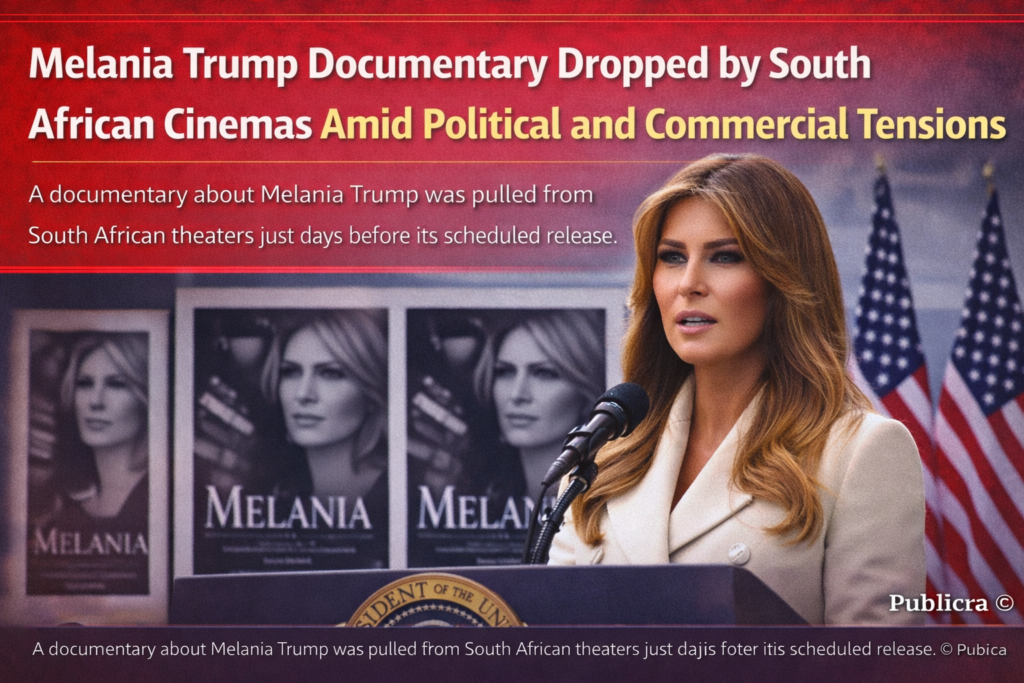
The sudden withdrawal of a high-profile documentary about Melania Trump from South African theaters highlights the intersection of global politics, market risk, and cultural polarization.
A Film Pulled at the Last Moment
A documentary centered on Melania Trump, the first lady of the United States, has been abruptly withdrawn from theatrical release in South Africa, just days before its scheduled global premiere. The decision, taken by the local distributor, has sparked questions about whether politics, commercial concerns, or broader cultural backlash played a decisive role.
While the distributor insists the move was purely internal and not the result of censorship or government pressure, the timing of the withdrawal—against a backdrop of strained U.S.–South Africa relations and mixed reception to the film worldwide—has drawn significant attention.
What Happened to the South African Release?
The documentary, titled “Melania,” was slated to open in South African theaters alongside its international rollout. However, Filmfinity, the company responsible for distributing the film locally, announced that it would no longer proceed with the theatrical release.
The company cited “recent developments” as the reason for the cancellation but declined to specify what those developments were. Importantly, Filmfinity stated that it had not been pressured by authorities or advocacy groups to pull the film.
Industry insiders described the move as sudden, noting that major theater chains had already been informed that the film met all regulatory requirements and was cleared for screening.
A Documentary Surrounded by Controversy
From its announcement, “Melania” has attracted intense scrutiny.
The film follows Melania Trump in the weeks leading up to her husband’s second inauguration, offering a behind-the-scenes portrait of her role as first lady. Supporters of President Donald Trump have promoted the documentary as a revealing and inspiring personal account, while critics have dismissed it as a political branding exercise.
The polarization surrounding the Trump name has followed the film into international markets, making it a risky proposition for distributors—especially outside the United States.
Commercial Risk and Weak Ticket Demand
Despite significant financial backing, the documentary has reportedly struggled with advance ticket sales in multiple markets.
Amazon invested an estimated $40 million to acquire the rights to the film, with additional spending on global marketing campaigns. Industry analysts noted that the investment was unusually large for a political documentary, particularly one focused on a public figure as divisive as Melania Trump.
In South Africa, cinema operators reportedly saw thin pre-sales, raising concerns about whether the film could perform well enough to justify a wide theatrical release.
For distributors, pulling a film before release—while costly—can sometimes be less risky than absorbing losses from empty theaters.
The Director Factor and #MeToo Backlash
Another layer of controversy stems from the film’s director, Brett Ratner, who has not released a major Hollywood project since 2017, when he was accused of sexual misconduct during the height of the #MeToo movement.
Although Ratner has denied wrongdoing, his return to filmmaking has drawn criticism from activists and cultural commentators. For some audiences, the director’s involvement has become inseparable from the film itself, further complicating its reception.
In markets sensitive to gender rights and accountability, this association may have weighed on distributor calculations.
Political Context: U.S.–South Africa Relations at a Low Point
The film’s withdrawal comes during a period of deep diplomatic tension between South Africa and the United States.
Since returning to office, President Donald Trump has repeatedly criticized South Africa, including making widely disputed claims about violence against the country’s white minority. South African officials and civil society groups have strongly rejected these assertions, describing them as misinformation.
Additionally, the Trump administration has imposed new tariffs and trade measures that have affected South African exports, fueling resentment toward U.S. policy.
Against this backdrop, a documentary celebrating the American first lady—closely associated with Trump’s political brand—was always likely to face heightened scrutiny.
Was Politics the Deciding Factor?
While Filmfinity has not cited political pressure, analysts say politics cannot be entirely separated from the decision.
South Africa’s film market is highly competitive, and distributors are sensitive to public sentiment. In an environment where anti-Trump sentiment is widespread, exhibitors may have feared protests, boycotts, or reputational risk.
At the same time, there is no evidence that the South African government or regulators intervened. The country’s Film and Publications Board said it was unaware of the decision to pull the film.
This suggests the move was likely a commercial judgment influenced by the broader political climate, rather than direct censorship.
Reaction From Theater Chains
Major cinema operators expressed surprise at the abrupt cancellation.
Executives from leading theater chains said they had been informed earlier that the film had passed all regulatory checks and would be released as planned. Some described the reversal as unusual but acknowledged that distributors ultimately control release decisions.
Theaters emphasized that they do not engage in censorship and that programming choices are typically driven by audience demand and commercial viability.
Global Release Still Moving Forward
Despite the South African cancellation, “Melania” is still expected to debut in other international markets and on streaming platforms.
Amazon’s involvement ensures that the documentary will reach a global audience, even if theatrical releases are scaled back in certain regions.
Industry experts note that streaming platforms increasingly serve as a fallback for politically sensitive content that struggles in cinemas.
What This Says About Politics and Entertainment
The episode underscores a broader trend: global entertainment is increasingly shaped by geopolitics.
Films linked to controversial political figures face:
- Heightened scrutiny across borders
- Uneven reception in different cultural contexts
- Greater financial risk for distributors
In this environment, content decisions are rarely about art alone—they are about audience sentiment, political climate, and brand risk.
Melania Trump’s Global Image
Unlike her husband, Melania Trump has often been portrayed as more reserved and distant from political battles. However, the documentary places her squarely within the Trump political narrative.
For international audiences unfamiliar or uncomfortable with U.S. domestic politics, that association may limit appeal—especially in countries where Trump’s policies have been viewed unfavorably.
A Commercial Call, Not a Ban
Crucially, the film has not been banned in South Africa. The decision to withdraw came from the distributor, not regulators.
This distinction matters in a country with a strong commitment to free expression following decades of apartheid-era censorship.
Most observers agree that the move reflects market caution rather than suppression.
What Happens Next?
Questions remain:
- Will the film return to South African screens later?
- Will other countries follow suit?
- Can streaming success offset weak theatrical performance?
For now, the withdrawal serves as a case study in how political identity can shape the fate of cultural products far beyond their country of origin.