
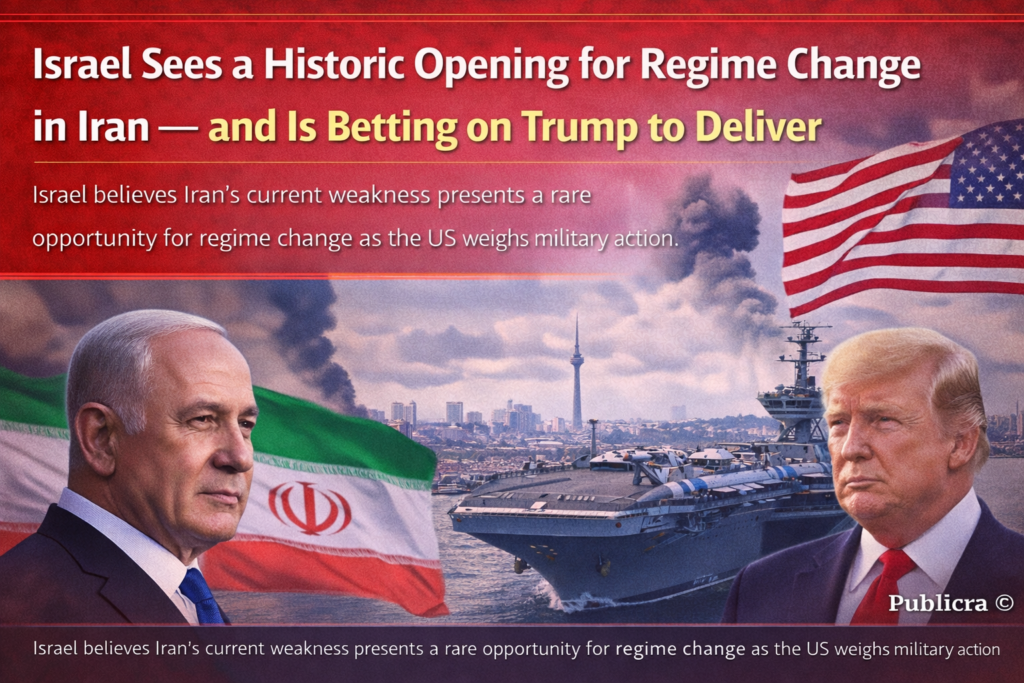
As US military pressure builds around Iran, Israeli leaders believe this moment of Iranian vulnerability may be their best chance in decades — but only if Washington is willing to go all the way.
Silence That Speaks Volumes
As speculation intensifies over a possible US strike on Iran, Israel’s leadership has adopted an unusually restrained public posture. There have been no dramatic speeches, no public demands, and few official statements — a striking contrast to the urgency unfolding behind the scenes.
Israeli analysts say the silence is deliberate. With US forces positioned across the Gulf and Washington openly debating military options, Israeli leaders see this moment as uniquely powerful — and potentially fleeting.
For Prime Minister Benjamin Netanyahu, Iran has long represented the most dangerous and destabilizing threat facing Israel. Now, amid widespread protests inside Iran, weakened regional proxies, and reduced air defenses following last year’s war, Israel believes the conditions may finally exist for something it has sought for decades: regime change in Tehran.
Why Israel Is Letting the US Take the Lead
Israel’s strategic restraint is not hesitation — it is calculation.
Former Israeli intelligence officials say Jerusalem believes Washington must lead any decisive action against Iran. The reasoning is simple:
- The US has unmatched military capabilities
- It carries greater international legitimacy
- It can absorb the geopolitical fallout more effectively
As one former senior Israeli intelligence official put it, allowing America to act first increases both the scale and credibility of any intervention.
Behind closed doors, Israeli intelligence officials have been in constant contact with their US counterparts. Israel’s military intelligence chief reportedly met senior figures at the Pentagon and CIA this week, sharing assessments and potential Iranian targets.
Netanyahu’s Longstanding Iran Doctrine
Netanyahu has spent much of his political career warning that Iran poses an existential threat to Israel.
His core beliefs include:
- Iran’s ballistic missile program is aimed directly at Israel
- Tehran’s nuclear ambitions cannot be contained indefinitely
- Iran’s regional proxy network — including Hezbollah — exists to surround Israel with firepower
Netanyahu has repeatedly argued that deals and limited strikes only delay the problem, while leaving the regime intact and learning from each confrontation.
Israeli analysts now believe Netanyahu is privately urging Washington toward maximalist action, not symbolic or limited strikes.
Why Israel Wants Regime Change — Not a Deal
Israel’s leadership is deeply skeptical of renewed negotiations with Iran.
From Israel’s perspective, a deal that:
- Leaves Iran’s leadership in place
- Allows missile development to continue
- Preserves proxy militias
would ultimately increase long-term danger.
Israeli lawmakers across party lines argue that partial solutions carry greater risks than decisive action.
Many believe that another cycle of limited strikes would provoke Iranian retaliation without permanently reducing the threat — repeating a pattern seen multiple times over the past decade.
Lessons From the 12-Day War
Last year’s 12-day conflict between Iran, Israel, and the US looms large in Israeli strategic thinking.
During that war:
- Israeli and US forces struck Iranian nuclear and missile facilities
- Iran responded with hundreds of ballistic missiles
- Some missiles penetrated Israeli air defenses
- Apartment buildings in Tel Aviv were hit
- At least 28 civilians were killed
Israeli defense planners had anticipated even higher casualties. While Israel’s air defense systems intercepted most projectiles, the conflict demonstrated that Iran retains significant retaliatory capability.
Many analysts believe Iran learned from that war — adjusting tactics, improving missile survivability, and rebuilding stocks.
Iran’s Current Weakness — and Why Israel Sees Opportunity
Despite its ability to retaliate, Iran is widely viewed as being at its weakest point in years.
Key factors include:
- Degraded air defenses following recent strikes
- Reduced effectiveness of regional proxy forces
- Economic collapse and inflation
- Nationwide protests challenging the regime’s authority
Israeli analysts argue that these pressures have created a rare strategic window.
In their view, another delay could allow Iran to rebuild strength, reinforce proxies, and harden defenses — making future action far more costly.
Public Opinion Inside Israel
Israeli public sentiment largely supports strong action.
Polls consistently show:
- A majority of Jewish Israelis support military action against Iran
- Support remains high even after last year’s missile strikes
- Many view short-term suffering as necessary for long-term security
In Tel Aviv and other cities still repairing damage from Iranian missiles, opinions vary — but the sense of existential threat remains strong.
Some Israelis express hope that regime change could ultimately benefit both Israelis and Iranians, though others worry about civilian suffering and instability.
The Risks of Regime Change
Despite Israeli optimism, experts warn that overthrowing Iran’s leadership would be extraordinarily risky.
Concerns include:
- No clear successor to Iran’s Supreme Leader
- A fractured opposition inside Iran
- Potential civil war
- Regional destabilization
Several analysts stress that air power alone rarely topples regimes, and that internal collapse cannot be reliably engineered from outside.
A younger successor from the same elite could prove just as hostile — or more unpredictable.
Netanyahu’s Political Gamble
Netanyahu faces elections this year and has worked to restore his image as Israel’s ultimate security leader following the Hamas attacks.
Regime change in Iran — or even the removal of Iran’s Supreme Leader — would represent a historic political achievement.
But it is also a gamble:
- If the US hesitates, Israel could face retaliation without transformation
- If Iran collapses chaotically, blame may fall on Israel
- If Trump reverses course, Israel could be left exposed
Israeli analysts say Netanyahu is willing to take that risk — but only if he believes Trump will fully commit.
The Trump Factor: Unpredictable but Central
Israel’s calculations hinge heavily on Donald Trump.
Trump has:
- Issued military threats against Iran
- Offered negotiations in parallel
- Shifted conditions publicly
Some Israeli analysts believe Trump is open to dramatic action, while others fear his unpredictability makes him unreliable at the decisive moment.
Trump’s current focus appears to be narrowing toward Iran’s nuclear program, raising hopes in the region that negotiations could resume — even as Israel fears a deal that leaves the regime standing.
Negotiations or War: The Narrowing Path
Both Iran and the US say they are open to talks — but red lines remain wide apart.
Washington has demanded:
- An end to uranium enrichment
- Limits on ballistic missiles
- Cuts to regional proxy support
Tehran views all three as existential issues.
Analysts warn that if talks fail, military action becomes more likely — and far harder to contain.
A Region Holding Its Breath
Across the Middle East, governments and civilians alike are watching closely.
A US-led strike could:
- Ignite regional conflict
- Disrupt global energy markets
- Trigger mass displacement
Yet many Israeli leaders believe inaction carries even greater danger.
For them, this moment represents a convergence of weakness, opportunity, and American power — one that may never come again.
A Defining Moment
Israel’s quiet posture masks intense urgency. Behind closed doors, its leadership believes history may be at a crossroads — and that the future of Middle Eastern security could be decided in Washington as much as in Tehran.
Whether this moment ends in diplomacy, limited strikes, or a transformational conflict will depend on choices made in the coming weeks.
For now, Israel is watching — and waiting — as Trump weighs the decision.