
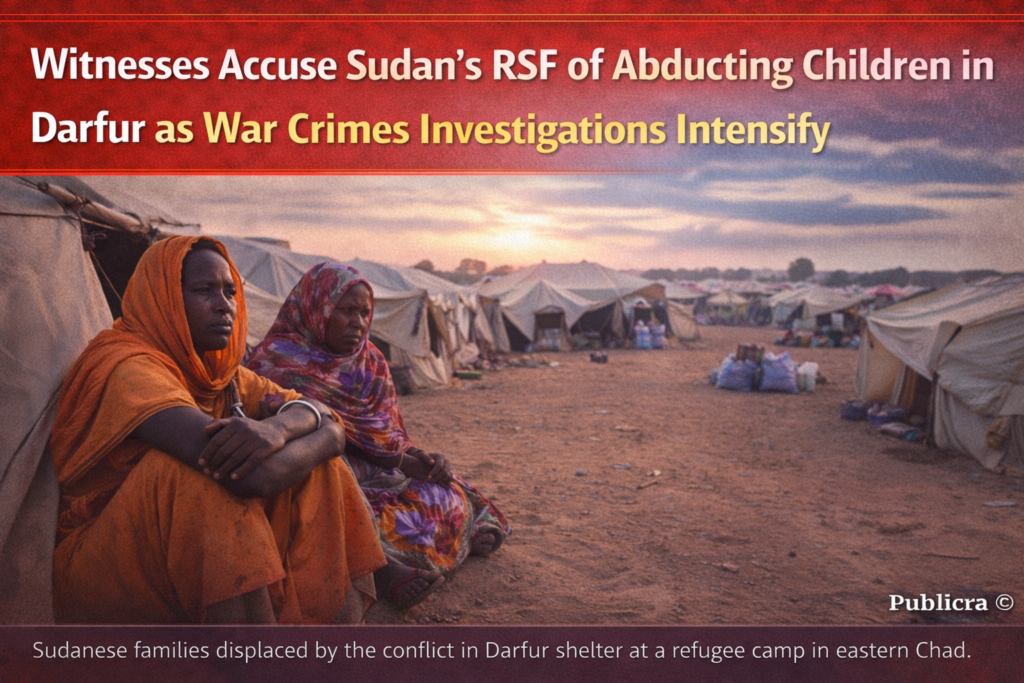
Accounts from refugees describe children taken during attacks in Darfur, sometimes after their parents were killed, raising fears of enslavement and crimes against humanity amid Sudan’s deepening civil war.
A War Within a War
As Sudan’s civil war enters its third year, new allegations emerging from Darfur have deepened concerns over the scale of abuses against civilians—especially children. Refugees and witnesses fleeing the region describe children being forcibly taken by fighters from the Rapid Support Forces (RSF) during attacks on towns and displacement routes, in some cases after their parents were killed.
Human rights experts say the accounts—gathered from survivors who escaped to other parts of Sudan and neighboring Chad—may point to unlawful detention, child exploitation, and potentially enslavement, violations prohibited under international law.
The RSF has denied deliberately targeting civilians and says it investigates abuses attributed to its fighters. However, the testimonies add to mounting evidence being examined by international investigators.
Sudan’s War and the Battle for Darfur
Sudan has been engulfed in conflict since April 2023, when fighting erupted between the national army and the RSF over control of the state. The war has devastated the country, killing tens of thousands, displacing millions, and triggering what the United Nations calls the world’s largest humanitarian crisis.
Darfur, long scarred by ethnic violence, has once again become a central battleground. The RSF, which evolved from the Janjaweed militias accused of genocide in the early 2000s, has been blamed by rights groups for mass killings and attacks on non-Arab communities.
Accounts of Child Abductions
According to interviews conducted with more than two dozen witnesses, children ranging from infants to teenagers were abducted during RSF-led assaults across Darfur, including during the takeover of the city of al-Fashir in October.
Witnesses described:
- Fighters taking children after their parents were killed
- Children being forced into vehicles at gunpoint
- Families told the children would be used to herd animals
In several cases, relatives said they have not heard from the abducted children since.
Reuters, which first documented the accounts, said it could not independently verify every incident or trace the children’s whereabouts, highlighting the difficulty of investigating abuses in an active war zone.
A Pattern Stretching Back to 2023
The testimonies describe at least 23 separate abduction incidents dating back to the first year of the conflict. Many occurred along displacement routes or near camps sheltering people fleeing violence.
Several witnesses said children were taken alongside stolen livestock—suggesting the abductions were tied to forced labor rather than random violence.
Human rights researchers say the descriptions resemble patterns documented during earlier Darfur conflicts, when children were forced into domestic work, herding, or sexual exploitation.
Experts Warn of Enslavement Crimes
Three international legal experts said the alleged abductions could meet the legal threshold for:
- War crimes
- Crimes against humanity
- Acts of enslavement
Patricia Sellers, a former adviser at the International Criminal Court (ICC) on slavery-related crimes, said the accounts—if proven—would violate multiple international treaties banning child exploitation and forced labor.
“These acts would not be isolated abuses,” she said, “but part of a systematic pattern.”
UNICEF: A Broader Pattern of Violations
The United Nations children’s agency, UNICEF, said it had not received confirmed reports of children being abducted specifically for enslavement, but noted that the testimonies align with a broader pattern of grave violations against children in Sudan.
These include:
- Recruitment of child soldiers
- Killings and maiming
- Sexual violence
- Forced displacement
UNICEF has repeatedly warned that children in Darfur face extreme risks due to the collapse of protection systems.
The Siege and Fall of al-Fashir
In late October, the RSF consolidated its control over Darfur after capturing al-Fashir, a city that had sheltered hundreds of thousands of displaced people.
The city had endured an 18-month siege, and witnesses accused RSF fighters of abuses during and after the takeover, including killings and mass detentions.
In January, a deputy prosecutor at the International Criminal Court told the UN Security Council that investigators believe war crimes and crimes against humanity were committed in al-Fashir, particularly against women and children.
RSF Response and Denials
The RSF has not responded directly to the latest allegations regarding child abductions. In previous statements, it has denied intentionally targeting civilians and said it places fighters suspected of abuses under investigation.
The group has also claimed that some atrocities attributed to its forces were carried out by rivals disguised in RSF uniforms—an assertion disputed by rights groups.
Sudanese Army and Government Reaction
Sudan’s army-backed government said the alleged abductions were consistent with abuses committed by Janjaweed militias during the previous Darfur conflict.
It stated that the government “cannot accept leaving citizens hostage to militia violence,” but offered few details on how civilians would be protected in RSF-controlled areas.
Children as Targets in a Fragmented War
Witnesses described fighters referring to abducted children using derogatory terms linked to ethnic identity and alleged loyalty to the army.
Researchers say the targeting of children reflects:
- Ethnic dimensions of the conflict
- Breakdown of command structures
- Use of terror to control populations
Several witnesses said the children were taken along with seized animals, reinforcing fears that forced labor is a key motive.
Long-Term Consequences
Humanitarian groups warn that abducted children face long-term risks including:
- Physical and psychological trauma
- Loss of education
- Family separation
- Exploitation
The lack of access for aid groups and investigators makes reunification efforts extremely difficult.
Accountability and International Response
The ICC has reopened investigations into Darfur, and international pressure is growing for accountability.
However, enforcement remains limited, as Sudan’s conflict continues without a comprehensive ceasefire and international access remains restricted.
A Crisis Hidden in Plain Sight
The alleged abduction of children in Darfur underscores the extreme vulnerability of civilians trapped in Sudan’s war. While global attention often focuses on military developments, the humanitarian toll—especially on children—continues to mount largely out of view.
As investigators gather evidence, families searching for missing children face an agonizing uncertainty, while the world confronts yet another test of its commitment to protecting the most vulnerable in conflict zones.