
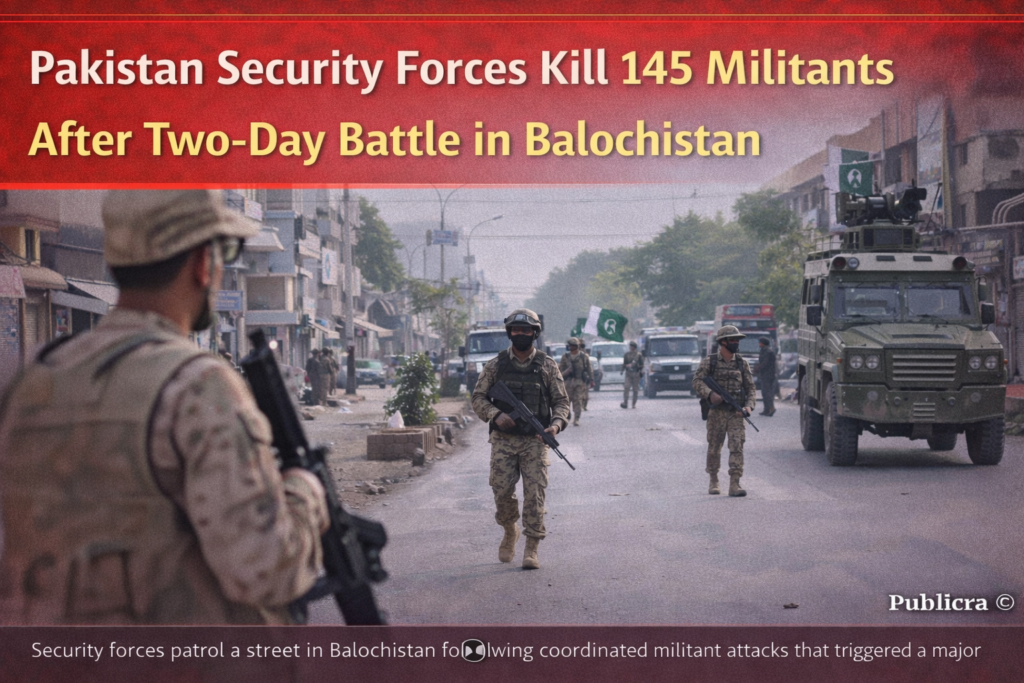
A wave of coordinated attacks across Balochistan triggered one of Pakistan’s deadliest counter-militant operations in years, highlighting a sharp escalation in the country’s insurgency crisis.
A Province Shaken by Coordinated Violence
Pakistan’s southwestern province of Balochistan has witnessed one of its deadliest security crises in years after a series of coordinated militant attacks prompted a massive counter-operation by Pakistani forces, resulting in the deaths of 145 militants over a 40-hour period.
The violence, which unfolded across multiple districts including Quetta, Gwadar, Mastung, and Noshki, left at least 31 civilians and 17 security personnel dead, according to provincial authorities. Officials say the scale, coordination, and brutality of the attacks mark a dangerous escalation in the long-running insurgency in the resource-rich but volatile province.
What Happened: Timeline of the Attacks
According to Pakistani officials, the attacks began almost simultaneously across several urban centers on Saturday.
Militants:
- Entered hospitals, schools, markets, and banks
- Disguised themselves as civilians
- Opened fire indiscriminately
- Attempted suicide bombings
- Temporarily blocked key roads
Pakistan’s junior interior minister Talal Chaudhry said the attackers deliberately targeted civilians and used them as human shields, complicating rescue and counter-terror operations.
40 Hours of Fighting
Security forces responded with large-scale counter-operations involving:
- The Pakistan Army
- Police units
- Frontier Corps
- Counterterrorism departments
Balochistan Chief Minister Sarfraz Bugti confirmed that:
- 92 militants were killed on Saturday
- 41 were killed on Friday
- Total militants killed: 145
“This is the highest number of militants killed in such a short span since the insurgency intensified,” Bugti said.
The Human Cost
Authorities reported:
- 31 civilians killed
- 17 law enforcement personnel killed
The attacks caused extensive damage to public infrastructure, including police stations, government buildings, and commercial areas. In Quetta, burned vehicles, bullet-scarred buildings, and cordoned streets reflected the intensity of the violence.
Hospitals were placed on emergency footing as casualties poured in, while authorities imposed movement restrictions to prevent further attacks.
Who Claimed Responsibility?
The Baloch Liberation Army (BLA), a banned separatist group, claimed responsibility for the attacks.
In a statement, the group said it had launched a coordinated operation named “Herof”, meaning “Black Storm”, targeting security forces and state installations across Balochistan.
The BLA has long opposed the Pakistani state, citing grievances over:
- Political marginalization
- Economic exploitation of natural resources
- Heavy security presence in the province
Why Balochistan Matters
Balochistan is Pakistan’s largest province by area but its least populated. It is strategically crucial due to:
- Rich mineral and gas reserves
- Proximity to Iran and Afghanistan
- The Gwadar Port, a flagship project under the China-Pakistan Economic Corridor (CPEC)
Militant groups argue that local communities have not benefited from development projects and accuse the state of repression—claims the government strongly rejects.
Intelligence Warnings and Pre-Operations
Chief Minister Bugti said intelligence agencies had received advance warnings of a large-scale militant operation.
“We had intelligence reports that such attacks were being planned,” he said, adding that pre-emptive operations were launched a day earlier.
Despite these measures, the militants were still able to execute simultaneous attacks, raising concerns about:
- Intelligence gaps
- Urban security vulnerabilities
- Militant infiltration tactics
A Broader Surge in Militancy
The Balochistan attacks are part of a wider surge in militancy across Pakistan.
In recent months:
- Attacks have increased in Balochistan and Khyber Pakhtunkhwa
- Militants have targeted security forces, Chinese interests, and civilians
- Cross-border militancy concerns have grown following instability in Afghanistan
Security analysts warn that Pakistan faces a multi-front insurgency challenge that requires both military and political solutions.
Civilian Targets and Tactics
Officials said militants deliberately targeted crowded civilian locations to:
- Maximize casualties
- Create fear and chaos
- Stretch security resources
The use of civilian disguises has alarmed authorities, as it makes detection far more difficult and risks wrongful suspicion of innocent people.
Human rights groups have urged restraint during counter-operations to ensure civilian protection.
Government Response and Security Measures
In the aftermath, authorities:
- Tightened security checkpoints
- Restricted movement in sensitive areas
- Increased intelligence surveillance
- Deployed additional forces to key installations
The federal government reiterated its commitment to “zero tolerance” for militant violence and vowed to restore stability.
Political and Economic Implications
The attacks raise serious questions about:
- Investor confidence in Balochistan
- Security of CPEC projects
- Regional stability near Iran and Afghanistan
China, which has significant investments in the province, has previously urged Pakistan to strengthen security for its nationals and projects.
Can Military Action Alone Work?
Security experts caution that while the scale of the counter-operation shows the state’s capacity to respond, military force alone cannot resolve long-standing grievances.
They argue that:
- Political reconciliation is needed
- Economic inclusion must improve
- Local communities should have a stake in development
Without these steps, analysts warn, militancy may continue to regenerate.
Public Fear and Resilience
Residents in Quetta described fear, shock, and exhaustion following the attacks.
Many businesses remained closed, while families avoided public spaces. At the same time, local leaders praised emergency responders and civilians who helped victims despite the danger.
A Critical Test for Pakistan
The killing of 145 militants marks a major tactical victory for Pakistani security forces—but it also underscores the severity of the insurgency challenge facing the country.
As Balochistan remains at the center of regional security concerns, Pakistan faces a defining test: whether it can pair forceful security measures with long-term political and economic solutions to prevent future bloodshed.