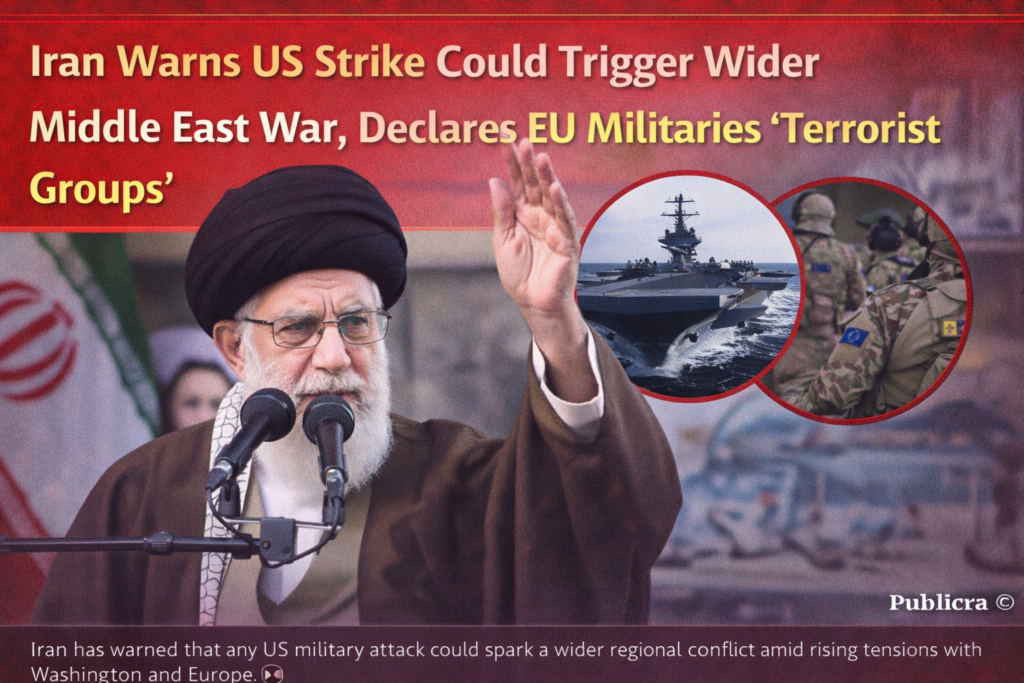
Tehran issues stark warnings over potential US military action, retaliates against European measures, and signals a widening geopolitical confrontation across the Middle East.
A Dangerous Escalation in an Already Volatile Region
Tensions between Iran, the United States, and Europe have intensified sharply, with Tehran warning that any American military attack would trigger a regional conflict and announcing a retaliatory designation of European Union armed forces as “terrorist groups.”
The warnings come amid a growing US naval presence in the Middle East, renewed threats from President Donald Trump, and deepening diplomatic rifts following European action against Iran’s Islamic Revolutionary Guard Corps (IRGC).
As military assets converge and rhetoric hardens, regional and global powers are increasingly concerned that miscalculation could push the Middle East into another major conflict.
Iran’s Warning: “Regional Conflict Is Inevitable”
Iranian officials said on Sunday that any US military action against Iran would not remain limited or contained.
Senior figures close to Iran’s leadership warned that:
- A US strike would provoke immediate retaliation
- Neighboring countries hosting US forces could be drawn in
- Energy routes and regional stability would be at risk
Iran’s Supreme Leader Ayatollah Ali Khamenei, speaking days earlier in Tehran, emphasized that Iran would not yield under military pressure and would respond decisively to any attack.
US Military Build-Up Raises Alarm
The warning follows a significant expansion of US naval and air assets in the Middle East.
According to US officials:
- Additional warships have been deployed to the region
- Aircraft carriers and support vessels are operating near strategic waterways
- Surveillance and missile defense capabilities have been reinforced
Washington says the deployments are defensive and intended to protect US forces and allies. Tehran, however, views the buildup as preparation for possible strikes.
Trump’s Pressure Campaign on Iran
President Donald Trump has repeatedly warned Iran that:
- It must accept a new nuclear agreement
- End uranium enrichment beyond agreed limits
- Halt support for regional proxy groups
Trump has also threatened military action if Iran fails to comply or if violence against protesters continues.
Iran has rejected what it calls “negotiations under threat,” insisting it will not bargain away its security or sovereignty.
Retaliation Against Europe: A Diplomatic Shock
In a major escalation, Iran announced it was designating EU member-state armed forces as terrorist groups, a direct response to European actions targeting the IRGC.
This move follows:
- European measures labeling the IRGC as a terrorist organization
- Expanded sanctions against Iranian military and security figures
Iranian officials described Europe’s actions as “hostile alignment” with Washington and said Tehran had no choice but to respond.
What the Terrorist Designation Means
Iran’s designation is largely symbolic but carries serious political implications:
- Iranian law now treats EU military personnel as hostile actors
- Diplomatic relations may deteriorate further
- Risk of confrontation involving European assets in the region increases
Analysts warn the move deepens Iran’s isolation while raising risks for European forces operating in the Middle East.
Strait of Hormuz: Strategic Flashpoint
Iran denied reports that it planned naval exercises in the Strait of Hormuz, a critical chokepoint for global oil shipments.
However, officials reiterated that:
- Iran retains full capability to defend its waters
- Any threat to its security would be met proportionally—or beyond
About one-fifth of the world’s oil supply passes through the strait, making any instability there a global economic concern.
Nuclear Talks: Narrowing Window
Despite the hostile rhetoric, both Iran and the US say diplomacy is not completely off the table.
However, key obstacles remain:
- Iran refuses to halt enrichment entirely
- The US demands broader restrictions
- Trust between the sides is minimal
European diplomats fear that the collapse of talks could leave military action as the default option.
Europe Caught in the Middle
The crisis places European governments in a difficult position:
- Supporting US pressure risks escalation
- Engaging Iran risks transatlantic tension
European leaders have called for de-escalation while maintaining sanctions, a balance that has so far failed to ease tensions.
Regional Fallout if Conflict Erupts
Security experts warn that any conflict involving Iran would likely:
- Spread to Iraq, Syria, Lebanon, and the Gulf
- Disrupt global energy markets
- Trigger mass displacement
- Draw in multiple state and non-state actors
Iran’s network of allies and proxies gives it significant reach beyond its borders.
Iran’s Strategic Messaging
Iran’s leadership appears focused on:
- Deterrence through escalation rhetoric
- Demonstrating resolve to domestic audiences
- Warning Europe against deeper involvement
By broadening the confrontation, Tehran may be attempting to raise the cost of military action for its adversaries.
What Happens Next?
Several paths remain possible:
- A diplomatic breakthrough under pressure
- Continued brinkmanship without conflict
- Limited strikes escalating into wider war
For now, the region remains on edge as military assets, political calculations, and international diplomacy collide.
A Precarious Moment for Global Security
Iran’s warnings and retaliatory actions underscore how fragile the current balance has become. With the US increasing its military footprint, Europe drawn deeper into confrontation, and diplomacy hanging by a thread, the risk of escalation is real.
Whether leaders choose restraint or confrontation in the coming weeks could shape Middle Eastern—and global—security for years to come.