
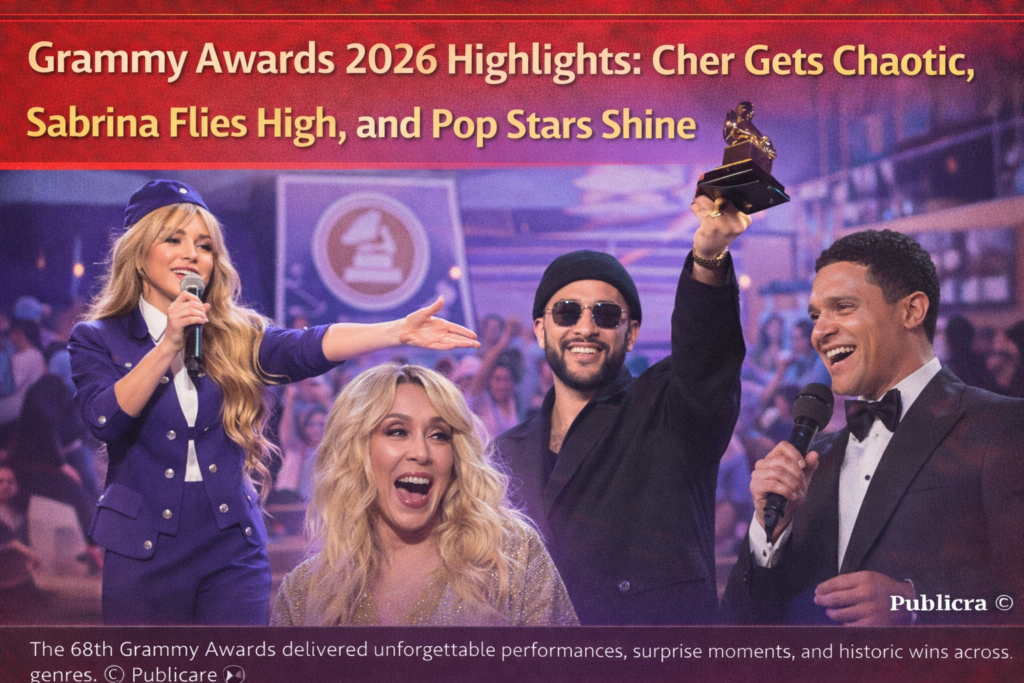
From unpredictable live TV moments to breakthrough wins and bold performances, the 68th Grammy Awards delivered spectacle, surprise and a snapshot of where music is heading next.
Biggest Night Delivers Again
The 68th Grammy Awards proved once again that no matter how polished the industry becomes, live music’s biggest night still thrives on unpredictability. From awkward gaffes and heartfelt tributes to daring fashion and genre-defining performances, the ceremony in Los Angeles offered a chaotic, joyful, and occasionally baffling celebration of global music culture.
Hosted for the final time by Trevor Noah, the 2026 Grammys reflected a music industry in transition—one where streaming stars, TikTok alumni, genre-bending artists, and legacy icons all shared the same stage.
Cher’s Chaotic Comeback Steals the Show
One of the night’s most talked-about moments came courtesy of Cher, who returned to the Grammy stage for the first time in 18 years.
Accepting a lifetime achievement award, the pop icon delivered a warm, rambling speech about following dreams—before accidentally announcing the wrong winner for record of the year. The moment briefly stunned the audience before laughter rippled through the room.
“I love live television,” joked Trevor Noah, summing up the chaos perfectly.
The incident instantly became one of the ceremony’s most viral moments, reminding viewers that live awards shows still have the power to surprise.
Trevor Noah’s Final Grammys: Humor With a Side of Reality
Trevor Noah’s sixth—and final—turn as Grammy host was marked by wit, warmth, and topical humor.
The show opened with a high-energy performance of APT by Bruno Mars and Rosé, setting the tone for a night that leaned heavily into global pop.
Noah joked about modern anxieties, quipping that America’s new national drinking game was “every time you turn on the news, you drink”—a line that drew knowing laughter in a year marked by political and social turbulence.
Sabrina Carpenter Takes Flight With Theatrical Pop
Sabrina Carpenter delivered one of the night’s most imaginative performances with an aviation-themed rendition of her chart-topping hit Manchild.
Dressed as a pilot, Carpenter danced through a surreal airport fantasy filled with absurd male archetypes and playful symbolism. The performance was intentionally nonsensical—and that was the point.
It cemented Carpenter’s reputation as one of pop’s most confident visual storytellers, proving she can blend humor, spectacle, and hit-making with ease.
Bad Bunny Makes Grammy History
Bad Bunny dominated headlines after winning Album of the Year, marking another historic milestone for Latin music on the global stage.
Though contractually barred from performing due to his upcoming Super Bowl halftime appearance, the Puerto Rican star still managed to steal attention through a playful on-stage exchange with Trevor Noah.
The moment underscored Bad Bunny’s cultural dominance—he didn’t need a performance to command the room.
Pharrell Williams Reflects on a Career in Real Time
Honored with the Global Impact Award, Pharrell Williams offered one of the night’s most self-aware moments.
As a montage of his hits played, the producer admitted that watching his own career unfold on screen felt like “listening to your voicemail on a loudspeaker.”
His speech paid tribute to the influence of Black music and the power of creativity, striking a reflective tone amid the night’s spectacle.
Rock Honors, Heartfelt Tributes and Yungblud’s Bittersweet Win
British rocker Yungblud won Best Rock Performance for a live rendition of Changes, recorded during Ozzy Osbourne’s farewell concert.
The win carried emotional weight following Osbourne’s death last summer. Yungblud described the award as “bittersweet,” while Osbourne’s family expressed gratitude for the tribute.
The moment highlighted how the Grammys continue to serve as a bridge between rock’s past and its evolving future.
K-Pop Makes Grammy History
The K-pop genre reached a new milestone when Golden, from Netflix’s KPop Demon Hunters, won Best Song for Visual Media—the first Grammy ever awarded to a K-pop track.
Songwriter EJAE humorously credited her dentist for inspiring the song during a routine check-up, adding levity to a historic moment for the genre.
Fashion Risks and Red Carpet Shockwaves
The red carpet delivered its own headlines.
- Heidi Klum turned heads in a nude latex dress that limited her movement but maximized attention.
- Chappell Roan sparked debate with a daring topless look accented only by jewelry.
- Justin Bieber shocked audiences by performing in silk boxer shorts, socks, and a guitar—prompting jokes about “OnlyFans eligibility.”
The looks reflected a Grammys tradition: pushing boundaries where fashion and performance intersect.
A Child Star Steals Hearts
Eight-year-old Aura V became the youngest Grammy winner in history after winning Best Children’s Music Album alongside her father.
Her poised acceptance speech and joyful presence provided one of the night’s most uplifting moments, reminding viewers that music’s future remains bright—and sometimes bedtime can be delayed for history.
Lady Gaga’s Controlled Chaos
Lady Gaga delivered a performance that was equal parts disco, punk, and performance art.
Performing Abracadabra with a stripped-down rock ensemble, Gaga abandoned polished pop for raw theatrics—screaming vocals, dramatic lighting, and her signature maximalist flair.
It was classic Gaga: polarizing, theatrical, and unforgettable.
Steven Spielberg Joins the EGOT Club
Legendary filmmaker Steven Spielberg officially joined the elite EGOT club after winning a Grammy for Music for John Williams.
With Oscars, Emmys, Tonys, and now a Grammy to his name, Spielberg’s achievement highlighted the increasingly blurred lines between film, music, and storytelling.
TikTok Stars, Different Outcomes
Former Hype House members Addison Rae and Alex Warren both performed as Best New Artist nominees.
Rae’s polished, dance-driven performance contrasted with Warren’s technically troubled set, underscoring the gap between viral fame and live performance experience.
The award ultimately went to Olivia Dean, whose soulful presence and musical maturity earned widespread praise.
Country Music’s Identity Shift
The Grammys introduced separate awards for traditional and contemporary country, reflecting the genre’s expanding boundaries.
While some saw the change as controversial, winners Zach Top and Jelly Roll embraced the moment as evidence of country music’s evolution.
A Night That Captured Music’s Crossroads
The 2026 Grammys weren’t just an awards show—they were a snapshot of a music industry redefining itself.
From global pop dominance and genre fusion to nostalgia, risk-taking, and emerging voices, the ceremony captured both where music has been—and where it’s heading.