
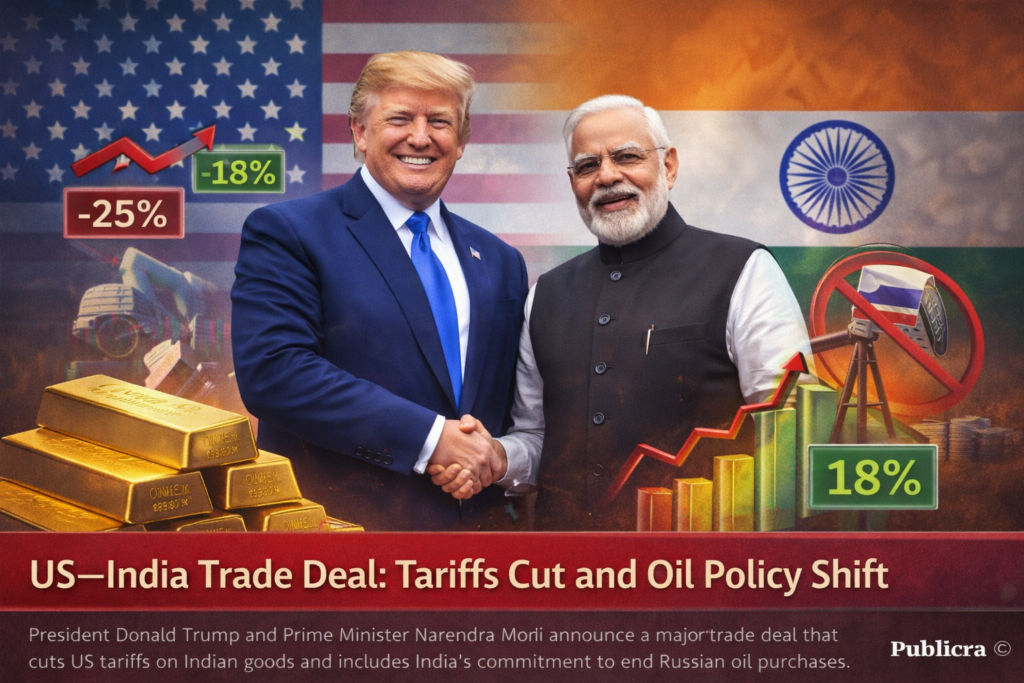
President Trump and Prime Minister Modi announce a sweeping economic partnership after months of trade tensions, reshaping global trade dynamics and geopolitical alignments. US and India Forge New Trade Deal: Tariff Reductions, Oil Shift and $500 Billion Trade Pledge
A Breakthrough in Bilateral Relations
In a major development in global trade and geopolitics, the United States and India agreed on a comprehensive trade deal following a phone call between US President Donald Trump and Indian Prime Minister Narendra Modi on Monday. According to Mr. Trump, the agreement will lower US tariffs on Indian goods from 25% to 18% and includes India’s commitment to end its purchases of Russian oil, a key element of the negotiation process aimed at reducing financial support for Moscow amid the war in Ukraine.
The announcement comes against the backdrop of significant economic and diplomatic tensions between the two countries over the past year, including periods when tariffs reached as high as 50% and Indian exports plummeted.
A Strategic Shift: From Trade Tensions to Economic Cooperation
Tariff Reductions and Reciprocal Trade
Under the new deal:
- The United States will cut its “reciprocal tariff” on Indian imports from 25% to 18%.
- A separate 25% penalty tariff previously imposed to penalize Indian purchases of Russian oil will be dropped as part of the agreement.
- India has agreed to reduce its own trade barriers against US goods, including moving toward eliminating certain tariffs altogether.
According to Trump, the tariff shift was agreed upon “out of friendship and respect for Prime Minister Modi.” He also reaffirmed that India agreed to purchase more than $500 billion worth of US goods, including energy, technology, agricultural products, and coal.
Ending Russian Oil Purchases: A Diplomatic Turning Point
A central pillar of the agreement is India’s commitment to halt purchases of Russian crude oil, a significant change in New Delhi’s energy strategy. India had been one of the world’s largest buyers of Russian oil, using discounted supplies to fuel its rapidly growing economy and energy demands.
Trump said that, in exchange, India would favor oil imports from the United States and potentially from Venezuela, expanding the trade relationship beyond traditional goods.
This part of the deal aligns with Washington’s efforts to reduce Russia’s energy revenue amid the prolonged war in Ukraine. U.S. policymakers had previously used tariffs as leverage to influence India’s energy sourcing decisions, which this agreement now effectively resolves.
Economic Fallout and Market Response
Indian Exports and Trade Balance
India’s exports to the US had suffered under high tariff barriers implemented in 2025, prompting New Delhi to seek alternative markets, including partnerships with the European Union and other trading blocs.
With the tariff reduction now in place, analysts expect:
- A rehabilitation of Indian export growth
- Renewed foreign investment interest
- More competitive pricing for Indian products in the US market
Stock Markets and Business Reaction
Following Trump’s announcement, Indian and US markets showed positive signs, with notable gains in shares of major Indian firms like Infosys, Wipro, and HDFC Bank, driven by optimism around enhanced trade flows and clearer policy direction.
Geopolitical Implications
A Realignment in Global Trade
The trade deal is not occurring in isolation; it follows closely after India signed a landmark free trade agreement with the European Union, often characterized as the “mother of all deals.” This sequence of moves reflects New Delhi’s strategic diversification of trade partnerships amidst pressures from Western allies.
The tariff deal with the US, alongside enhanced cooperation with the EU, positions India as a central node in global trade networks—balancing ties between Western powers and maintaining its economic autonomy.
India’s Strategic Diplomacy: Balancing Interests
Despite the tariff conflict earlier in 2025, Indian officials are framing the new deal as beneficial for both countries. Prime Minister Modi’s statement on social media thanked President Trump and highlighted the mutually beneficial cooperation that the agreement represents for the people of both nations.
For India, the deal also complements its broader trade strategy, which has included expanding markets through free trade negotiations with the EU and ASEAN nations.
Energy Security and Global Oil Markets
India’s shift in oil sourcing has implications beyond bilateral trade. As one of the world’s fastest-growing energy consumers, India’s reduced reliance on Russian crude could:
- Strengthen US and Venezuelan energy exports
- Shift global energy flows
- Influence pricing and regional supply chains
However, the transition will take time and requires significant adjustments from energy infrastructure and supply agreements.
Critics and Challenges
Not all analysts are uniformly optimistic. Some observers caution that:
- The actual implementation of tariff reductions and oil policy changes will require detailed legal and commercial frameworks
- India’s energy requirements may still drive some level of Russian imports during the transitional phase
- Broader geopolitical tensions, including the Russia–Ukraine conflict, could continue to complicate economic strategies
Such complexities highlight that while the deal marks a breakthrough, navigating its full economic and political impact will be a long-term process.
A New Chapter in India-US Economic Relations
The US–India trade deal announced by President Trump and Prime Minister Modi appears to reset the tone of bilateral economic engagement. By reducing tariffs and moving India away from Russian oil dependence, both nations signal a deeper and more strategic partnership.
While challenges remain, the agreement lays the groundwork for more robust trade flows, economic growth, and a redefined geopolitical balance in the 21st century.