
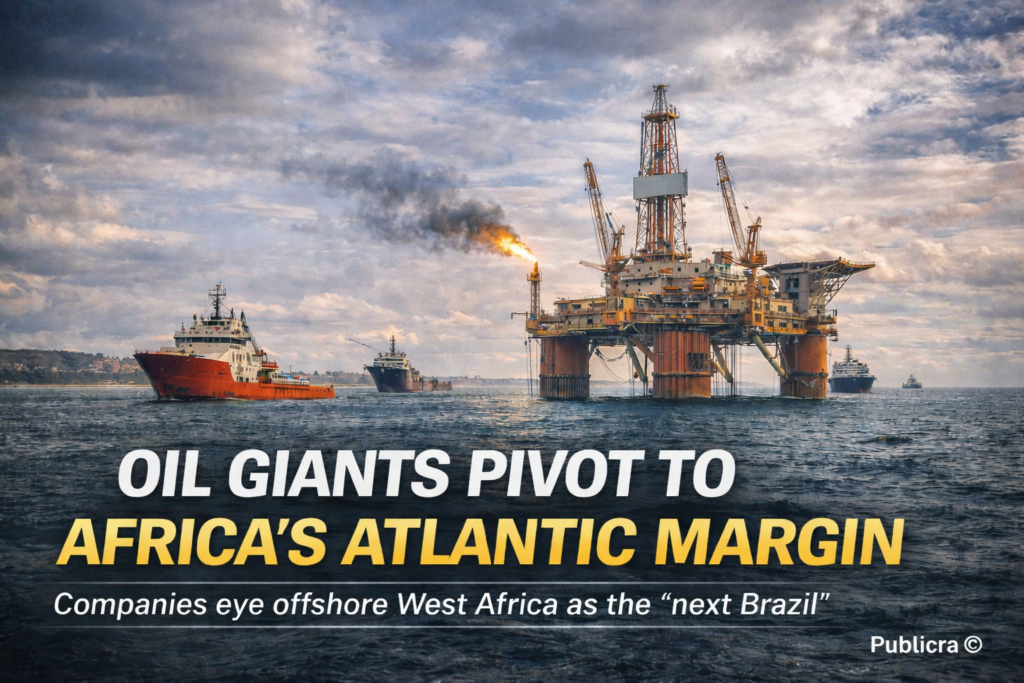
Chevron, TotalEnergies, Shell and others expand offshore exploration in West and Southern Africa as U.S. shale matures and global energy demand remains resilient
Why Africa Is Back on Big Oil’s Map
After years of focusing heavily on U.S. shale and selective Middle Eastern investments, the world’s largest oil companies are once again turning their attention to Africa’s Atlantic coastline. New offshore licensing rounds, deepwater discoveries, and policy reforms in countries such as Angola, Namibia, Senegal, and Guinea-Bissau are reshaping global exploration strategies.
Chevron, TotalEnergies, Shell, Eni, BP, and a growing group of international and independent explorers are snapping up offshore blocks in West and Southern Africa. Their goal is ambitious: to uncover the “next Brazil” — a reference to Brazil’s pre-salt offshore discoveries that transformed the country into one of the world’s largest deepwater oil producers over the past two decades.
The renewed push comes at a time when U.S. shale production growth is slowing, while global energy demand remains higher for longer than many analysts predicted earlier in the energy transition debate. For oil majors seeking to replenish reserves and secure long-term production into the 2030s and beyond, Africa’s underexplored offshore basins are once again seen as one of the most promising frontiers.
Why Oil Majors Are Looking Beyond U.S. Shale
For more than a decade, U.S. shale dominated global oil investment strategies. The Permian Basin and other shale plays offered:
- Short development cycles
- Rapid production growth
- Lower upfront exploration risk
- Flexible capital allocation
However, analysts now say shale’s growth curve is flattening. While U.S. shale will remain a major source of global supply, it is no longer the engine of explosive growth it once was. Production is increasingly dependent on continuous drilling, and sweet spots are becoming more competitive and costly to access.
As a result, oil majors are diversifying their upstream portfolios to ensure long-term reserve replacement. Offshore Africa offers:
- Large, contiguous exploration acreage
- Untapped deepwater geology
- Long production lifecycles
- Potential for multi-billion-barrel discoveries
Energy consultancies note that the “acreage reload” strategy seen in Africa mirrors earlier moves in Brazil and Guyana before those regions delivered world-class discoveries.
Africa’s Atlantic Margin: A Geological Twin of Brazil
One of the most compelling arguments driving renewed interest in Africa’s offshore potential is geology. The Atlantic margin of West and Southern Africa shares a common geological history with Brazil and Suriname on the opposite side of the ocean. These regions were once connected before the breakup of the ancient supercontinent Gondwana.
Geologists point to structural similarities in:
- Sedimentary basins
- Salt layers
- Hydrocarbon migration pathways
- Reservoir formations
This geological “twin basin” theory underpins the belief that Africa’s offshore margins could host pre-salt style reservoirs similar to those that unlocked Brazil’s offshore boom.
Companies exploring offshore Angola, Namibia, Senegal, and Mauritania are applying lessons learned from Brazil’s pre-salt developments — including advanced seismic imaging, deepwater drilling techniques, and high-pressure reservoir management.
Namibia and Angola: Emerging Deepwater Hotspots
Namibia’s Orange Basin
Namibia has emerged as one of Africa’s most promising new offshore frontiers. The Orange Basin, in particular, has attracted attention following a string of discoveries by international oil companies and independent explorers.
Key drivers of Namibia’s appeal include:
- Deepwater discoveries with light crude oil
- Political stability relative to other frontier regions
- Government openness to foreign investment
- Modern petroleum legislation and licensing frameworks
Although commercial production remains several years away, the scale of recent discoveries has positioned Namibia as a potential future energy hub for Southern Africa.
Angola’s Regulatory Reforms
Angola, Sub-Saharan Africa’s second-largest oil producer, is undergoing a strategic transformation of its energy sector. Recent reforms include:
- Tax incentives for mature offshore blocks
- New licensing rounds to attract foreign capital
- Regulatory clarity aimed at reducing investor risk
- Policies to encourage gas exploration alongside oil
Angola’s decision to leave OPEC has also given the country greater flexibility in managing output levels, making it more attractive to companies seeking production growth opportunities. Major players such as Shell, Eni, and BP have renewed or expanded their offshore interests in Angolan waters.
The MSGBC Basin: A New West African Frontier
The MSGBC basin — spanning Mauritania, Senegal, The Gambia, Guinea-Bissau, and Conakry — has become another focal point for exploration activity. Chevron’s recent entry into offshore blocks in Guinea-Bissau signals growing confidence in the basin’s potential.
Energy analysts note that the MSGBC basin could host multi-billion-barrel resources, although much of the area remains underexplored compared to more mature basins in Nigeria and Angola.
The basin’s attractiveness stems from:
- Large unexplored acreage
- Growing regional cooperation
- Offshore infrastructure potential
- Strategic positioning near transatlantic shipping routes
The Role of Regulatory Reforms in Attracting Investment
One of the biggest barriers to foreign investment in African energy projects historically has been regulatory uncertainty. In recent years, several African governments have implemented reforms aimed at improving investor confidence, including:
- Simplified licensing procedures
- Transparent production-sharing contracts
- Improved fiscal terms
- Reduced bureaucratic delays
- Legal frameworks aligned with international standards
Countries such as Nigeria, Angola, and Senegal have made notable progress in modernizing their petroleum laws. These reforms are crucial for attracting the billions of dollars required to develop deepwater projects, which often take a decade or more from discovery to production.
Balancing Energy Security and the Energy Transition
The renewed investment in offshore Africa comes amid global debates about the future of fossil fuels in a world striving to meet climate goals. Oil majors argue that even under aggressive energy transition scenarios, oil and gas will remain essential components of the global energy mix for decades.
From the perspective of African governments, offshore oil and gas development is often framed as:
- A pathway to economic development
- A source of foreign exchange earnings
- A means of funding social programs and infrastructure
- A tool for improving domestic energy access
At the same time, international lenders and climate advocates continue to pressure companies and governments to align new projects with emissions reduction commitments and sustainability goals. Many oil majors are attempting to reconcile these competing priorities by pairing upstream investments with carbon capture initiatives, methane reduction programs, and renewable energy projects in host countries.
Geopolitics and Global Energy Security
Africa’s offshore boom is unfolding against a backdrop of shifting global energy geopolitics. The war in Ukraine, tensions in the Middle East, and supply chain disruptions have heightened concerns about energy security among major importing nations.
For Europe in particular, African offshore gas projects are seen as potential alternatives to Russian energy supplies. LNG developments in Senegal and Mauritania, as well as gas finds in Angola and Namibia, could play a growing role in diversifying European energy imports over the next decade.
Meanwhile, China continues to expand its footprint in African energy infrastructure, adding another layer of geopolitical competition to the region’s offshore race.
Environmental and Social Considerations
Deepwater offshore projects raise environmental concerns, particularly regarding:
- Oil spill risks
- Marine ecosystem impacts
- Coastal community livelihoods
- Carbon emissions from production and transport
Energy companies now face heightened scrutiny from regulators, investors, and civil society groups. Environmental impact assessments, community engagement programs, and transparency around revenue management are increasingly central to project approvals.
Several African nations are also exploring how offshore revenues can be channeled into climate adaptation efforts, infrastructure resilience, and economic diversification to reduce long-term dependence on hydrocarbons.
What Comes Next for Africa’s Offshore Boom?
Industry experts say the next five years will be critical in determining whether Africa’s offshore renaissance lives up to its “next Brazil” potential. Key factors to watch include:
- Success rates of new exploration wells
- Stability of regulatory frameworks
- Global oil price trends
- Technological advancements in deepwater drilling
- Progress on local content policies and workforce development
If early discoveries translate into commercially viable production hubs, Africa’s Atlantic margin could reshape global oil supply dynamics well into the 2040s.
Final Outlook: Africa’s Offshore Bet and the Future of Global Energy
As oil majors recalibrate their global portfolios, Africa’s Atlantic margin is emerging as one of the most strategically significant exploration frontiers of the decade. The combination of Brazil-like geology, regulatory reforms, and sustained global demand has created a powerful investment narrative.
Whether Africa becomes the “next Brazil” will depend on the success of current drilling campaigns, the stability of policy environments, and the industry’s ability to balance energy security with environmental responsibility. What is clear is that the race for Africa’s offshore resources is no longer theoretical — it is already reshaping the global energy map.