
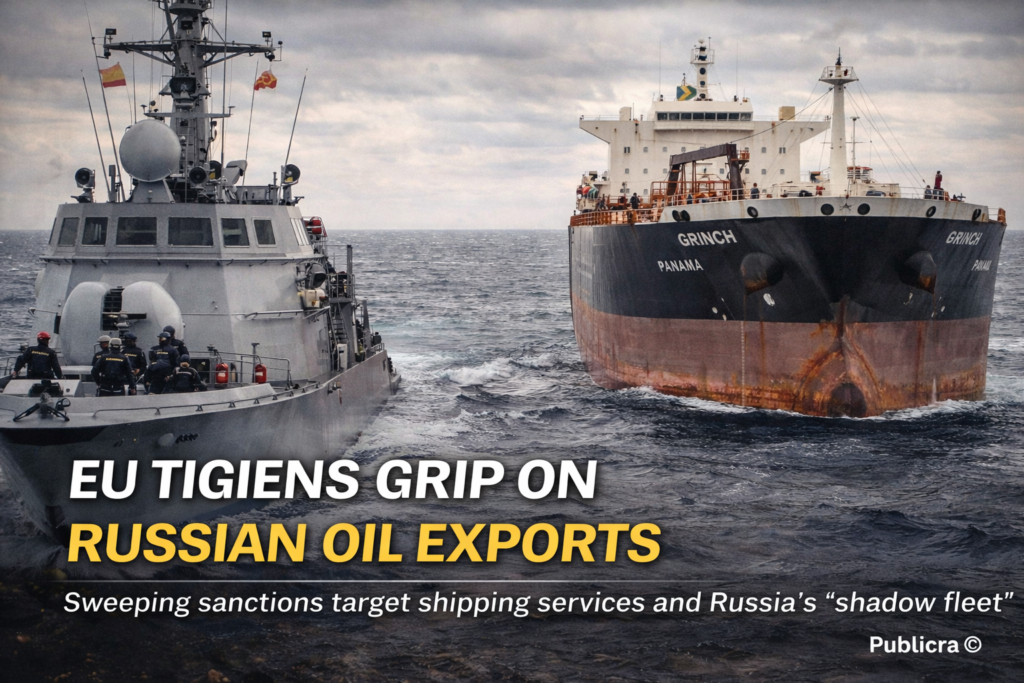
Brussels moves to choke off Moscow’s maritime crude trade with broad service bans, expanded ‘shadow fleet’ listings, and tighter anti-circumvention tools
Europe Raises the Stakes on Russia’s Energy Revenues
The European Union has proposed its most far-reaching sanctions package to date against Russia’s energy exports, aiming to disrupt the maritime services that underpin Moscow’s seaborne crude oil trade. The new measures go beyond the existing G7 price cap mechanism by seeking to ban a wide array of Western services—from shipping and insurance to maintenance and technical support—that enable Russian oil to reach global markets.
Announced by the European Commission as part of the bloc’s 20th sanctions package since Russia’s full-scale invasion of Ukraine, the proposal marks a strategic escalation in Europe’s economic pressure campaign. The plan targets not only Russia’s state revenue streams but also the complex web of intermediaries and “shadow fleet” tankers that have helped Moscow continue exporting oil despite years of restrictions.
As the war enters another year with no comprehensive peace settlement in sight, Brussels is signaling that it is prepared to use every economic lever available to curtail Russia’s ability to finance its military campaign. The proposed measures could reshape global energy flows, strain shipping hubs in parts of the Mediterranean, and test the cohesion of Europe’s sanctions enforcement regime.
From Price Caps to Service Bans: A Strategic Shift
Since late 2022, Western countries have relied primarily on a price cap regime to limit Russia’s oil revenues while allowing third countries to continue buying Russian crude at or below a set price. The cap was designed to prevent a sudden shock to global energy markets while curbing Moscow’s earnings. In practice, however, enforcement has proven difficult, and Russia has adapted by assembling a “shadow fleet” of tankers and using complex shipping arrangements to skirt restrictions.
The European Commission’s new proposal represents a pivot away from the price cap’s reliance on compliance by shipping companies and insurers. Instead, it seeks to impose a blanket ban on services that facilitate Russian seaborne crude exports. This includes:
- Shipping and chartering services
- Insurance and reinsurance
- Port and maintenance services
- Technical and engineering support
- Maritime financing and brokerage
By targeting the service ecosystem rather than just the sale price of oil, Brussels aims to close loopholes that have allowed Russian exports to continue flowing to markets such as China and India.
The ‘Shadow Fleet’ and the Enforcement Challenge
A central feature of Russia’s sanctions evasion strategy has been the expansion of its so-called shadow fleet—aging tankers often operating under opaque ownership structures, false flags, or shell companies registered in jurisdictions with limited regulatory oversight. These vessels operate outside mainstream Western insurance and classification systems, making them harder to track and regulate.
The EU’s proposed sanctions package includes adding dozens more vessels to its blacklist, raising the total number of sanctioned ships into the hundreds. The goal is twofold:
- Increase operational risk for shipowners and operators involved in Russian oil transport.
- Deter ports and service providers from offering assistance to vessels linked to sanctions evasion.
European officials argue that disrupting the shadow fleet is critical not only for economic pressure but also for maritime safety and environmental protection, as many of these tankers are older and operate without proper oversight.
Impact on Greece, Cyprus, and Malta: A Delicate Balancing Act
The new measures could have significant implications for EU member states with large shipping industries, particularly Greece, Cyprus, and Malta. These countries host some of the world’s largest tanker fleets and maritime service providers, many of which have historically played a role in transporting Russian crude.
Under the proposed ban, EU-based companies would be prohibited from providing services that support Russian oil shipments, even when the oil is destined for non-EU markets. This could force shipping firms to reassess routes, contracts, and client relationships.
While European leaders emphasize the geopolitical necessity of the measures, shipping industry groups warn of potential economic fallout, including:
- Loss of revenue for European maritime hubs
- Increased insurance and compliance costs
- Market distortions favoring non-Western shipping operators
Balancing sanctions enforcement with the economic interests of member states will be a key political challenge as the package moves toward adoption.
China and India: The Global Energy Ripple Effect
Russia has redirected much of its oil exports toward Asian markets, particularly China and India, since European imports plummeted following earlier sanctions. These countries have benefited from discounted Russian crude, helping to cushion their domestic energy costs.
If the EU’s service ban is implemented effectively, it could complicate Russia’s ability to supply these markets at scale. However, analysts caution that the impact will depend on several factors:
- Whether non-Western shipping and insurance networks can fully replace Western services
- How aggressively third countries enforce or ignore Western sanctions
- The availability of alternative vessels and financing channels
China and India are unlikely to formally join the sanctions regime, but logistical constraints could still affect supply chains and pricing dynamics in Asian energy markets.
Beyond Oil: Expanding the Sanctions Net
The proposed package extends well beyond crude oil. Brussels has signaled its intention to broaden restrictions on a range of Russian exports and financial channels, including:
- New import bans on selected metals and chemicals
- Restrictions on critical minerals used in industrial and military applications
- Expanded sanctions on regional Russian banks
- Tighter controls on cryptocurrency platforms used for sanctions evasion
The EU is also preparing to deploy a new “anti-circumvention tool,” which would allow the bloc to restrict the sale of sanctioned goods to third countries suspected of re-exporting them to Russia. This marks a significant evolution in sanctions policy, potentially affecting countries in Central Asia and beyond that serve as transit points in Russia’s trade networks.
Geopolitical Context: Sanctions as Leverage for Diplomacy
European leaders have framed the new sanctions as part of a broader strategy to pressure Moscow into meaningful peace negotiations. The logic is that sustained economic constraints—particularly on energy revenues, which form a cornerstone of Russia’s fiscal base—will eventually force the Kremlin to reassess the costs of prolonging the conflict.
However, the effectiveness of sanctions as a diplomatic lever remains contested. Critics argue that Russia has already demonstrated resilience by restructuring its trade patterns and domestic economy. Supporters counter that sanctions operate over the long term, gradually eroding financial capacity and technological access.
What is clear is that the EU is positioning itself for a protracted economic standoff, with sanctions policy becoming a central pillar of its foreign policy toolkit.
Energy Markets and Price Volatility
Any significant disruption to Russian oil exports carries implications for global energy markets. While Russia has lost much of its European market share, it remains a major global supplier. A sudden reduction in export capacity could contribute to price volatility, particularly if alternative supply sources fail to compensate.
Energy analysts are watching several variables closely:
- OPEC+ production decisions
- U.S. shale output trends
- Demand recovery in Asia
- The resilience of Russia’s export logistics
European policymakers insist that the sanctions are designed to minimize global market disruption, but the interconnected nature of energy markets means that unintended consequences cannot be ruled out.
Legal and Political Hurdles to Adoption
The proposed sanctions package must be approved by all EU member states, a process that can be politically complex. Some countries have previously raised concerns about the economic impact of sanctions on domestic industries. Others have called for stronger enforcement mechanisms to ensure that measures are applied uniformly across the bloc.
Key issues likely to feature in negotiations include:
- Phasing-in periods for service bans
- Exemptions for humanitarian or safety-related services
- Coordination with G7 partners to avoid regulatory arbitrage
- Legal safeguards for European firms transitioning away from Russian-linked business
The outcome will test the EU’s unity at a time when geopolitical cohesion is under strain.
The Long-Term Outlook: Sanctions as a Structural Feature
With no immediate end to the conflict in Ukraine, sanctions are increasingly becoming a structural feature of Europe’s relationship with Russia rather than a temporary policy tool. The proposed measures signal that Brussels is preparing for a prolonged period of economic decoupling in strategic sectors such as energy, finance, and critical materials.
Over time, this decoupling could reshape trade routes, investment patterns, and geopolitical alliances, reinforcing a more fragmented global economic order.
A High-Stakes Escalation in Economic Warfare
The EU’s proposed ban on services supporting Russian seaborne crude exports represents a significant escalation in the economic campaign against Moscow. By targeting the logistical backbone of Russia’s oil trade, Brussels is seeking to strike at one of the Kremlin’s most vital revenue streams. Whether these measures achieve their intended political and economic impact will depend on enforcement, international coordination, and Russia’s capacity to adapt.
As the sanctions regime evolves, the broader implications for global energy markets, maritime industries, and geopolitical alignments will continue to unfold—underscoring that the battle over energy and trade is now a central front in the wider conflict.