
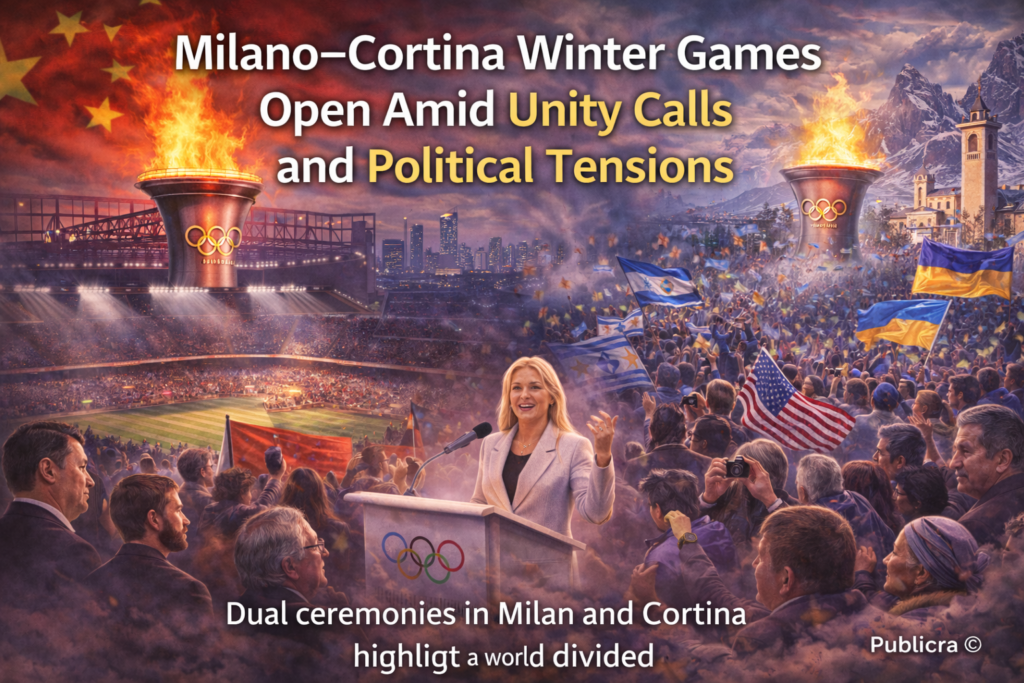
Italy’s grand Olympic opening blends culture and spectacle as geopolitical tensions ripple through the crowd
A Spectacle Framed by a Fractured World
The opening ceremony of the Milano–Cortina Winter Olympics was designed as a celebration of harmony—an artistic fusion of Italy’s urban dynamism and alpine heritage. Held across Milan’s iconic San Siro stadium and the mountain town of Cortina d’Ampezzo, the event showcased fashion, music, and sport in a meticulously choreographed production. Yet beneath the glittering surface, the ceremony reflected the geopolitical tensions shaping the world in 2026.
Crowd reactions to political figures and national delegations revealed how global conflicts and diplomatic strains have found their way into the Olympic arena. While Olympic leaders reiterated the movement’s commitment to unity and peace, the opening night made clear that the Games, despite their unifying ideals, do not exist in a vacuum. In a world marked by wars, rivalries, and polarization, even the Olympics can become a stage where international tensions are subtly—and sometimes overtly—expressed.
This article explores how political undercurrents emerged during the opening ceremony, what the dual-host format symbolizes for the future of mega-sporting events, and how the Olympics are navigating their role in an increasingly divided global landscape.
A Dual-Host Opening: Milan Meets Cortina
For the first time in Winter Olympic history, the opening ceremony unfolded across two host locations simultaneously. Milan, Italy’s financial and cultural hub, and Cortina d’Ampezzo, the storied alpine resort town, were linked in a synchronized broadcast that aimed to reflect the dual identity of the Games: cosmopolitan city life and mountain tradition.
The lighting of two Olympic cauldrons—one in Milan’s historic Arco della Pace and another in Cortina’s central square—symbolized the unity of these distinct settings. Organizers described the concept as a modern reinterpretation of Italy’s cultural diversity, blending fashion, design, music, and winter sports heritage.
From a logistical standpoint, the dual-host format reflects a broader trend in mega-events: spreading infrastructure demands and economic benefits across multiple cities. This approach is increasingly favored by host nations seeking to manage costs and leave more sustainable legacies. The Milano–Cortina model may serve as a template for future Olympic bids in countries wary of the financial burden associated with hosting large-scale sporting events.
Culture, Fashion, and National Identity on Display
Italy’s opening ceremony leaned heavily into its global reputation for art, fashion, and music. Performances celebrated Italian design, cinematic heritage, and the country’s historical contributions to culture. International pop stars and Italian icons shared the stage, underscoring the Games’ global appeal.
The artistic theme of “harmony” sought to project a message of unity across borders, echoing the Olympic Charter’s ideals. Yet the juxtaposition of polished cultural imagery with spontaneous political reactions from the crowd highlighted the tension between the Olympic vision and the realities of contemporary geopolitics.
Political Reactions in the Crowd: What Happened
Despite the ceremony’s celebratory tone, political tensions surfaced in the form of audible reactions to certain delegations and political figures. The presence of high-profile international leaders drew mixed responses, with some greeted warmly and others facing jeers or boos from segments of the audience.
Reactions to national teams varied between the two host venues, underscoring how public sentiment can differ across regions and communities. While some delegations were met with enthusiastic applause, others encountered audible dissent, reflecting the broader global debates and conflicts that shape public opinion.
Such moments, while brief, illustrate the challenges faced by the International Olympic Committee (IOC) in maintaining political neutrality. The Olympic movement has long emphasized that sport should transcend politics, yet history shows that the Games often mirror the political climate of their time—from Cold War boycotts to protests over human rights and conflicts.
IOC’s Message: Unity in a Polarized Era
In her address, the IOC president emphasized that the Olympic Games are meant to bring people together across political, cultural, and ideological divides. The message was clear: the Games should serve as a space where athletes and spectators alike can celebrate shared humanity, even when governments and societies are at odds.
This call for unity resonates with the IOC’s longstanding mission but also highlights the growing difficulty of maintaining that stance in a hyperconnected world. Social media amplifies every reaction, and global audiences interpret events through diverse political lenses. The IOC’s challenge is not only to promote unity symbolically but also to manage the practical realities of hosting an event watched by billions in an era of constant political scrutiny.
Athletes Caught Between Sport and Politics
For athletes, the Olympics remain the pinnacle of sporting achievement—a culmination of years of training and sacrifice. Yet they increasingly find themselves navigating a landscape where their participation is interpreted through political contexts beyond their control.
Athletes from conflict-affected regions often carry symbolic weight, with their presence seen as statements of resilience or resistance. Meanwhile, competitors from countries embroiled in geopolitical disputes may face public reactions shaped by international tensions rather than their sporting achievements.
Many athletes have called for the Games to remain a space of respect and fair competition, urging spectators to separate political grievances from the celebration of sport. However, as global audiences bring their own perspectives to the event, maintaining that separation becomes increasingly challenging.
Security, Diplomacy, and the Olympic Stage
The presence of international dignitaries at the opening ceremony also highlighted the Olympics’ role as a venue for informal diplomacy. High-profile events provide opportunities for bilateral meetings and symbolic gestures, even when official diplomatic channels are strained.
At the same time, heightened security measures reflect concerns about potential protests, cyber threats, and the safety of participants and spectators. Organizers have invested heavily in security infrastructure, blending physical surveillance with digital monitoring to safeguard the event.
The Olympics thus function as both a cultural festival and a geopolitical stage, where soft power, public diplomacy, and national image-building converge.
The Olympics in a Fragmented Media Environment
Media coverage of the opening ceremony varied widely across outlets and regions. While many focused on the spectacle and cultural performances, others highlighted the political reactions in the crowd as emblematic of deeper global divisions.
This fragmented media landscape means that the same event can be interpreted in radically different ways depending on the audience and platform. For some, the ceremony was a triumphant showcase of Italian culture and Olympic spirit. For others, it underscored how deeply politics has permeated even the world’s most celebrated sporting events.
What This Means for the Future of Global Sports
The Milano–Cortina opening ceremony offers a snapshot of the evolving role of global sporting events in the 21st century. As geopolitical tensions rise and societies become more polarized, the expectation that sports can remain entirely apolitical may be increasingly unrealistic.
Future Olympic hosts and organizers will likely need to:
- Anticipate and manage political reactions in public venues
- Strengthen communication strategies around neutrality and inclusivity
- Enhance security and crowd management protocols
- Foster dialogue with athletes about navigating political symbolism
At the same time, the enduring appeal of the Olympics lies in their ability to inspire across borders. The challenge is preserving that inspirational core while acknowledging the complex realities of the world in which the Games take place.
Harmony Tested in a Divided World
The Milano–Cortina Winter Olympics opened with a message of harmony, creativity, and shared humanity. Yet the political reactions heard in the stadiums served as a reminder that the Games unfold against a backdrop of global tensions that cannot simply be switched off for a ceremony.
As athletes prepare to compete and the world turns its attention to the sporting drama ahead, the Olympics once again occupy a delicate space between idealism and reality. Whether the Games can foster moments of unity in an increasingly polarized world will depend not only on the organizers and the IOC, but also on audiences willing to embrace sport as a rare common ground in fractured times.