
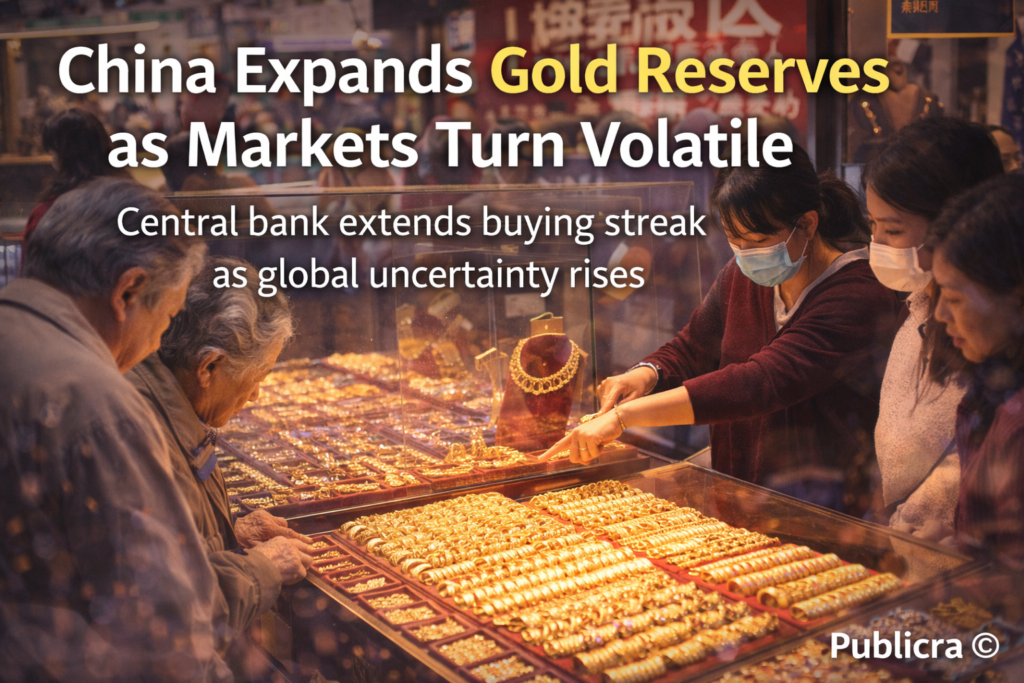
PBOC extends its bullion buying streak into a 15th straight month, underscoring Beijing’s push to diversify reserves amid currency and geopolitical risks
Why China Is Stockpiling Gold Again
China’s central bank has quietly but steadily built one of the world’s most significant gold accumulation programs over the past two years. The People’s Bank of China (PBOC) confirmed that it added to its bullion reserves for a 15th consecutive month in January, reinforcing a broader trend among central banks to diversify reserves away from traditional currencies amid global economic and geopolitical uncertainty.
This sustained buying spree comes at a time when gold prices have experienced extraordinary volatility, swinging between record highs and sharp corrections. The renewed interest in gold reflects not only market speculation but also deeper structural shifts in how countries manage reserves, hedge against financial risks, and navigate a changing global monetary order.
This article explores why China is increasing its gold holdings, how global market dynamics and U.S. monetary policy are influencing bullion prices, what this trend means for investors and policymakers, and how China’s strategy fits into a broader realignment of global reserve management.
The Numbers: What the Latest PBOC Data Shows
According to official data, China’s gold reserves rose again in January, extending a buying streak that began in late 2024. While the monthly increase appears modest in volume terms, the cumulative effect over more than a year underscores a strategic commitment to gold as a long-term reserve asset.
At the same time, the reported value of China’s gold reserves rose sharply, reflecting not only incremental purchases but also the surge in global gold prices over recent months. The valuation of reserves can fluctuate significantly as bullion prices move, highlighting how gold plays a dual role as both a physical asset and a market-sensitive store of value.
Why Central Banks Are Turning to Gold
China is not alone in ramping up gold purchases. Central banks around the world have been net buyers of gold for several consecutive years, driven by several overlapping trends:
1. Geopolitical Risk and Sanctions
The weaponization of financial systems through sanctions has prompted many countries to reconsider their reliance on foreign currencies and assets held in jurisdictions subject to geopolitical pressure. Gold, being a tangible asset held domestically, offers a degree of insulation from external financial controls.
2. Currency Diversification
The U.S. dollar remains the dominant reserve currency, but concerns over long-term fiscal sustainability, political polarization, and shifting monetary policy have led reserve managers to seek diversification. Gold provides a hedge against currency depreciation and monetary instability.
3. Inflation and Financial Volatility
Periods of high inflation, debt accumulation, and market volatility tend to revive interest in gold as a store of value. Even as inflation moderates in some economies, uncertainty around growth prospects and financial stability continues to support demand.
Gold’s Rollercoaster Ride: From Record Highs to Sharp Corrections
Gold prices have experienced dramatic swings in recent months, reflecting a complex interplay of speculative trading, monetary policy expectations, and geopolitical developments.
The surge to record levels earlier this year was fueled by:
- Safe-haven demand amid geopolitical tensions
- Expectations of looser U.S. monetary policy
- Heavy speculative positioning in futures markets
However, the subsequent pullback illustrates how sensitive gold prices are to changes in expectations around interest rates and central bank leadership in major economies. Shifts in U.S. Federal Reserve policy signals can quickly alter the opportunity cost of holding non-yielding assets like gold, leading to rapid price corrections.
For China’s central bank, however, short-term price fluctuations are less relevant than the long-term strategic role of gold in reserve management. Central bank purchases tend to be guided by structural considerations rather than tactical market timing.
China’s Broader Reserve Strategy
Gold accumulation is one component of a broader strategy by China to diversify and strengthen its foreign exchange reserves. Historically, China has held a significant portion of its reserves in U.S. Treasury securities. While Treasuries remain a core asset due to their liquidity and safety, Beijing has gradually increased its exposure to alternative assets, including:
- Gold
- Other foreign currencies
- Strategic investments through sovereign funds
This diversification strategy reflects a desire to reduce vulnerability to exchange rate fluctuations, geopolitical risks, and shifts in global financial conditions. It also aligns with China’s long-term ambition to internationalize the yuan and reduce reliance on the dollar-centric financial system.
Domestic Gold Demand: A Mixed Picture
While central bank buying remains robust, China’s domestic gold consumption has shown mixed trends. Overall consumer demand for gold jewelry has softened in recent years, reflecting weaker household spending amid economic headwinds. At the same time, investment demand for gold bars and coins has surged, driven by:
- Household concerns about economic uncertainty
- Volatility in property and equity markets
- A search for safe-haven assets among retail investors
This divergence highlights the dual nature of gold demand in China: jewelry purchases are sensitive to income and consumer sentiment, while investment demand rises during periods of uncertainty.
Global Implications: What China’s Buying Means for Markets
China’s sustained gold accumulation has implications for global bullion markets and investor sentiment:
Support for Long-Term Gold Demand
Large, consistent purchases by central banks provide a structural floor for gold demand, even when speculative interest wanes. This can help stabilize prices over the long term.
Signal of Strategic Hedging
When major reserve holders increase gold exposure, it signals a cautious outlook on the global financial system. Markets often interpret such moves as a vote of no confidence in the stability of traditional reserve assets.
Impact on Currency Markets
Rising gold reserves can be seen as part of a broader trend toward reserve diversification, potentially reducing incremental demand for dollar-denominated assets over time. While this is unlikely to threaten the dollar’s dominance in the near term, it underscores a gradual shift in the global monetary landscape.
The Dollar, the Fed, and the Gold Connection
Gold prices are closely linked to U.S. monetary policy. When interest rates are high, the opportunity cost of holding gold rises, as investors can earn higher yields on cash and bonds. Conversely, expectations of rate cuts tend to support gold prices.
Changes in leadership or policy direction at the U.S. Federal Reserve can therefore have an outsized impact on bullion markets. For central banks like the PBOC, these policy shifts reinforce the rationale for maintaining diversified reserves that are less sensitive to any single country’s monetary policy trajectory.
Is China Stockpiling Gold for De-Dollarization?
Some analysts interpret China’s gold buying as part of a broader “de-dollarization” strategy. While gold accumulation does reduce marginal reliance on dollar assets, it is important to view this trend in context:
- The dollar still accounts for the majority of global reserves
- Gold remains a relatively small share of China’s total reserves
- Liquidity considerations mean Treasuries will remain central to reserve management
Rather than signaling an abrupt shift away from the dollar, China’s gold purchases reflect a gradual hedging strategy—diversifying risk in an increasingly multipolar financial world.
What Comes Next: Will the Buying Continue?
Whether China’s central bank continues its gold-buying streak will depend on a range of factors, including:
- Global financial stability
- Geopolitical developments
- U.S. monetary policy direction
- Domestic economic conditions
If global uncertainty remains elevated, central bank demand for gold is likely to stay strong. Conversely, a sustained period of market stability and rising real yields could temper buying momentum. However, the structural drivers behind reserve diversification suggest that gold will remain a strategic asset for central banks in the years ahead.
Gold Returns to the Center of Global Reserve Strategy
China’s continued gold accumulation underscores a broader rethinking of reserve management in an era defined by geopolitical tension, financial fragmentation, and shifting monetary policies. While gold’s price may fluctuate sharply in the short term, its strategic role as a hedge against uncertainty appears to be strengthening.
For investors and policymakers alike, the message is clear: gold is no longer just a commodity or a speculative asset—it is once again a central pillar in how nations think about financial security in an unpredictable world.