
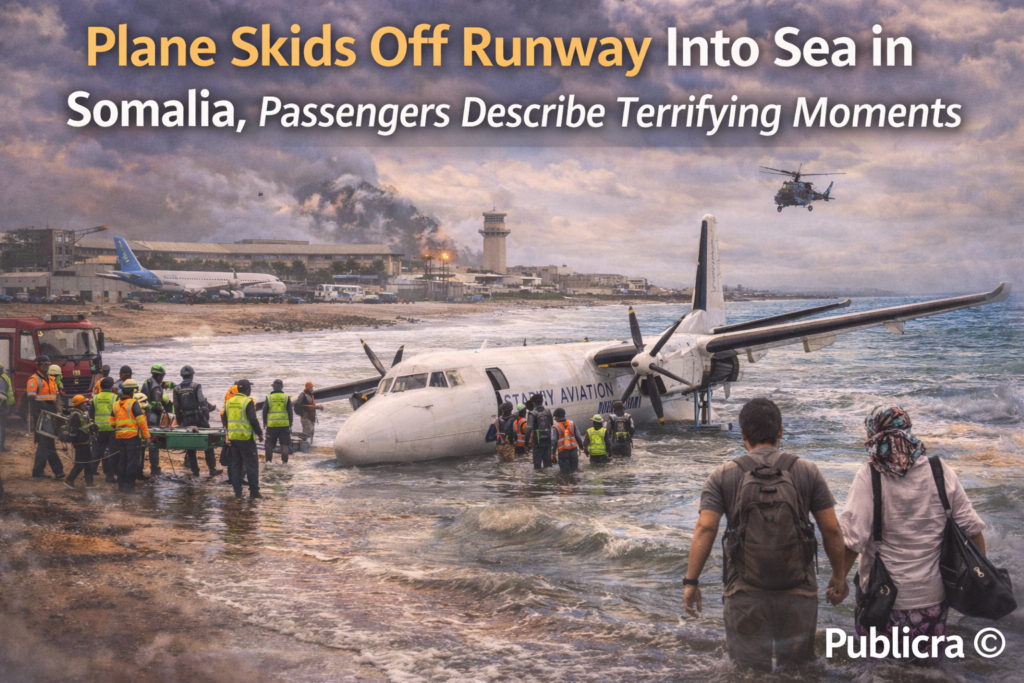
All 55 passengers survived after a turboprop aircraft overshot the runway and came to rest in shallow waters near Mogadishu’s main airport, raising new safety concerns.
Somalia Plane Crash Landing: What Happened in Mogadishu?
On February 10, 2026, a regional passenger aircraft operated by Starsky Aviation crash-landed near the shoreline of Mogadishu after suffering technical difficulties shortly after takeoff. The turboprop aircraft, a Fokker 50, had departed from Aden Adde International Airport when the flight crew identified a mechanical issue and attempted to return to the runway.
Instead of coming to a controlled stop, the aircraft skidded beyond the runway boundary, eventually halting in shallow seawater near the Indian Ocean coastline. Miraculously, all 55 passengers and crew members survived the incident, and no fatalities were reported.
This near-disaster has drawn international attention to Somalia’s aviation safety standards, emergency response systems, and infrastructure challenges—particularly in a country still recovering from decades of conflict and instability.
🧍 Passenger Accounts: Panic, Prayer, and Survival
Survivors described moments of fear and confusion as the aircraft lost braking control. One elderly passenger said that within minutes of takeoff, the pilot announced that the plane would return due to a technical defect. As the engines faltered and the plane touched down hard, many passengers reportedly began praying.
Witnesses described how the aircraft struck the runway but continued moving uncontrollably before veering toward the coast. When the plane finally stopped in knee-deep water, emergency exits were opened, and passengers were instructed to evacuate quickly.
Despite the chaos, the evacuation was orderly, and the crew is being widely praised for their calm and professionalism under pressure. Passengers later expressed gratitude that the incident did not escalate into a fatal disaster.
🧑✈️ Pilot Response and Emergency Procedures
Aviation experts say the outcome of the incident highlights the importance of pilot training and adherence to emergency protocols. The captain reportedly made quick decisions to abort the flight and guide the aircraft away from populated areas, minimizing the risk to people on the ground.
The crew’s clear instructions and swift evacuation procedures likely prevented injuries. Such professionalism underscores how human factors can make the difference between a near-miss and a tragedy in aviation emergencies.
🏥 Emergency Response: Medical Checks and Airport Safety
Following the crash landing, all passengers were taken to nearby medical facilities for precautionary evaluations. While no serious injuries were reported, authorities said medical checks were necessary due to the physical stress of the emergency landing.
Somalia’s Civil Aviation Authority launched an investigation to determine the precise cause of the mechanical failure. Initial reports suggest a braking or engine-related malfunction, though officials have not confirmed specific technical details.
The incident has renewed scrutiny on runway safety measures at Aden Adde International Airport, including runway length, braking systems, and the availability of runway overrun safety areas (RESAs), which are designed to reduce damage when aircraft overshoot runways.
🛫 Aviation Safety in Somalia: A System Under Pressure
Somalia’s aviation sector has faced unique challenges over the past three decades. Years of civil conflict severely damaged airport infrastructure, air traffic control systems, and regulatory oversight. Although international partners and the Somali government have invested in rebuilding efforts, many airports still operate under constrained conditions.
Key challenges include:
- Aging runway infrastructure
- Limited navigation and landing assistance systems
- Shortage of trained aviation maintenance personnel
- Heavy reliance on older aircraft models for regional flights
While Mogadishu’s main airport has seen improvements, the incident highlights that safety margins remain thin, especially during technical emergencies.
🌍 Regional Aviation and Safety Standards in East Africa
The crash landing also raises broader questions about aviation safety in East Africa, where regional carriers operate in difficult environments. Weather unpredictability, limited spare parts availability, and constrained maintenance budgets can all increase operational risks.
International aviation bodies such as the International Civil Aviation Organization (ICAO) have worked with African states to improve regulatory frameworks and safety oversight. However, implementation gaps remain, especially in countries emerging from conflict or economic hardship.
This incident may serve as a catalyst for renewed investment in:
- Runway safety systems
- Aircraft maintenance oversight
- Emergency response training for airport personnel
- Passenger safety awareness programs
🔧 Aircraft Maintenance and Aging Fleets: A Global Issue
The Fokker 50 involved in the incident is a turboprop aircraft model introduced in the late 1980s. While many older aircraft remain safe when properly maintained, aviation experts note that aging fleets require more intensive inspections and component replacements.
In developing markets, older planes are often used due to lower acquisition costs. However, this places additional pressure on maintenance teams and regulators to ensure airworthiness standards are rigorously upheld.
Globally, the aviation industry is grappling with supply chain challenges for spare parts, rising maintenance costs, and workforce shortages. These pressures can indirectly affect safety if not properly managed.
🛡️ Why Everyone Survived: Key Safety Factors
Several factors contributed to the absence of fatalities in this incident:
- The pilot’s quick decision-making
- The aircraft’s controlled trajectory away from dense urban areas
- The shallow water near the shoreline, which reduced impact forces
- The crew’s calm handling of passenger evacuation
- The relatively low speed at which the aircraft left the runway
Together, these elements turned a potentially catastrophic event into a survivable emergency.
🧭 What Happens Next: Investigation and Reforms
The Somali Civil Aviation Authority, along with aviation safety experts, is expected to conduct a full investigation into:
- The mechanical failure that triggered the aborted flight
- The performance of runway braking systems
- Emergency response timelines
- Aircraft maintenance records
Findings from the investigation could lead to:
- Updated safety protocols
- Enhanced inspections for regional aircraft
- Infrastructure upgrades at Mogadishu airport
- Training improvements for pilots and ground crews
🌐 Broader Implications for African Air Travel
Air travel in Africa is growing rapidly, driven by business travel, humanitarian operations, and regional connectivity. However, safety incidents—especially high-profile ones—can undermine public confidence.
This incident reinforces the importance of:
- Transparent safety reporting
- Continuous training for aviation personnel
- International cooperation to improve infrastructure
- Investment in modern aircraft fleets
Looking Ahead: Strengthening Safety in Fragile Airspaces
As Somalia continues rebuilding, aviation safety will remain a critical pillar of economic development, humanitarian access, and regional integration. The near-tragedy in Mogadishu is a reminder that progress in infrastructure and governance must go hand-in-hand with safety oversight.
For passengers, the event underscores the importance of trusting trained crews and following safety instructions during emergencies. For regulators and operators, it is a call to accelerate reforms and investments that can prevent future incidents.