
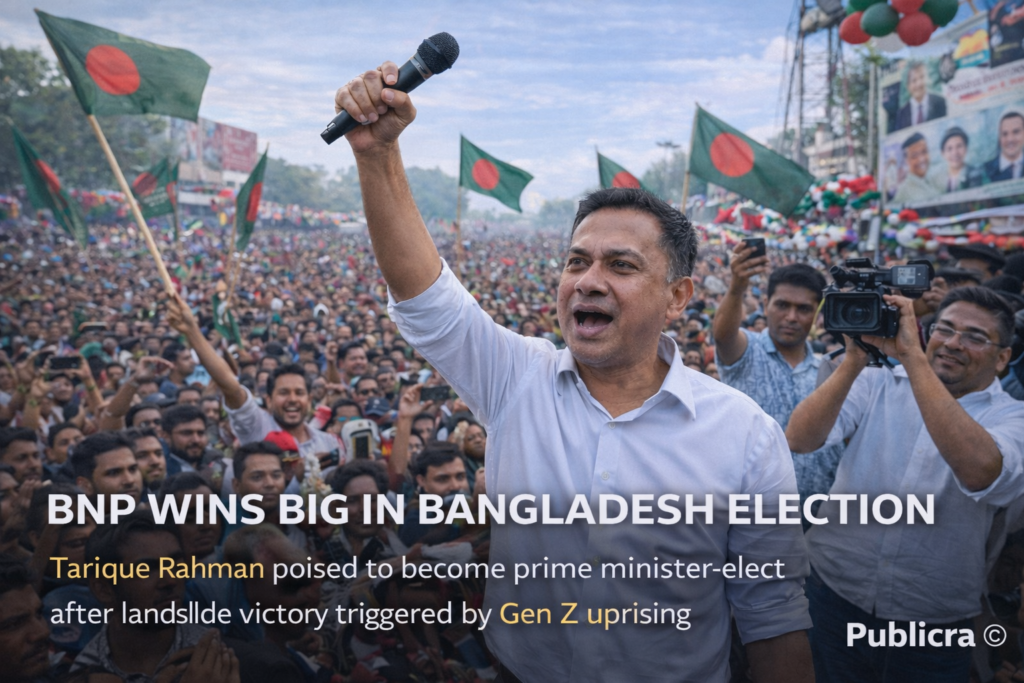
Historic vote ushers in a new government led by Tarique Rahman as voters demand democratic reform, economic recovery, and accountability after years of centralized rule.
Bangladesh has entered a decisive new political chapter. In the country’s first general election since the youth-led uprising that toppled a long-standing government, the Bangladesh Nationalist Party (BNP) secured a commanding parliamentary majority, winning more than two-thirds of seats. The historic vote has propelled BNP leader Tarique Rahman toward the prime ministership and raised expectations for sweeping democratic reforms, economic stabilization, and a reset of governance after years of centralized rule.
The election was notable not only for its scale and outcome but also for what it symbolized: a powerful electoral echo of the Gen Z movement that reshaped the political landscape. With the Awami League barred from contesting and Islamist and student-led parties emerging as significant players, voters delivered a mandate for change—yet one that comes with heavy responsibilities and real risks for the incoming government.
A Historic Vote After Youth-Led Upheaval
The 2024–25 Gen Z protests—sparked by frustrations over governance, accountability, jobs, and rising costs of living—mobilized millions of young Bangladeshis across cities and campuses. Their demands went beyond party politics, calling for institutional reforms, term limits, judicial independence, and credible elections. The subsequent transition created the conditions for a high-stakes general election that many citizens viewed as a referendum on the country’s democratic future.
Turnout, while not overwhelming, reflected meaningful engagement in a moment of national reset. For many first-time voters, the ballot box became the continuation of street-level activism—an attempt to translate protest energy into policy outcomes. The BNP’s landslide victory thus carries expectations not only of political change, but of tangible improvements in daily life.
The New Prime Minister-Designate: Opportunity and Scrutiny
Tarique Rahman’s rise to the cusp of executive power marks a dramatic reversal of fortune after years away from frontline politics. Returning to the country shortly before the vote, he campaigned on restoring democratic norms, strengthening institutions, and rebuilding public trust. His appeal blended continuity—drawing on BNP’s traditional base—with a promise of renewal aimed at younger voters who fueled the uprising.
Yet the scale of BNP’s victory intensifies scrutiny. With a large majority comes the capacity to legislate swiftly—but also the risk of repeating the concentration of power that many voters sought to dismantle. The new leadership faces an immediate credibility test: can it govern inclusively, protect dissent, and avoid the pitfalls of winner-take-all politics?
Parliament’s New Balance: Islamists and Student Parties Gain Ground
With the Awami League absent from the contest, the parliamentary field widened. Jamaat and allied Islamist parties emerged as the second-largest bloc, while the student-led National Citizen Party (NCP)—born out of protest networks—secured a foothold. This diversified chamber reflects a society in transition, where traditional party loyalties coexist with new political identities forged in activism.
The presence of youthful lawmakers introduces fresh energy and ideas, but also demands political maturity. Their role in shaping reform agendas—particularly around education, employment, digital rights, and anti-corruption measures—could determine whether the post-uprising momentum translates into lasting institutional change.
Democratic Reforms: From Promises to Practice
Voters backed a package of democratic reforms alongside the election, signaling appetite for structural change. The proposals circulating in political discourse include:
- Prime ministerial term limits to prevent prolonged concentration of power
- A directly elected upper house to deepen parliamentary checks and representation
- Stronger presidential oversight to balance executive authority
- Enhanced judicial independence to safeguard due process and civil liberties
Implementing such reforms requires constitutional amendments, political consensus, and a commitment to restraint by those in power. The BNP’s supermajority could accelerate reform—or, if misused, weaken the very checks the reforms seek to strengthen. Civil society groups and student leaders are expected to monitor implementation closely.
The Economy: Inflation, Jobs, and Cost of Living
Economic stabilization tops the new government’s agenda. Rising food prices, pressure on household incomes, and uneven job creation have strained public confidence. For a youthful population entering the workforce, the lack of stable employment is a defining concern.
Key economic priorities include:
- Inflation control: Stabilizing essential food prices through supply-chain reforms and targeted subsidies
- Job creation: Expanding manufacturing, green energy, and digital services to absorb young workers
- SME support: Improving access to credit for small businesses to stimulate local employment
- Investment climate: Ensuring regulatory predictability to attract domestic and foreign investment
Success will depend on fiscal discipline, transparency in procurement, and credible anti-corruption enforcement. The government’s early budget decisions will signal whether campaign rhetoric is translating into concrete relief for households.
Youth Expectations: From Protest to Policy
Gen Z voters are not a monolith, but they share common demands: accountability, opportunity, and voice. Many who mobilized in the streets now expect seats at policy tables—through consultative councils, youth employment programs, and digital platforms for civic feedback.
Areas where youth policy could deliver quick wins:
- Skills and apprenticeships aligned with market needs
- Affordable higher education and vocational pathways
- Start-up financing and digital infrastructure
- Civic tech platforms to monitor service delivery and report corruption
If young citizens feel sidelined after the election, disillusionment could resurface. Sustained engagement is essential to converting protest legitimacy into durable democratic participation.
Women in Parliament: Representation Remains a Challenge
Despite commitments to broaden representation, the number of women elected remains low. This gap underscores structural barriers—from party nominations to campaign financing and safety concerns—that limit women’s political participation. Expanding women’s representation is not only a matter of equity; it is central to effective governance in areas such as education, healthcare, labor rights, and social protection.
Potential measures include gender quotas in party lists, campaign finance support for women candidates, and stronger protections against harassment. Delivering on these commitments would align reform rhetoric with inclusive practice.
Governance and Accountability: Breaking with the Past
Public confidence in institutions hinges on transparent governance. The new administration inherits skepticism rooted in allegations of corruption and rights abuses during previous periods of BNP rule decades ago. To overcome this legacy, early signals matter:
- Independent anti-corruption bodies with prosecutorial authority
- Open data on public spending and procurement
- Freedom of the press and protections for whistleblowers
- Police and administrative reform to ensure due process
A credible reform agenda requires not only laws, but enforcement—and a willingness to allow oversight even when politically inconvenient.
Regional Diplomacy: Repairing Ties and Balancing Interests
Relations with neighboring India are a priority for the incoming government, particularly across trade, border management, energy cooperation, and migration. Stability in bilateral ties can support economic recovery and regional connectivity. At the same time, Bangladesh must navigate broader South Asian dynamics, balancing partnerships while safeguarding sovereignty and development goals.
Trade facilitation, infrastructure connectivity, and climate resilience projects present opportunities for pragmatic diplomacy that deliver tangible benefits at home.
Security, Pluralism, and Social Cohesion
The expanded role of Islamist parties in parliament raises questions about pluralism, minority rights, and the protection of secular civic space. The government’s approach to social cohesion will be closely watched—particularly how it ensures freedom of belief, protects minority communities, and maintains a neutral state framework that respects Bangladesh’s diverse social fabric.
Sustaining pluralism requires consistent enforcement of equal protection under the law and firm action against hate speech or political violence.
The Risk of Overreach—and the Promise of Renewal
A supermajority can be a double-edged sword. It enables swift reform but can also tempt leaders to sideline opposition and civil society. The durability of Bangladesh’s democratic reset depends on institutional restraint, robust debate, and respect for dissent. The incoming leadership’s tone—toward media, courts, and critics—will set the standard for the new era.
If the BNP delivers on reforms, stabilizes prices, and creates jobs, the election could mark the beginning of a more accountable political culture. If it consolidates power without checks, the cycle of centralization may repeat, eroding the very gains voters demanded.
What Comes Next: The First 100 Days
The government’s initial actions will define public confidence:
- Announce a reform timetable for constitutional and institutional changes
- Present a stabilization plan to curb inflation and protect food security
- Launch youth employment initiatives with clear funding and targets
- Strengthen oversight bodies and publish transparency commitments
- Engage opposition and civil society in consultative forums
Delivering visible progress within the first 100 days can anchor the transition and reassure a public hungry for results.
A Mandate for Change—with Accountability
Bangladesh’s election marks a pivotal moment in the country’s democratic journey. The BNP’s landslide victory, shaped by the energy of a Gen Z uprising, gives the incoming government both the authority and the obligation to reform institutions, revive the economy, and restore trust. The path ahead is complex: balancing swift action with checks and balances, honoring youth demands while governing inclusively, and rebuilding regional ties without compromising domestic priorities.
History will judge this transition not by the size of the victory, but by the quality of governance that follows. For millions who voted for change, the expectation is simple and profound: that this moment becomes the start of a more accountable, open, and opportunity-rich Bangladesh.