
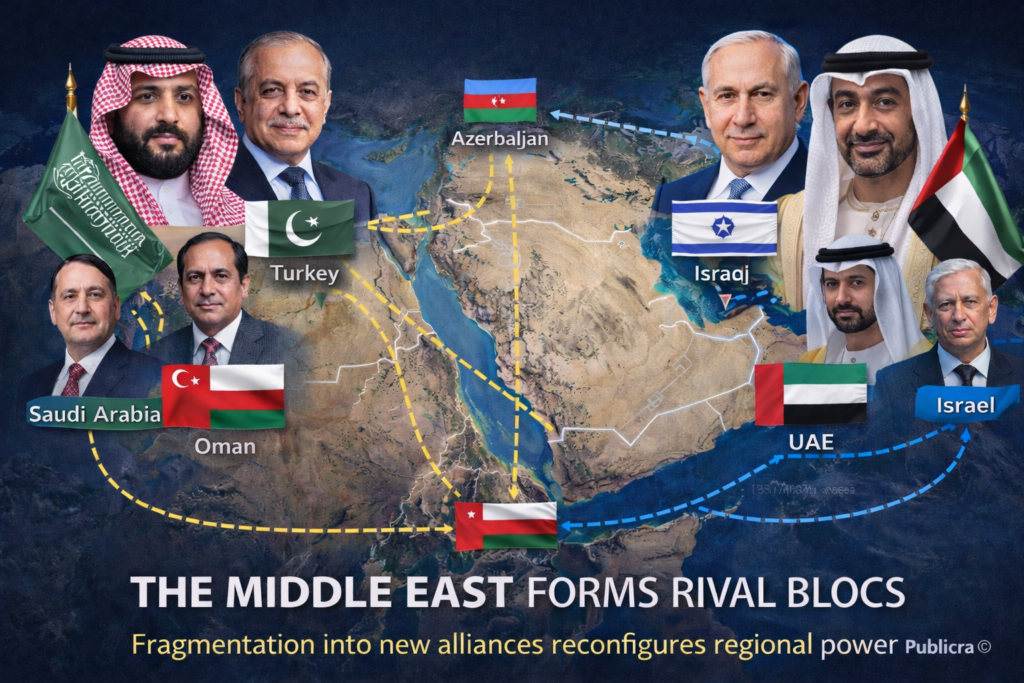
As old security guarantees fade, Middle Eastern states are forging new alliances, redrawing regional balances, and learning to manage power in a multipolar world.
The Middle East’s New Power Map: How Rival Blocs Are Reshaping the Region
The Middle East is entering a new geopolitical season. Long-standing security assumptions that once shaped the region’s strategic behavior are weakening, while new habits of power are emerging in real time. For decades, many regional states calibrated their security choices under the expectation that an external guarantor would act as the ultimate stabilizer. Today, that expectation is increasingly uncertain. In the space left behind, Middle Eastern countries are learning to act not merely as arenas of global competition, but as authors of their own regional order.
This transformation is neither smooth nor settled. The region is fragmenting into rival blocs—loose but increasingly structured alignments shaped by defense cooperation, energy routes, diplomatic initiatives, and shared threat perceptions. As these blocs take shape, the Middle East’s political geography is being redrawn, with consequences for conflict management, economic development, and the broader global balance of power.
The End of Automatic Security Guarantees
For much of the post–Cold War era, regional security thinking revolved around a familiar model: major powers would provide a protective umbrella, and Middle Eastern states would manage their risks within that framework. Even when relations with external guarantors were tense, the underlying assumption was that deterrence would hold and that escalation could be contained.
Recent years have eroded that confidence. A series of regional shocks, crises, and perceived hesitations by external actors have forced local governments to confront a sobering reality: security may no longer be reliably outsourced. This realization is driving a shift toward layered partnerships, regional defense arrangements, and greater emphasis on indigenous military-industrial capacity.
The result is a region that is no longer content to rely on inherited security architectures. Instead, states are assembling their own networks of deterrence, cooperation, and crisis management—sometimes overlapping, sometimes competing.
The Rise of Regional Blocs
Two broad security configurations are becoming visible across the Greater Middle East. They are not formal alliances in the traditional sense, but rather evolving networks of cooperation that reflect shared concerns and strategic calculations.
Bloc One: Sovereignty and Strategic Autonomy
One emerging alignment centers on states seeking greater strategic autonomy and reduced dependence on external security guarantees. This grouping is anchored by Saudi Arabia, Türkiye, Egypt, Pakistan, and Oman, with several other states watching closely or engaging selectively. The common thread is a desire to build regional capacity—through defense cooperation, joint exercises, intelligence sharing, and defense-industrial partnerships.
This bloc emphasizes sovereignty-driven security: the idea that regional stability should be managed primarily by regional actors. Defense co-production, shared training programs, and coordinated diplomatic initiatives are becoming tools to institutionalize this approach. The growing closeness among Saudi Arabia, Türkiye, and Egypt is particularly consequential, as it links three major political and military centers with influence across the Gulf, the Eastern Mediterranean, and North Africa.
Bloc Two: Technology-Centered Security Partnerships
A countervailing configuration is forming around Israel and the United Arab Emirates, whose relationship has deepened into robust defense-industrial and technology cooperation. This alignment prioritizes advanced systems—air defense, surveillance, cyber capabilities, and unmanned platforms—as a way to offset regional threats and uncertainties.
The logic of this bloc is capability-driven security. Rather than relying on mass or geography, it emphasizes technological edge and rapid integration of advanced systems. This model is attractive to states seeking to compress the time between threat detection and response, especially in a region where drones, missiles, and hybrid warfare tools are proliferating.
The Role of Connector States
Between these blocs are connector states that maintain ties across rival networks, complicating any simple map of alignment. Azerbaijan, for example, illustrates how energy routes, defense cooperation, and regional diplomacy intersect. With strong ties to Türkiye, deep security and energy links with Israel, and expanding cooperation with Gulf partners, Azerbaijan functions as a bridge between competing security ecosystems.
Such connector states add flexibility to the regional system but also introduce complexity. Their dual-track diplomacy can reduce polarization by maintaining channels across blocs, yet it can also amplify strategic ambiguity. In a region where signaling matters, the movements of connector states are closely watched by all sides.
Defense-Industrial Cooperation: The New Glue of Alliances
One of the most significant shifts in the Middle East’s security landscape is the move from arms purchasing to defense-industrial cooperation. Co-production agreements, joint research and development, and shared manufacturing facilities are becoming central to alliance-building. These arrangements do more than provide hardware; they embed relationships into domestic economies, labor markets, and technological ecosystems.
For governments pursuing economic diversification, defense-industrial partnerships serve dual purposes: strengthening security while supporting industrial policy and job creation. Over time, these ties create constituencies for sustained cooperation, making alliances more resilient to political changes.
This trend also reflects a broader global shift toward multipolarity in technology and defense. As access to advanced systems becomes more diversified, regional states have greater room to maneuver—and greater incentive to hedge their partnerships.
Diplomacy in a Multipolar Region
As military cooperation deepens, diplomatic formats are also evolving. Regional states are experimenting with new forums to manage tensions, prevent miscalculations, and explore confidence-building measures. These initiatives are driven by pragmatic recognition that rivalry without communication increases the risk of unintended escalation.
New diplomatic platforms often include actors from across competing blocs, reflecting a desire to keep channels open even as alignments solidify. The goal is not to erase rivalry but to manage it—to create off-ramps before crises harden into conflicts.
This shift marks a departure from the past, when regional diplomacy was often mediated or dominated by external powers. Today, there is growing appetite for region-led dialogue mechanisms that reflect local priorities and threat perceptions.
Flashpoints and Spillover Zones
The Middle East’s emerging blocs are not confined to traditional theaters of conflict. The Red Sea corridor, the Horn of Africa, and key maritime chokepoints have become integral to regional security thinking. Ports, islands, shipping lanes, and undersea cables connect regional security to global trade, making local disputes globally consequential.
Developments in these peripheral zones increasingly reverberate back into the core Middle Eastern security system. As energy routes and digital infrastructure become strategic assets, competition over access and influence in these areas is intensifying. This expands the geography of rivalry and raises the stakes of miscalculation.
The Iran Factor and Escalation Risks
No discussion of Middle Eastern security blocs can avoid the question of Iran. Competing threat perceptions vis-à-vis Iran are shaping alignments and driving military cooperation across the region. For some states, the primary concern is preventing regional escalation that could spiral into wider conflict. For others, the focus is on deterring perceived expansion of influence and maintaining a favorable balance of power.
The risk is that bloc formation hardens security dilemmas. Defensive measures by one side can be interpreted as offensive preparations by the other, triggering countermeasures and arms races. In such an environment, even localized incidents carry the potential for rapid escalation, particularly when domestic political pressures incentivize strong responses.
Economic Transformation Meets Strategic Uncertainty
The region’s security realignment is unfolding alongside ambitious economic transformation agendas. Gulf states, Türkiye, and Egypt are pursuing large-scale investments in tourism, industry, renewable energy, and infrastructure. These projects require stability, predictability, and investor confidence—conditions that persistent geopolitical turbulence can undermine.
This tension creates a paradox: states are arming and aligning to manage risk, yet excessive militarization and polarization threaten the very economic futures they seek to build. The challenge for policymakers is to strike a balance between deterrence and de-escalation, between strategic autonomy and cooperative security.
Risks of Bloc Politics
The formation of rival blocs carries inherent dangers:
- Security dilemmas: Defensive buildups can be misread as preparations for aggression.
- Alliance entrapment: Smaller states may be drawn into conflicts driven by larger partners.
- Escalation spirals: Exercises, deployments, and signaling can trigger counter-signals.
- Fragmented governance: Competing security architectures complicate crisis management and coordination.
History offers cautionary lessons about bloc politics. In the absence of effective deconfliction mechanisms, rival alignments can drift toward confrontation—even when none of the actors seek war.
Toward a Regional Security Architecture?
Despite these risks, the current moment also contains an opening. As regional states assume greater responsibility for their own security, the foundations of a more sustainable regional security architecture could gradually emerge. Such an architecture would not eliminate rivalry or ideological differences, but it could institutionalize mechanisms for crisis communication, maritime coordination, airspace deconfliction, and arms restraint.
Over time, competitive coexistence may replace zero-sum confrontation. Regional institutions—formal or informal—could evolve to manage disputes and reduce the likelihood that local crises escalate into systemic conflicts. The path to such an outcome will be uneven, marked by experimentation, setbacks, and hard bargaining. Yet the alternative—perpetual instability under conditions of weakening external guarantees—is increasingly untenable.
From Arena to Architect
The Middle East is no longer merely a stage on which global powers play out their rivalries. It is becoming a region that shapes its own strategic environment, even as it grapples with fragmentation into rival blocs. The fading of old security assurances has forced regional actors to innovate—building new partnerships, investing in indigenous capabilities, and experimenting with region-led diplomacy.
Whether this recomposition leads to a more stable multipolar equilibrium or to intensified rivalry will depend on the choices made in the coming years. If regional states succeed in balancing competition with cooperation, the Middle East could emerge as a co-designer of the new global order rather than a perpetual battlefield of its transitions.