
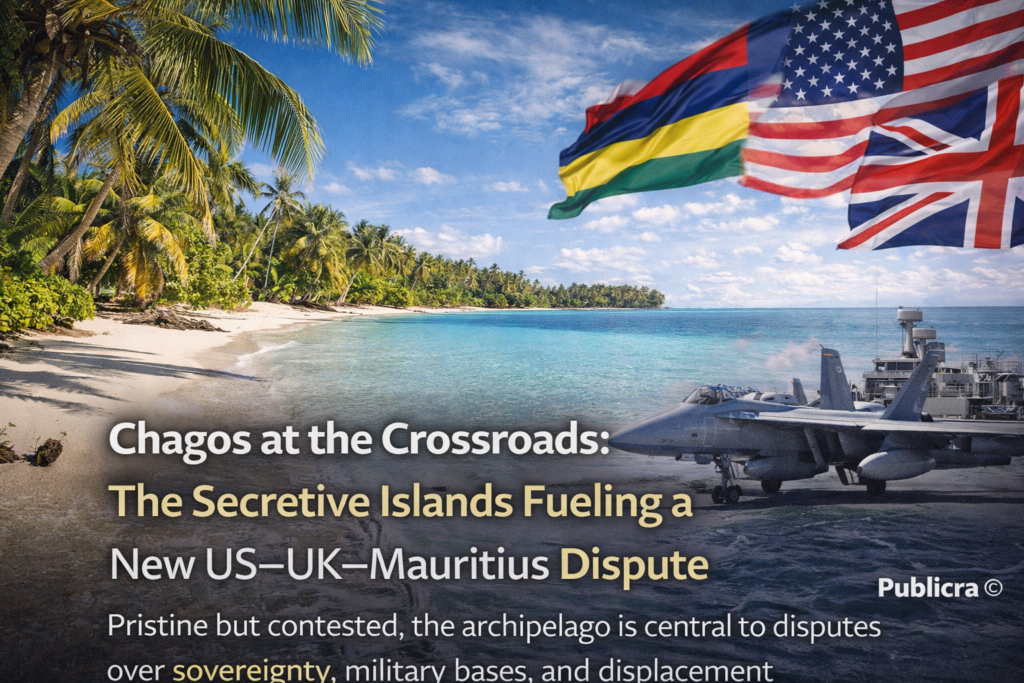
A pristine archipelago with a painful past becomes the center of renewed geopolitical tension over sovereignty, military basing, displaced communities, and climate risk.
Far from the world’s shipping lanes and tourist routes, the Chagos Archipelago lies scattered across a vast expanse of the Indian Ocean. To the casual observer, these palm-fringed atolls appear to be a tropical paradise: white sand beaches, luminous turquoise lagoons, and coral reefs among the most intact on the planet. Yet behind the postcard beauty lies one of the most contested and emotionally charged territorial disputes in modern geopolitics. The fate of Chagos has once again become the subject of intense debate among the United Kingdom, the United States, and Mauritius—reviving unresolved questions about colonial legacies, forced displacement, military power, and the rights of an exiled people.
As diplomatic negotiations stall and resumes are announced behind closed doors, the future of these islands remains uncertain. The decisions being taken today will shape not only strategic arrangements in the Indian Ocean but also the lives of thousands of Chagossians who were forcibly removed from their homeland decades ago. Chagos has become a symbol of how remote places can carry enormous geopolitical weight—and how history continues to cast long shadows over contemporary policy.
A Remote Archipelago with Global Significance
The Chagos Archipelago comprises seven atolls and dozens of low-lying islands scattered across thousands of square kilometers of ocean. Its geographic isolation has preserved ecosystems that are increasingly rare elsewhere in the tropics. Coral reefs teem with life, seabird colonies remain among the largest in the region, and the surrounding waters support migratory species crucial to Indian Ocean biodiversity.
This remoteness, however, also made Chagos attractive for strategic military purposes. Its location places it within operational reach of the Middle East, South Asia, and East Africa. In an era when global powers seek forward-operating bases to project influence and secure sea lanes, Chagos occupies a uniquely valuable position. The archipelago’s largest island, Diego Garcia, hosts a highly sensitive military facility that has become central to security planning in the broader Indo-Pacific region.
Thus, Chagos is simultaneously a natural sanctuary and a linchpin of modern military logistics—a paradox that lies at the heart of today’s disputes.
Colonial Legacies and the Question of Sovereignty
Chagos’ modern political status is rooted in colonial-era decisions that continue to reverberate. In the mid-20th century, as decolonization reshaped the global order, administrative boundaries drawn by colonial powers hardened into international borders. Chagos was separated from Mauritius prior to Mauritian independence, creating a distinct overseas territory administered by the UK.
Mauritius has long contested this separation, arguing that it was coerced and inconsistent with principles of self-determination. From Mauritius’ perspective, Chagos is an integral part of its territorial integrity. For the UK, the arrangement has been framed as a lawful administrative decision taken during a transitional period. The disagreement has become emblematic of how colonial-era maneuvers continue to shape sovereignty disputes long after empires formally receded.
Recent diplomatic efforts to resolve the issue through negotiated transfer arrangements have exposed fault lines not only between London and Port Louis, but also with Washington, which views Diego Garcia as strategically indispensable. The resulting impasse underscores how sovereignty disputes are rarely bilateral when major military interests are at stake.
The Forced Displacement of the Chagossians
Perhaps the most painful chapter in Chagos’ history is the forced removal of its Indigenous inhabitants. Over the course of the late 1960s and early 1970s, the resident population was relocated to make way for military infrastructure. Families who had lived on the islands for generations were uprooted and transported to unfamiliar shores, often with little support, documentation, or compensation.
The social consequences were severe. Displaced communities faced poverty, marginalization, and cultural erosion in their new environments. Many Chagossians struggled to maintain their language, traditions, and communal bonds. Elders who had known no other home spent their final years in exile, unable to return to ancestral lands.
Decades later, calls for justice and resettlement remain central to Chagossian advocacy. While some policy proposals envision limited returns to outer islands, restrictions on access to Diego Garcia and uncertainties about sovereignty have left many displaced people feeling excluded from decisions that determine their own future.
Diego Garcia: Security, Strategy, and Secrecy
Diego Garcia’s strategic value has only grown over time. The base supports a range of military operations, logistical coordination, and surveillance activities across multiple theaters. For U.S. planners, the island offers a secure platform far from mainland vulnerabilities. For the UK, it represents a continuing security partnership and a legacy of its global military footprint.
However, the presence of a large military facility within a disputed territory complicates diplomatic solutions. Any change in sovereignty arrangements must reconcile Mauritian claims, British administrative roles, U.S. security requirements, and Chagossian rights. This web of interests makes straightforward resolutions elusive.
Critics argue that strategic imperatives have repeatedly overridden humanitarian concerns. Supporters of the base counter that regional stability and international security justify its continued operation. The tension between these positions reflects a broader dilemma in global politics: how to balance security infrastructure with historical justice.
Environmental Protection and the Marine Reserve Debate
In the early 21st century, much of the Chagos Archipelago was designated as a large marine protected area. Conservationists hailed the move as a landmark step in ocean protection, creating one of the world’s largest no-take marine reserves. The absence of permanent human settlement allowed ecosystems to recover, turning Chagos into a living laboratory for reef resilience and marine biodiversity.
Yet environmental protection has also become entangled with politics. Some Chagossians view conservation measures with ambivalence, fearing that environmental restrictions could be used to limit resettlement and maintain exclusion. Others see potential for sustainable livelihoods through eco-tourism and artisanal fisheries, provided governance structures include displaced communities as stakeholders rather than obstacles.
As climate change accelerates, the ecological stakes are rising. Coral bleaching events, rising sea levels, and increasing storm intensity threaten the very ecosystems the marine reserve was designed to protect. Any future governance arrangement must therefore integrate conservation with social justice and climate adaptation.
Climate Change: A Low-Lying Future at Risk
Chagos’ low elevation makes it acutely vulnerable to sea-level rise. Like many Indian Ocean islands, even modest increases in ocean levels threaten freshwater lenses, coastal vegetation, and infrastructure. For policymakers, this raises difficult questions: what does resettlement mean in a place that may face existential climate risks within decades?
Climate change complicates sovereignty debates by introducing long-term uncertainty. Investments in resettlement, conservation, or infrastructure must contend with the possibility that some islands may become uninhabitable over time. This reality underscores the need for forward-looking planning that accounts not only for political resolution but also for environmental resilience.
For displaced Chagossians, climate vulnerability adds another layer of injustice. The prospect of returning to a homeland threatened by rising seas highlights the compounded costs of delayed justice—where environmental risks intersect with historical displacement.
Diplomacy Behind Closed Doors
Recent negotiations over Chagos have reignited criticism about transparency. Chagossian representatives have repeatedly expressed concern that decisions are being made without meaningful consultation. The perception that outcomes are negotiated among governments, with affected communities relegated to observers, echoes past grievances and deepens mistrust.
Diplomatic processes that exclude stakeholders risk undermining legitimacy. Sustainable solutions require inclusive dialogue that recognizes Chagossians not merely as historical footnotes, but as rights-bearing communities with a stake in the islands’ future. Without such inclusion, any agreement—however legally sound—may struggle to achieve moral and social acceptance.
Regional Geopolitics and the Indian Ocean Theatre
Chagos sits within a broader context of intensifying competition in the Indian Ocean. As global powers recalibrate their strategies toward the Indo-Pacific, islands, ports, and sea lanes have taken on renewed importance. The archipelago’s strategic value thus intersects with larger patterns of naval deployment, logistics, and alliance-building.
This regional competition complicates sovereignty arrangements. Decisions about Chagos reverberate across diplomatic relationships, defense planning, and regional security perceptions. For smaller states, the outcome signals how their interests may be treated when they intersect with great-power priorities.
Paths Forward: Justice, Security, and Sustainability
What might a sustainable future for Chagos look like? Any durable solution must reconcile four imperatives:
- Sovereignty and Legal Resolution: Addressing the historical dispute in a way that respects international norms and decolonization principles.
- Human Rights and Resettlement: Ensuring displaced Chagossians have a meaningful voice and tangible options for return or restitution.
- Security Arrangements: Accommodating legitimate defense needs without perpetuating exclusion or injustice.
- Environmental Stewardship: Protecting fragile ecosystems while enabling sustainable, community-led livelihoods.
Achieving balance among these goals requires political courage, creative diplomacy, and a commitment to inclusive governance. The complexity of Chagos is not an excuse for inaction; it is a reason for more thoughtful engagement.
A Paradise Shaped by Power
The Chagos Archipelago embodies the contradictions of the modern world: breathtaking natural beauty entwined with geopolitical rivalry, environmental preservation shadowed by historical injustice, and strategic utility colliding with human rights. As the US–UK–Mauritius dispute resurfaces, the islands remind us that even the most remote places are not beyond the reach of global power politics.
Whether Chagos becomes a model for reconciled sovereignty and inclusive conservation—or remains a symbol of unresolved colonial legacies—will depend on choices made now. The voices of those once removed from these shores must be central to the conversation. Only then can this paradisiacal archipelago move from being a site of contestation to a shared vision of justice, security, and sustainability.