
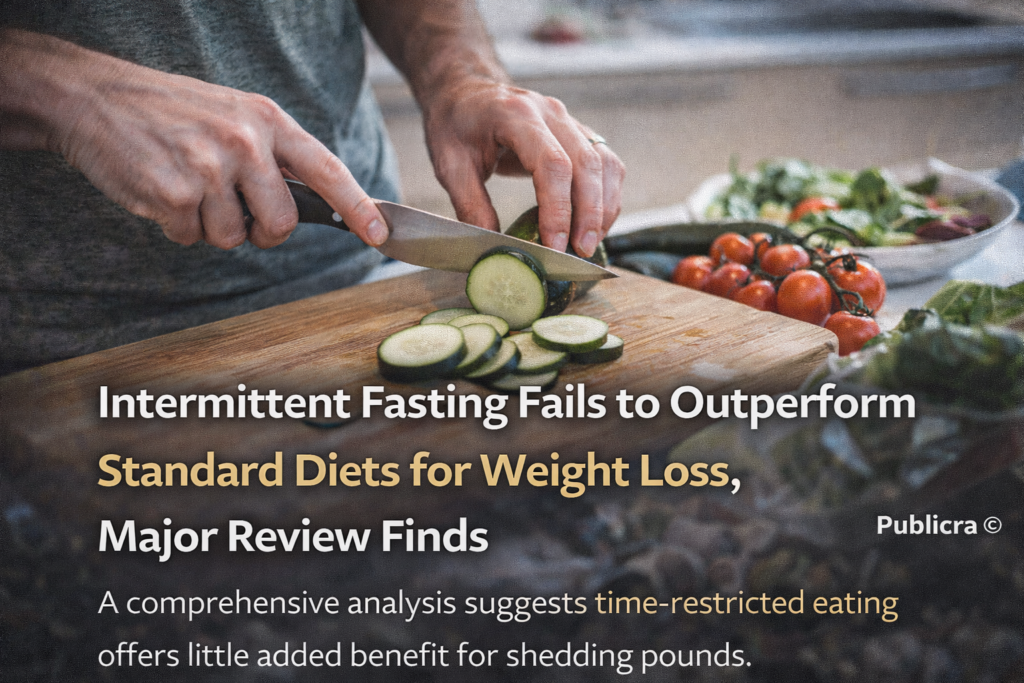
A comprehensive analysis suggests time-restricted eating offers little added benefit for shedding pounds, raising questions about social media hype and long-term health claims.
Intermittent fasting has surged in popularity over the past decade, promoted across social media platforms, wellness blogs, and fitness communities as a powerful shortcut to weight loss and metabolic health. But a large scientific review now suggests that the practice may offer little to no additional benefit for weight loss compared with traditional calorie-controlled diets. The findings challenge the narrative that time-restricted eating delivers superior results and underscore the importance of sustainable, evidence-based approaches to managing weight.
The review analyzed results from multiple controlled studies involving adults who were overweight or obese, comparing intermittent fasting approaches with conventional dietary advice or minimal intervention. While some participants did lose weight, the overall outcomes did not significantly exceed those achieved through standard calorie reduction and healthier eating patterns. Experts say the results highlight a recurring theme in nutrition science: there are no shortcuts to lasting weight loss.
What the Review Examined and Why It Matters
The research synthesized evidence from more than 20 clinical studies conducted across several regions, encompassing nearly 2,000 adults. Participants followed various intermittent fasting protocols over periods ranging from a few months up to a year. The review assessed changes in body weight, quality of life, and selected health indicators.
The significance of this analysis lies in its scope. Rather than focusing on a single fasting method, it evaluated multiple formats of intermittent fasting against established dietary guidance. This broader lens provides a more realistic picture of how fasting performs in real-world settings. The conclusion—that intermittent fasting does not significantly outperform standard dieting for weight loss—challenges claims that fasting uniquely “resets” metabolism or unlocks special fat-burning pathways.
What Is Intermittent Fasting and Why It Became Popular
Intermittent fasting refers to eating patterns that alternate between periods of eating and fasting. Common approaches include:
- Time-restricted eating: Limiting daily food intake to a specific window, such as eight hours.
- 5:2 pattern: Eating normally on five days per week and substantially reducing intake on two non-consecutive days.
- Alternate-day fasting: Alternating between days of normal eating and days of very low calorie intake.
The appeal of intermittent fasting is partly psychological. Many people find it easier to follow time-based rules than to count calories meticulously. The simplicity of “when” to eat rather than “what” to eat resonates in a culture overwhelmed by dietary complexity. Influencers and wellness advocates have amplified claims that fasting improves metabolism, insulin sensitivity, and longevity—claims that are not uniformly supported by robust human evidence.
Weight Loss Outcomes Compared With Traditional Dieting
When comparing intermittent fasting with conventional calorie-controlled diets, the review found little difference in average weight loss outcomes. Participants in both groups achieved modest reductions in body weight, but fasting did not confer a statistically significant advantage.
This finding aligns with a central principle of weight management: calorie balance matters more than timing alone. While meal timing can influence appetite and adherence for some individuals, total energy intake remains the dominant factor driving weight change. If intermittent fasting leads to reduced calorie intake, weight loss may occur—but similar results can be achieved through consistent calorie reduction without fasting windows.
Quality of Life and Adherence Challenges
Beyond weight loss, quality of life and adherence are critical measures of any dietary approach’s sustainability. The review found that intermittent fasting did not consistently improve quality of life compared with standard dietary advice. Some participants reported benefits such as simplicity and reduced decision fatigue, while others experienced hunger, irritability, or difficulty maintaining social eating patterns.
Adherence is a major challenge in nutrition interventions. Diets that are difficult to sustain often fail over the long term, regardless of short-term efficacy. Intermittent fasting may suit some lifestyles but conflict with others, particularly those with irregular schedules, family obligations, or cultural eating practices. Sustainable weight management depends on finding patterns that fit an individual’s daily reality.
Metabolic Health: Potential Benefits Beyond Weight Loss
While the review found limited added benefit for weight loss, intermittent fasting may influence metabolic markers in some individuals. Preliminary research suggests potential improvements in insulin sensitivity, lipid profiles, and inflammatory markers—though findings are inconsistent and often derived from small or short-term studies.
These metabolic effects may be more pronounced in certain populations, such as individuals with insulin resistance or early-stage metabolic dysfunction. However, experts caution that such benefits are not guaranteed and that similar improvements can be achieved through balanced diets, regular physical activity, adequate sleep, and stress management.
Social Media Hype Versus Scientific Evidence
The popularity of intermittent fasting has been fueled by compelling narratives on social media—before-and-after photos, testimonials, and claims of rapid transformation. This creates a perception that fasting is a superior method for weight loss. The review’s findings highlight a persistent disconnect between public perception and scientific evidence.
Nutrition trends often surge ahead of research, driven by anecdote and marketing rather than rigorous trials. While individual success stories are valid, they do not establish population-level effectiveness. Evidence-based guidance emphasizes that no single diet works for everyone and that personalization is key.
Weight Loss Injections and the Changing Landscape of Obesity Treatment
The broader context of weight management has evolved with the rise of prescription weight loss injections. These medications can produce significant short-term weight reduction, but evidence suggests that discontinuation often leads to rapid weight regain. This reality reinforces the importance of sustainable lifestyle changes alongside any pharmacological support.
Intermittent fasting has been proposed by some as a non-pharmaceutical alternative or complement to medications. However, the review suggests that fasting alone does not outperform standard approaches. Integrating dietary changes with behavioral support, physical activity, and medical guidance remains the cornerstone of effective obesity management.
Individual Differences: One Size Does Not Fit All
The review underscores that responses to dietary interventions vary widely. Factors such as baseline metabolic health, work schedules, cultural habits, psychological relationship with food, and social support influence outcomes. For some individuals, intermittent fasting may be a helpful structure that simplifies eating patterns. For others, it may increase stress or disordered eating tendencies.
Clinicians emphasize a case-by-case approach, tailoring recommendations to individual preferences, health conditions, and life circumstances. The goal is not to prescribe a single “best” diet, but to identify patterns that are safe, effective, and sustainable for each person.
Implications for Public Health and Policy
From a public health perspective, the findings caution against promoting intermittent fasting as a superior or universal solution for weight loss. Messaging that oversimplifies complex behaviors risks disappointment and disengagement when expected results do not materialize. Public health strategies benefit from emphasizing foundational habits: balanced nutrition, portion control, regular physical activity, adequate sleep, and supportive environments.
Policies that improve access to healthy foods, create opportunities for physical activity, and address socioeconomic barriers are likely to yield broader population-level benefits than promoting any single dietary trend.
Practical Guidance for Those Considering Intermittent Fasting
For individuals curious about intermittent fasting, experts recommend approaching it as one of several possible tools rather than a guaranteed solution. Practical considerations include:
- Start with sustainability: Choose patterns that fit daily routines and social life.
- Focus on food quality: Eating windows should emphasize nutrient-dense foods, not just calorie restriction.
- Monitor health markers: People with diabetes, eating disorders, or other medical conditions should consult healthcare providers before fasting.
- Avoid extremes: Severe restriction can backfire, leading to overeating or metabolic stress.
Ultimately, consistency matters more than novelty. Habits that can be maintained over months and years are more likely to produce lasting results.
The Future of Fasting Research
The review highlights gaps in current evidence, including limited long-term data and variability in study quality. Future research should examine:
- Long-term outcomes beyond one year
- Effects on specific populations, including different age groups and metabolic profiles
- Psychological impacts and adherence patterns
- Comparative effectiveness against diverse dietary strategies
As research evolves, a more nuanced understanding of when and for whom intermittent fasting may be beneficial is likely to emerge.
Evidence Over Enthusiasm
Intermittent fasting remains an appealing concept in a culture seeking efficient solutions to complex health challenges. However, the latest comprehensive evidence suggests it does not outperform traditional dietary approaches for weight loss. The takeaway is not that fasting is ineffective, but that it is not a magic bullet.
Sustainable weight management is built on consistent, evidence-based habits rather than trend-driven shortcuts. As public interest continues to shift among dietary fads, grounding choices in robust research offers the best chance for long-term health and wellbeing.