
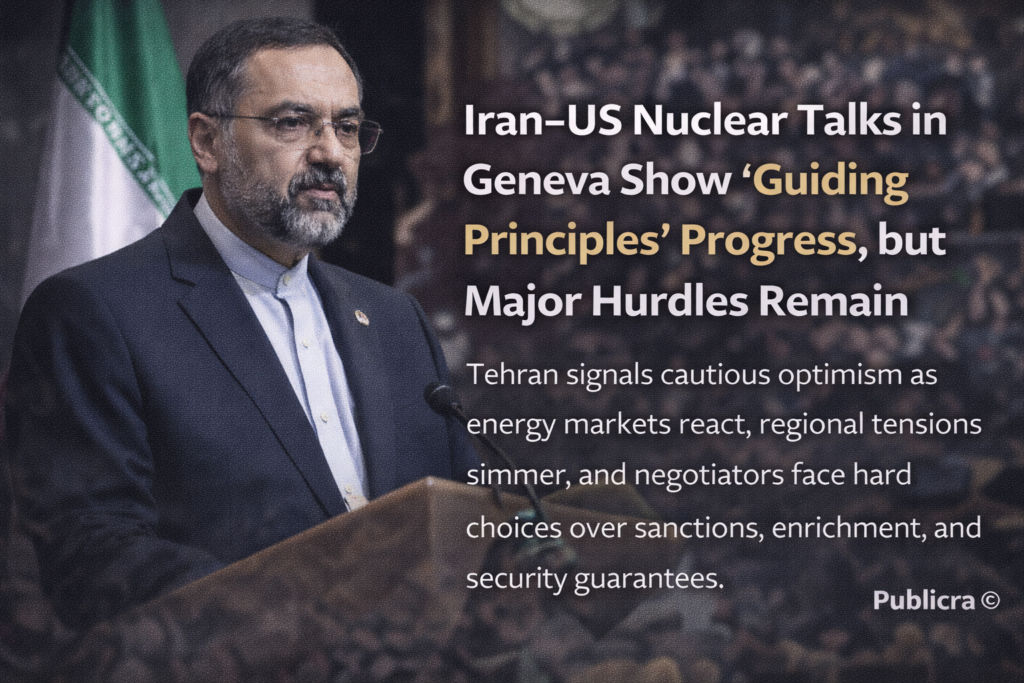
Tehran signals cautious optimism as energy markets react, regional tensions simmer, and negotiators face hard choices over sanctions, enrichment, and security guarantees.
Fresh diplomatic engagement between Iran and the United States in Geneva has produced what Iranian officials describe as agreement on broad “guiding principles” for future negotiations over Tehran’s nuclear programme. While the announcement triggered a cautious easing of market anxiety and tempered fears of imminent conflict, both sides have been careful to emphasize that progress does not equate to a finalized deal. The talks, mediated by regional intermediaries, highlight a complex diplomatic landscape in which nuclear constraints, sanctions relief, regional security, and domestic political pressures intersect.
The resumption of talks comes against a backdrop of heightened military posture in the region, economic strain within Iran, and growing international concern over nuclear proliferation risks. The challenge for negotiators is to convert broad principles into enforceable commitments without triggering escalation or undermining domestic support at home.
The Diplomatic Context Behind the Geneva Talks
The Geneva discussions represent the latest attempt to stabilize a volatile relationship defined by cycles of negotiation and confrontation. After years of stalled diplomacy and episodes of military brinkmanship, both capitals face incentives to de-escalate. For Washington, preventing further nuclear advancement and avoiding a regional conflict are strategic priorities. For Tehran, sanctions relief and economic stabilization are increasingly urgent amid inflationary pressures and constrained export revenues.
The talks were conducted indirectly through mediators, reflecting the political sensitivity of direct engagement. This format allows both sides to test the waters without overcommitting publicly, preserving flexibility in domestic narratives. However, indirect diplomacy can slow progress and complicate verification of intentions, placing a premium on clear communication through intermediaries.
What ‘Guiding Principles’ Actually Mean
Agreement on guiding principles signals convergence on broad objectives rather than specific policy instruments. These principles reportedly include commitments to continued dialogue, recognition of mutual security concerns, and a framework for sequencing concessions. Such understandings are necessary precursors to detailed negotiations on enrichment levels, inspection regimes, and sanctions relief.
Yet guiding principles are inherently fragile. Without concrete timelines and enforcement mechanisms, they risk becoming placeholders rather than pathways to resolution. The durability of these principles will depend on whether both sides can translate them into verifiable steps that build confidence over time.
Sanctions Relief Versus Nuclear Constraints
At the heart of the negotiations lies a familiar trade-off: limits on Iran’s nuclear activities in exchange for relief from economic sanctions. Iran seeks tangible economic gains, arguing that previous agreements failed to deliver durable benefits. The United States, meanwhile, faces domestic pressure to ensure that any sanctions easing is matched by meaningful, verifiable nuclear constraints.
This bargaining dynamic is complicated by trust deficits. Iranian officials point to past reversals of sanctions relief as evidence that guarantees are needed to ensure durability. US policymakers emphasize the need for compliance mechanisms that prevent rapid nuclear breakout. Bridging this gap requires creative sequencing—incremental relief tied to phased compliance—alongside credible assurances on both sides.
Uranium Enrichment: The Core Dispute
Uranium enrichment remains the most contentious issue. Iran insists on retaining the right to enrich uranium for civilian purposes, framing this as a sovereign entitlement under international norms. The United States and its partners worry that enrichment capacity shortens the pathway to weaponization, even if Tehran denies any intent to develop nuclear arms.
Negotiators face the challenge of defining acceptable enrichment thresholds, stockpile limits, and monitoring arrangements that balance these concerns. Technical compromises—such as dilution of higher-enriched material or caps on centrifuge deployment—could provide interim solutions. However, political acceptance of such measures hinges on whether they are perceived as fair and reciprocal.
Regional Security and the Strait of Hormuz Factor
Security dynamics in the Gulf add another layer of complexity. Temporary restrictions and military drills in strategic waterways highlight how regional tensions can ripple into global energy markets. The Strait of Hormuz, through which a significant share of global oil flows, remains a geopolitical chokepoint. Any perceived threat to its stability can trigger market volatility and international pressure for de-escalation.
For negotiators, regional security concerns are both a bargaining chip and a risk factor. Demonstrating restraint in maritime domains can build goodwill, while escalatory signaling may undermine diplomatic momentum. The linkage between nuclear talks and broader regional stability underscores the need for parallel confidence-building measures beyond the nuclear file.
Energy Markets and Economic Signaling
Market reactions to diplomatic signals illustrate the interconnectedness of geopolitics and global energy economics. Even tentative progress can ease risk premiums, while setbacks amplify volatility. For energy-importing nations, stability in the Gulf is a strategic priority; for energy producers, sanctions relief could reshape export dynamics and revenue flows.
Iran’s economy stands to benefit significantly from any easing of restrictions on energy exports and investment. However, translating diplomatic progress into economic recovery will require sustained compliance and international confidence. Investors and trading partners will watch closely for signs that any agreement is durable rather than provisional.
Domestic Politics and Negotiating Space
Both Tehran and Washington navigate domestic political constraints that shape their negotiating positions. In Iran, economic hardship and public discontent heighten the urgency of sanctions relief, but leadership must also demonstrate resilience against perceived external pressure. In the United States, electoral cycles and partisan divisions influence the appetite for compromise, with skepticism toward deals that appear to concede too much.
These domestic pressures can narrow negotiating space. Leaders must frame concessions as victories for national interest, not capitulation. Successful diplomacy often depends as much on domestic narrative management as on technical policy design.
The Role of Mediators and Multilateral Norms
Regional mediators play a crucial role in sustaining dialogue. Their involvement provides face-saving channels and helps align regional stakeholders with de-escalation goals. At the same time, multilateral norms—particularly those associated with nuclear non-proliferation—remain central reference points. Compliance with international monitoring regimes can enhance credibility and provide reassurance to skeptical partners.
The challenge is to integrate bilateral concessions within a multilateral framework that preserves broader non-proliferation norms. Any agreement perceived as weakening these norms risks triggering wider proliferation pressures.
Risks of Escalation and the Military Backdrop
Despite diplomatic engagement, military posturing continues to cast a long shadow over the talks. The presence of significant military assets in the region underscores the stakes of failure. While deterrence may prevent rash actions, it also heightens the risk of miscalculation. Incidents at sea, airspace violations, or proxy conflicts could derail diplomacy if not managed carefully.
De-escalation mechanisms—hotlines, maritime protocols, and crisis communication channels—are essential complements to nuclear talks. Building parallel safeguards can help ensure that tactical incidents do not spiral into strategic crises.
What Success Would Look Like
A sustainable outcome would likely involve phased nuclear constraints, calibrated sanctions relief, robust verification, and parallel confidence-building measures in regional security domains. Success would not be a single signing ceremony but a process of incremental implementation, monitored compliance, and adaptive diplomacy.
Equally important is the creation of mechanisms to manage disputes and address non-compliance without reverting to escalation. Dispute resolution frameworks and graduated response options can help preserve agreements under stress.
What Failure Would Mean for the Region
Failure of the talks would exacerbate regional instability, elevate proliferation risks, and increase the likelihood of military confrontation. The consequences would extend beyond bilateral relations, affecting energy markets, regional security architectures, and global non-proliferation efforts. For populations across the region, renewed conflict would compound humanitarian and economic pressures.
The stakes of diplomacy thus extend far beyond the negotiating table. The choices made in Geneva reverberate through regional alliances, global markets, and the credibility of international norms.
Cautious Optimism Amid Structural Challenges
The Geneva talks mark a tentative step toward stabilizing one of the most consequential diplomatic standoffs in the Middle East. Agreement on guiding principles is a necessary but insufficient foundation for a durable settlement. Transforming principles into practice will require political courage, technical rigor, and sustained engagement across multiple domains.
As negotiators prepare for next steps, the path forward remains narrow but navigable. The window for diplomacy is open, but it is framed by structural challenges that demand patience and pragmatism. Whether this moment becomes a turning point or another chapter in a cycle of engagement and rupture will depend on the willingness of both sides to align immediate interests with long-term stability.