
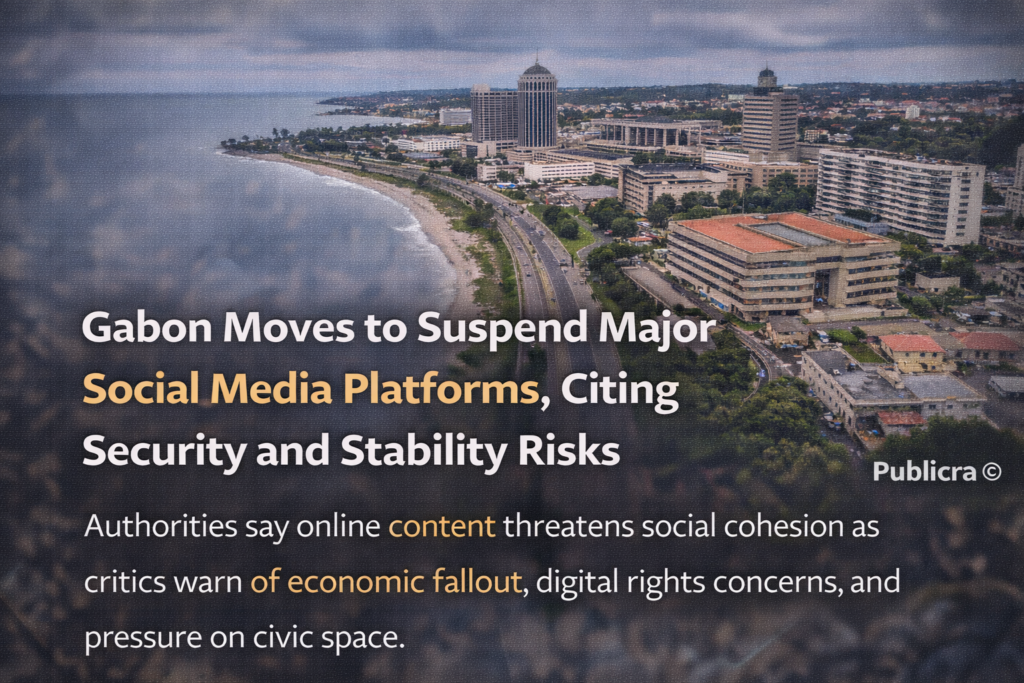
Authorities say online content threatens social cohesion as critics warn of economic fallout, digital rights concerns, and pressure on civic space.
Gabon’s media regulator has ordered the suspension of several major social media platforms, citing concerns that online content could undermine social cohesion and threaten the stability of national institutions. The decision, announced without a clear end date, has sparked an immediate debate over digital rights, economic impact, and the shrinking civic space in the Central African nation as it navigates a fragile post-coup political transition.
Authorities argue that the move is necessary to curb the spread of content deemed defamatory, hateful, or destabilizing. Civil society groups and business leaders counter that social networks have become essential tools for communication, commerce, and citizen engagement, and that broad restrictions risk deepening economic hardship and eroding trust in public institutions.
The Regulatory Decision and Its Immediate Impact
The High Authority for Communication ordered the suspension “until further notice,” signaling an open-ended approach that leaves businesses and users uncertain about the duration and scope of the restrictions. While officials have not publicly listed all affected platforms, monitoring groups reported disruptions to several widely used services. The lack of specificity has compounded confusion among citizens, small businesses, and media outlets that rely on social networks for outreach and revenue.
In urban centers, entrepreneurs who depend on digital platforms for sales and marketing reported an immediate drop in customer engagement. Informal traders, content creators, and gig workers—already vulnerable to economic shocks—face sudden barriers to reaching clients. For many Gabonese, social media is not merely a communication tool but a critical economic lifeline.
Security, Stability, and the Government’s Rationale
Government authorities framed the suspension as a protective measure aimed at preventing content that could incite unrest, spread misinformation, or inflame social divisions. In a country still consolidating political authority after a coup that ended decades of dynastic rule, concerns about public order carry particular weight. Officials argue that unchecked digital narratives can escalate tensions quickly, especially in contexts of economic strain and political uncertainty.
The challenge lies in balancing legitimate security concerns with proportional regulation. Blanket suspensions risk conflating harmful content with lawful expression, undermining the credibility of regulatory institutions. Without transparent criteria and due process, measures intended to protect stability may instead fuel perceptions of censorship.
Civil Society Concerns and the Shrinking Civic Space
Civil society leaders warn that the suspension risks narrowing an already constrained civic space. Social media platforms have become key channels for citizen expression, accountability advocacy, and community organizing. Curtailing access limits the ability of citizens to share information, mobilize support, and engage in public discourse.
In recent years, digital platforms have played a growing role in monitoring governance, exposing corruption, and coordinating humanitarian responses. Restrictions on these channels may weaken societal resilience by reducing the flow of information at a time when trust in institutions remains fragile. Critics argue that durable stability is better served by inclusive dialogue and transparent governance than by restricting communication.
Economic Consequences in a Fragile Economy
Gabon’s economy faces significant challenges, including high unemployment, reliance on food imports, and fiscal pressures linked to debt and liquidity constraints. Digital platforms have emerged as low-cost tools for entrepreneurship, enabling small businesses to reach customers without heavy infrastructure investment. Suspending these platforms risks disrupting livelihoods across sectors, from retail and services to creative industries.
The informal economy, which supports a substantial portion of the population, is particularly exposed. Many micro-entrepreneurs use social media to coordinate sales, advertise services, and receive payments. Interruptions can translate directly into lost income, exacerbating poverty and social vulnerability. The broader economy may also feel secondary effects as reduced digital activity dampens consumer engagement and market transparency.
Digital Rights, Freedom of Expression, and Legal Frameworks
The suspension raises fundamental questions about digital rights and freedom of expression. International norms emphasize that restrictions on speech should be lawful, necessary, and proportionate. Open-ended platform suspensions without clear criteria or judicial oversight risk falling short of these standards.
Legal experts argue that content moderation challenges are better addressed through targeted enforcement, platform cooperation, and digital literacy initiatives rather than broad shutdowns. Building regulatory capacity to address harmful content while safeguarding lawful expression is a long-term project that requires institutional investment and stakeholder engagement.
The Regional Context: Internet Restrictions in Africa
Gabon’s move fits into a broader regional pattern in which governments across parts of Africa have resorted to internet restrictions during periods of political tension. Such measures are often justified on grounds of security or public order, yet they carry reputational and economic costs. Investors, development partners, and international institutions increasingly view digital openness as a component of good governance and economic competitiveness.
Repeated use of shutdowns can erode trust in regulatory institutions and discourage digital innovation. Countries seeking to attract investment in technology and diversify their economies face a trade-off between short-term control and long-term growth. The digital economy thrives on predictability and openness; policy volatility can deter both domestic and foreign investment.
The Post-Coup Political Landscape and Governance Challenges
Gabon’s current political environment is shaped by a recent transition of power that promised reform and stabilization. Consolidating authority in such contexts often involves navigating public expectations for improved governance, transparency, and economic opportunity. Measures perceived as restricting freedoms can complicate efforts to build legitimacy and social trust.
Governance reforms require credible institutions capable of addressing misinformation and harmful content without resorting to blunt instruments. Strengthening independent regulators, judicial oversight, and public communication strategies can help manage digital risks while reinforcing the rule of law.
The Role of Technology Companies and Platform Governance
Technology companies operating in Gabon face complex responsibilities in addressing harmful content while respecting local laws and international standards. Effective platform governance involves content moderation policies, transparent enforcement mechanisms, and cooperation with regulators. However, unilateral government suspensions bypass these collaborative pathways, reducing opportunities for constructive engagement.
Building frameworks for co-regulation—where platforms, regulators, and civil society collaborate—can improve outcomes. Such approaches enable targeted interventions against harmful content while preserving access to digital tools that support economic and social activity.
Information Integrity, Misinformation, and Digital Literacy
Authorities’ concerns about misinformation highlight the need for robust information integrity strategies. Rather than suspending platforms, governments can invest in digital literacy programs that empower citizens to identify unreliable content. Partnerships with media organizations, educators, and community leaders can strengthen resilience against disinformation without undermining access to communication tools.
Independent media and fact-checking initiatives also play a critical role in maintaining information quality. Supporting these institutions enhances societal capacity to navigate complex digital environments, reducing the perceived need for restrictive measures.
Balancing Security with Openness in Policy Design
Effective policy design requires balancing security objectives with openness and rights protection. Proportionality is key: measures should be narrowly tailored to address specific risks, time-bound, and subject to review. Transparent communication about the scope, rationale, and duration of restrictions can mitigate public mistrust.
Accountability mechanisms—such as parliamentary oversight, judicial review, and public reporting—enhance legitimacy. When citizens understand the rules and see pathways for redress, compliance is more likely, and the risk of backlash diminishes.
Pathways Toward Restoration and Reform
Restoring access to social media platforms should be paired with reforms that address the underlying concerns cited by authorities. This includes developing clear content standards, strengthening regulatory capacity, and establishing cooperative frameworks with technology companies. Time-bound restrictions with published criteria for lifting suspensions can provide clarity to businesses and users.
Investing in digital infrastructure and skills can also support economic resilience. As Gabon seeks to diversify its economy and improve livelihoods, digital inclusion remains a critical pillar. Policy consistency will be essential to building investor confidence and fostering innovation.
Stability Through Trust, Not Silence
Gabon’s suspension of social media platforms reflects a governance dilemma faced by many countries in the digital age: how to manage online risks without undermining rights, economic activity, and social trust. While authorities cite security and stability, broad restrictions risk producing the opposite effect by disrupting livelihoods and narrowing civic space.
Durable stability is built on trust—trust in institutions, in transparent rules, and in the ability of societies to manage disagreement without silencing communication. As Gabon navigates its post-coup transition, policies that strengthen information integrity, regulatory capacity, and inclusive dialogue will better serve the country’s long-term security and prosperity than measures that mute the digital public square.