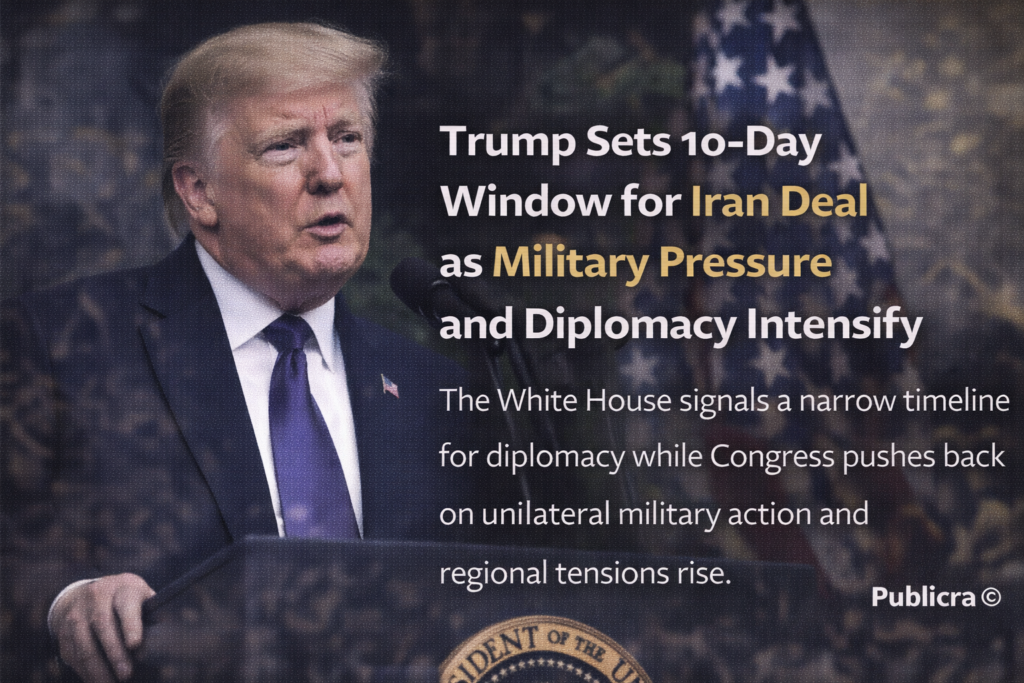
The White House signals a narrow timeline for diplomacy while Congress pushes back on unilateral military action and regional tensions rise.
President Donald Trump has set a stark timeline for resolving one of the world’s most volatile geopolitical standoffs, saying the international community will learn “over the next, probably, ten days” whether Washington reaches a diplomatic agreement with Tehran over Iran’s nuclear program—or escalates toward military action. The statement, delivered at the inaugural meeting of the White House’s Board of Peace, crystallizes the convergence of diplomacy, military posturing, and domestic political debate into a narrow decision window with global ramifications.
While U.S. and Iranian negotiators have reported measured progress in indirect talks hosted in Europe, Washington has simultaneously surged military assets into the Middle East. The dual-track approach reflects a strategy of coercive diplomacy: maintain pressure to shape negotiations while leaving open the path to a negotiated outcome. The compressed timeline underscores the urgency felt in Washington—and the risks of miscalculation in a region already strained by conflict.
The Ten-Day Timeline and Its Strategic Signal
The declaration of a ten-day window is less a procedural deadline than a strategic signal to multiple audiences: Tehran, U.S. allies, Congress, and global markets. For Iran, the message is that the window for compromise is narrowing. For allies, it conveys urgency and the possibility of rapid escalation. For domestic audiences, it frames the administration’s posture as decisive while keeping diplomacy nominally alive.
Deadlines in diplomacy can focus minds, but they also raise the stakes. Negotiations over nuclear programs are complex, involving technical verification, sanctions relief sequencing, and mutual security guarantees. Compressing such talks into a short window increases the risk that unresolved issues are deferred—or that brinkmanship replaces confidence-building.
Diplomacy in Motion: Progress Without Closure
Negotiators on both sides have acknowledged incremental progress on “guiding principles,” including verification mechanisms and pathways for sanctions relief. Yet both Washington and Tehran maintain red lines. The U.S. seeks durable limits on enrichment levels and monitoring regimes. Iran insists on recognition of its civilian nuclear rights and tangible economic relief. Bridging these positions requires trust that has eroded over years of mutual suspicion.
Diplomacy also unfolds amid regional anxieties. Energy markets, shipping lanes, and neighboring states track each signal closely, aware that escalation could disrupt trade and security across the Gulf and beyond. Even rumors of breakthroughs or setbacks can move markets and alter risk calculations for governments and businesses.
Military Posture and the Logic of Deterrence
Parallel to talks, U.S. forces have increased their footprint in the Middle East, including carrier deployments and enhanced air and missile defense capabilities. The administration frames these moves as deterrence—insurance against breakdowns in diplomacy and protection for U.S. personnel and partners. Critics warn that visible buildups can become self-fulfilling, raising the probability of incidents that spiral into confrontation.
Iran, for its part, has signaled readiness to respond to any attack on its territory or assets. The interplay of deterrence and signaling creates a fragile equilibrium. Military posturing may strengthen negotiating leverage, but it also narrows the margin for error, particularly in congested maritime corridors and contested airspace.
Congress, War Powers, and the Domestic Check on Escalation
The prospect of military action has revived debate in Congress over the War Powers framework and the constitutional balance between executive authority and legislative oversight. Lawmakers across party lines have argued that any sustained military campaign should require explicit congressional authorization. Proponents of restraint emphasize the human and economic costs of conflict, as well as the risk to U.S. forces stationed across the region.
While resolutions to constrain executive action face procedural hurdles, the debate itself shapes the political environment. It signals to allies and adversaries alike that U.S. policy is contested domestically, which can complicate deterrence messaging but also underscores democratic accountability.
Regional Implications: Allies, Energy, and Security Corridors
The Middle East sits at the crossroads of global energy flows and strategic chokepoints. Any escalation involving Iran risks ripple effects across shipping routes, insurance markets, and energy prices. Regional partners—some aligned closely with Washington, others pursuing hedging strategies—must calibrate their own security postures in response to U.S.-Iran dynamics.
States along critical maritime corridors are particularly sensitive to threats of disruption. Even limited incidents can elevate shipping costs and affect global supply chains. This economic interdependence adds pressure on all parties to avoid actions that could destabilize trade.
The Board of Peace and the Architecture of Mediation
The administration’s Board of Peace was initially framed as a multilateral forum to coordinate post-conflict stabilization in specific theaters. Its expanded remit reflects an ambition to shape broader conflict management frameworks. Whether such bodies can complement or supplant established multilateral mechanisms remains an open question. Their credibility depends on inclusivity, transparency, and tangible outcomes.
Mediation efforts in the Iran file rely heavily on intermediaries who can maintain communication channels even amid heightened tensions. These channels are essential for crisis de-escalation and technical problem-solving—particularly when direct dialogue is politically constrained.
Verification, Sanctions, and the Mechanics of a Deal
Any durable agreement hinges on verification and sequencing. Verification regimes must be robust enough to assure compliance while respecting sovereignty. Sanctions relief must be calibrated to incentivize adherence without undermining enforcement leverage. Past agreements faltered in part due to disputes over compliance and the durability of political commitments across administrations.
A sustainable framework would likely include phased steps: initial confidence-building measures, reciprocal concessions, and longer-term institutionalized monitoring. The ten-day political timeline contrasts with the multi-year technical processes required to implement and verify such arrangements.
Risks of Escalation and the Cost of Miscalculation
The convergence of deadlines, deployments, and domestic politics heightens the risk of miscalculation. History shows that crises often escalate not from deliberate intent but from misread signals, accidents, or domestic pressures that constrain leaders’ options. Clear communication channels, deconfliction mechanisms, and crisis management protocols are critical to preventing unintended escalation.
For the region, the costs of conflict would be severe: civilian harm, economic disruption, displacement, and long-term instability. For the global economy, shocks to energy markets and trade routes would reverberate widely.
Public Opinion, Information Integrity, and Strategic Communication
Public narratives shape policy space. Leaders frame timelines and options to build support or signal resolve. Information integrity is essential to prevent misinformation from inflaming tensions. Transparent communication about goals, constraints, and risks can help maintain public trust and reduce the likelihood that domestic pressures drive precipitous decisions.
In an era of rapid information flows, strategic communication must be coordinated across agencies and allies to avoid mixed signals that adversaries could exploit.
Scenarios Beyond the Ten Days
The ten-day window may culminate in several plausible outcomes: a framework agreement with further negotiations scheduled; a temporary pause with continued pressure; or escalation in response to perceived intransigence. Each scenario carries distinct risks and opportunities. A framework agreement could stabilize markets and open pathways for de-escalation. A pause risks prolonging uncertainty. Escalation could entrench hostilities and foreclose diplomatic options.
Policy planners must prepare contingencies for each pathway, ensuring that crisis management tools and diplomatic channels remain available even if talks falter.
Diplomacy Under Deadline Pressure
The ten-day timeline underscores a pivotal moment in U.S.-Iran relations, where diplomacy and deterrence collide under intense scrutiny. While deadlines can catalyze decisions, sustainable agreements require patience, verification, and political durability. The coming days will test whether coercive diplomacy can deliver a negotiated outcome—or whether the region edges closer to confrontation with global consequences.
For now, the world watches a narrowing window where choices made in Washington and Tehran could reshape regional security, global energy markets, and the credibility of diplomacy itself.