
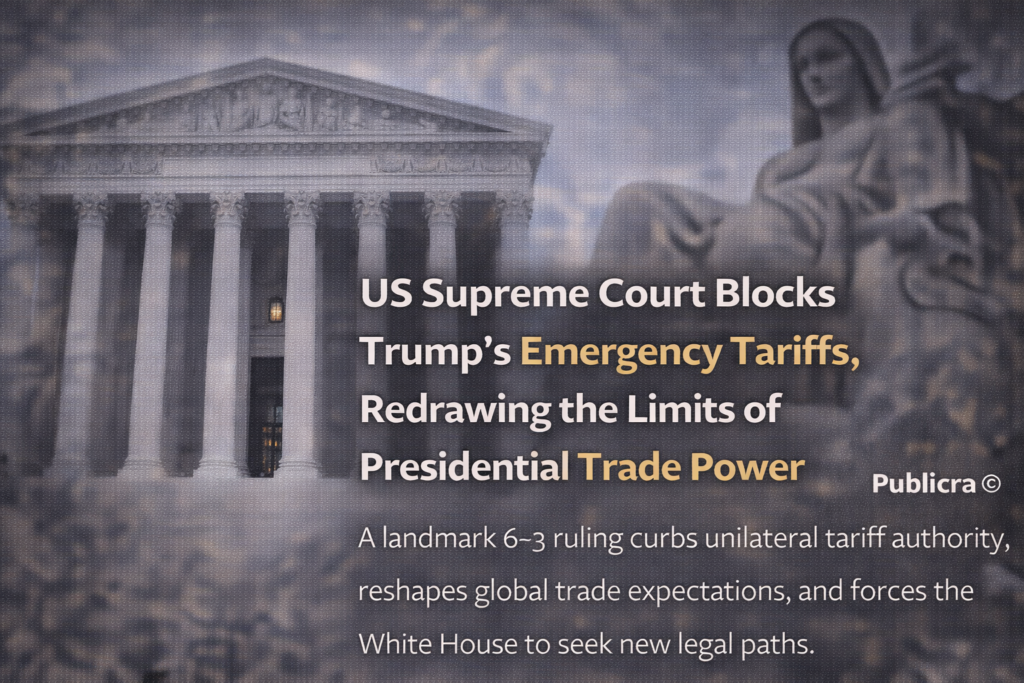
A landmark 6–3 ruling curbs unilateral tariff authority, reshapes global trade expectations, and forces the White House to seek new legal paths.
In a landmark decision with sweeping consequences for the global economy, the US Supreme Court has struck down President Donald Trump’s emergency-based tariffs, ruling that the president exceeded his legal authority by invoking a national emergency statute to impose broad import taxes. The 6–3 ruling clarifies constitutional boundaries between executive power and congressional authority over trade, reshaping the legal framework underpinning the administration’s signature trade strategy and forcing the White House to consider alternative pathways for economic coercion.
The judgment reverberated immediately across financial markets, trading floors, and diplomatic corridors. Stocks rallied, currencies adjusted, and trading partners recalibrated expectations for US trade policy. At its core, the ruling reasserts Congress’s constitutional role in tariff-setting and narrows the scope of unilateral presidential action in matters of “vast economic and political significance.”
The Supreme Court’s Ruling and Its Legal Foundation
The Court concluded that the emergency statute relied upon by the administration does not authorize the imposition of tariffs. While the law permits regulation of imports during declared national emergencies, the justices found that “regulation” does not encompass sweeping import taxes. By drawing this distinction, the Court emphasized that extraordinary assertions of executive power require clear congressional authorization.
The majority opinion underscored separation of powers, warning that endorsing the administration’s interpretation would displace longstanding executive–legislative collaboration over trade with unilateral policymaking. This reasoning aligns with a broader judicial trend that curbs expansive readings of executive authority in areas with profound economic implications.
Why the Decision Matters for US Trade Policy
Tariffs have been central to the administration’s economic and foreign policy toolkit, used to pressure trading partners, reshape supply chains, and extract concessions in negotiations. The ruling constrains the most flexible legal avenue previously used to impose rapid, across-the-board duties. As a result, the White House must now rely on narrower statutory authorities that typically require procedural steps, investigations, or findings tied to national security or unfair trade practices.
This shift reduces the speed and scope with which tariffs can be deployed, potentially lowering uncertainty for businesses while also limiting the administration’s leverage in negotiations. For global markets, the decision signals a rebalancing toward rules-based trade governance rather than ad hoc executive action.
Market Reactions and Investor Sentiment
Financial markets responded positively to the clarity provided by the ruling. Equity indices rose as investors priced in reduced policy volatility and lower risk of abrupt tariff escalations. Currency markets adjusted to reflect expectations of more predictable trade relations, while bond yields edged higher amid recalibrated growth expectations.
Businesses welcomed the ruling’s affirmation of legal predictability but cautioned that uncertainty remains as the administration explores alternative legal tools. The prospect of protracted litigation over refunds of previously collected tariffs adds complexity to corporate planning and balance sheets.
The Constitutional Balance Between Congress and the Presidency
The US Constitution assigns Congress the authority to levy taxes and tariffs, reflecting the founders’ intent to vest trade policy in the legislative branch. Over time, Congress has delegated certain authorities to the executive, enabling flexibility in responding to national security threats and unfair trade practices. The Court’s decision draws a firm boundary around the limits of such delegation.
By invoking doctrines that require clear congressional authorization for actions of major economic significance, the ruling reinforces legislative primacy in trade policy. This rebalancing may prompt Congress to revisit and clarify the scope of statutory trade authorities, particularly in an era of heightened geopolitical competition.
The Administration’s Next Moves: Alternative Legal Pathways
The White House has signaled that it will pursue other statutory routes to retain as much of the tariff regime as possible. These alternatives include authorities tied to national security assessments and retaliatory measures against unfair trade practices. However, such pathways often require formal investigations, public comment periods, and evidentiary findings, reducing the immediacy and breadth of action.
This proceduralization of tariff policy could slow the pace of trade coercion while increasing transparency. For trading partners, it offers clearer signals of intent and a more predictable framework for negotiation.
Global Trade Relations and Diplomatic Implications
The ruling is likely to recalibrate expectations among US trading partners. Governments that scrambled to negotiate exemptions or concessions under the threat of sweeping tariffs may now perceive a narrower window for unilateral US action. This could shift diplomatic dynamics toward more structured negotiations grounded in established trade frameworks.
At the same time, allies and competitors alike anticipate continued pressure through alternative tools. The administration’s commitment to aggressive trade enforcement remains, but the legal architecture governing its execution has changed.
Refunds, Compliance, and the Administrative Aftermath
One unresolved issue concerns the disposition of tariffs already collected under the invalidated authority. The administrative complexity of refunds, compliance adjustments, and potential litigation looms large. Importers and consumers may seek redress, while government agencies must navigate the operational implications of halting collections and processing claims.
The episode highlights the downstream costs of legal uncertainty in trade policy. Clear statutory authority and stable frameworks reduce administrative friction and legal exposure for both government and the private sector.
The Broader Debate Over Economic Nationalism
The ruling intersects with a broader debate over economic nationalism and the use of tariffs as a foreign policy instrument. Proponents argue that tariffs protect domestic industries and enhance bargaining power. Critics contend that they function as taxes on consumers, distort markets, and provoke retaliatory measures.
By narrowing unilateral tariff authority, the Court has injected a note of restraint into this debate, emphasizing that major shifts in trade policy should flow through democratic processes. The decision does not preclude tariffs altogether but channels them through more accountable mechanisms.
Implications for Supply Chains and Inflation
Tariff uncertainty has reshaped global supply chains, prompting firms to diversify sourcing and build redundancy. The ruling may stabilize planning horizons, enabling companies to make longer-term investments with greater confidence. Reduced tariff volatility could also ease inflationary pressures linked to import costs, benefiting consumers.
However, ongoing geopolitical competition and strategic decoupling trends mean that supply chain adjustments will continue. The legal framework for tariffs is one variable in a complex matrix of economic and security considerations.
Political Reactions and the Path Forward
Political reactions reflect partisan divides over executive power and trade strategy. Supporters of the ruling frame it as a victory for constitutional governance and consumer protection. Critics argue it constrains the executive’s ability to respond swiftly to economic threats.
Looking ahead, the interplay between Congress and the White House will shape the future of US trade policy. Legislative action to clarify tariff authorities could either expand or further constrain executive flexibility, depending on political alignments and policy priorities.
A Defining Moment for Trade Governance
The Supreme Court’s decision marks a defining moment in US trade governance, reaffirming constitutional boundaries and recalibrating the balance of power over tariffs. While the administration retains multiple tools to pursue its trade agenda, the era of sweeping emergency tariffs imposed unilaterally has been curtailed.
For the global economy, the ruling offers a measure of predictability in an otherwise volatile trade environment. For the United States, it underscores that durable economic policy rests not on improvisation, but on clear legal authority and democratic accountability.