
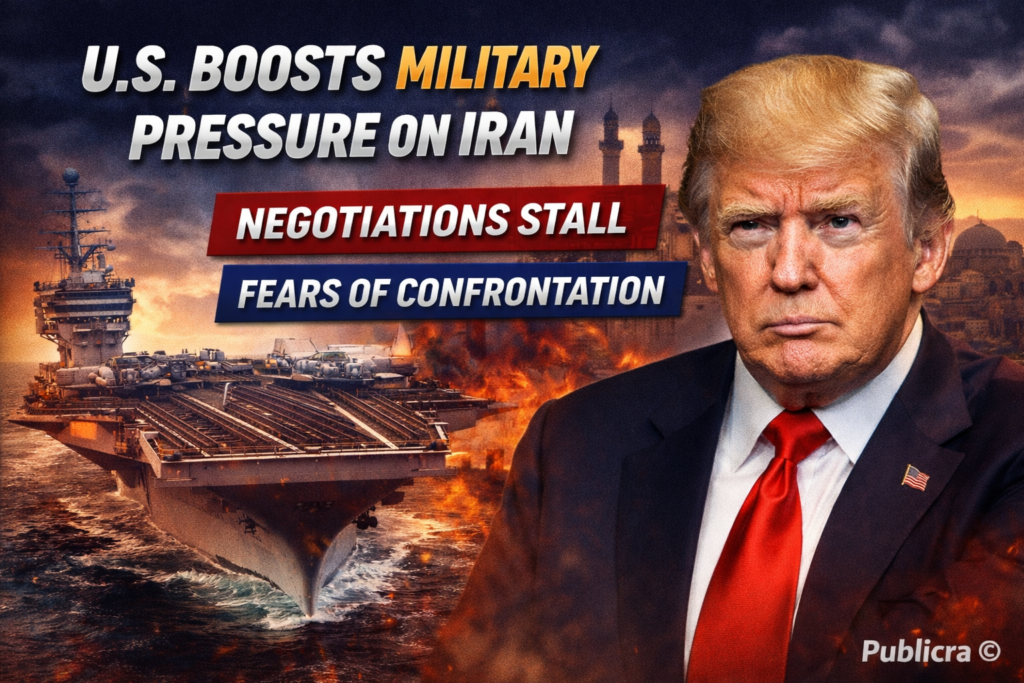
US envoy Steve Witkoff’s comments highlight rising tensions over Iran’s nuclear program, protests inside Iran, and the risk of regional escalation
The standoff between the United States and Iran has entered a dangerous new phase as President Donald Trump questions why Tehran has not “capitulated” despite Washington’s expanding military presence in the Middle East. The comments, relayed publicly by US special envoy Steve Witkoff, underscore the growing impatience within the White House over stalled negotiations surrounding Iran’s nuclear program.
As US warships and aircraft carriers move closer to the region, and as diplomatic efforts continue through indirect channels, the situation has become a high-stakes test of coercive diplomacy. At the same time, Iran is experiencing renewed anti-government protests on university campuses, revealing deep domestic pressures that complicate Tehran’s negotiating position.
The convergence of military pressure, nuclear diplomacy, and internal unrest has revived fears that miscalculation could tip the region into a wider conflict with global consequences.
The Meaning Behind Trump’s “Capitulation” Remark
Steve Witkoff, the president’s envoy handling sensitive negotiations, described Trump as “curious” about why Iran has not yielded under what Washington considers overwhelming pressure. While the administration has avoided using the word “frustrated,” the message is clear: the White House believes its combination of military deployments and diplomatic warnings should have compelled Tehran to make sweeping concessions on its nuclear activities.
The language of “capitulation” is significant. It frames diplomacy not as mutual compromise but as a test of pressure and endurance. Critics warn that such rhetoric risks boxing both sides into rigid positions, making de-escalation harder. Iranian leaders, sensitive to perceptions of sovereignty and national pride, are unlikely to respond favorably to language that suggests submission rather than negotiation.
This framing also shapes public expectations at home, where supporters may interpret any deal short of total Iranian rollback as insufficient, while opponents warn that maximalist demands raise the likelihood of confrontation.
The US Military Build-Up and Its Strategic Purpose
In recent weeks, the United States has significantly increased its military footprint near Iran. Multiple naval assets, including aircraft carriers, destroyers, and combat ships, have been deployed to waters close to the Persian Gulf and Arabian Sea. Fighter jets and surveillance aircraft have augmented the posture, signaling readiness for rapid action if negotiations fail.
From Washington’s perspective, this show of force serves multiple purposes: deterring Iranian military responses, reassuring regional allies, and strengthening the US negotiating hand. Military planners describe the posture as defensive but credible, designed to convey that options beyond diplomacy remain on the table.
However, such deployments are inherently risky. Large concentrations of military assets increase the chances of accidents, misinterpretations, or unintended clashes. Even minor incidents at sea or in contested airspace can escalate rapidly in an environment already saturated with suspicion and historical grievances.
The Nuclear Talks: Where Negotiations Stand
Indirect talks between US and Iranian officials have continued through intermediaries, focusing on constraints to Iran’s nuclear program in exchange for limited sanctions relief and security assurances. Negotiators have reportedly made incremental progress on technical elements, but major political hurdles remain.
The core dispute centers on uranium enrichment levels, verification mechanisms, and the long-term scope of restrictions. The United States and its European partners remain concerned that Iran’s nuclear advances could shorten the timeline to potential weapons capability. Tehran insists its program is for peaceful purposes and argues that it will not dismantle what it considers sovereign technological achievements without meaningful guarantees.
The looming threat of military action adds urgency to the talks but also complicates them. Diplomats note that negotiations conducted under the shadow of force often become more brittle, as each side worries that concessions may be interpreted as weakness.
Iran’s Domestic Unrest and Political Calculations
Inside Iran, renewed protests at major universities signal deep dissatisfaction with economic conditions, political restrictions, and recent security crackdowns. Student demonstrations, often a bellwether of broader social unrest, reflect frustration among younger Iranians who face high unemployment, inflation, and limited prospects.
The government’s response to protests has historically been forceful, and recent clashes between demonstrators and security forces have intensified public anger. These internal pressures shape Tehran’s foreign policy calculus. Leaders may fear that appearing to yield to external pressure could embolden domestic opposition, while prolonged confrontation risks further economic hardship that fuels unrest.
For the Iranian leadership, maintaining internal legitimacy is as critical as navigating international pressure. This dynamic makes quick diplomatic concessions politically costly, even if economic relief could benefit the population in the long run.
Regional Implications and the Risk of Escalation
The US–Iran standoff reverberates across the Middle East. Iran’s relationships with regional allies and proxy groups, as well as its rivalries with neighboring states, mean that any confrontation could spread beyond bilateral channels.
Regional partners hosting US forces worry about becoming frontline targets in a potential conflict. At the same time, Iran may seek to signal resolve through indirect actions across the region, increasing the risk of proxy confrontations that could spiral out of control.
Energy markets are particularly sensitive to Gulf tensions. Even the perception of heightened risk can drive up oil prices and disrupt shipping lanes, with knock-on effects for the global economy. The strategic waterways near Iran carry a substantial share of the world’s energy trade, making stability there a global concern.
The Limits of Coercive Diplomacy
The current strategy blends diplomatic engagement with overt military pressure, a classic example of coercive diplomacy. While such an approach can sometimes compel adversaries to negotiate, history shows it can also harden resistance.
Iranian political culture places high value on resistance to external coercion, rooted in historical experiences of foreign intervention. Publicly demanding capitulation may reinforce narratives within Iran that the United States seeks dominance rather than compromise. This, in turn, can empower hardliners who argue against engagement with Washington.
Effective diplomacy often requires offering credible off-ramps that allow leaders on both sides to claim success domestically. Without such pathways, negotiations risk becoming zero-sum contests of endurance rather than opportunities for pragmatic resolution.
International Reactions and Diplomatic Balancing
Allies of the United States are watching closely, balancing concerns over nuclear proliferation with fears of a wider conflict. European governments continue to emphasize diplomatic solutions, urging restraint and incremental confidence-building measures. Regional partners, while supportive of pressure on Iran’s nuclear program, remain wary of open conflict that could destabilize their own security environments.
International organizations and humanitarian groups warn that escalation would exacerbate civilian suffering across an already fragile region. The international community’s ability to influence outcomes is limited, but diplomatic channels remain active as mediators seek to prevent miscalculation.
The Role of Rhetoric in High-Stakes Diplomacy
Language matters in crises. Terms like “capitulation” carry connotations that resonate far beyond policy circles. Such rhetoric can mobilize domestic audiences but also inflame adversaries and narrow the space for compromise.
Diplomatic historians note that successful negotiations often depend on carefully calibrated language that signals firmness without humiliation. Publicly framing talks as a demand for surrender risks undermining the very goals of non-proliferation and regional stability that policymakers seek to achieve.
What Comes Next: Scenarios and Risks
Several paths lie ahead. One possibility is a limited diplomatic breakthrough, with Iran agreeing to additional transparency measures in exchange for narrowly defined relief. Another is prolonged stalemate, with continued military posturing and episodic flare-ups that stop short of full conflict.
The most dangerous scenario is miscalculation: a military incident that triggers rapid escalation before diplomacy can intervene. In such a case, even a brief clash could spiral into broader confrontation involving regional actors and disrupting global energy markets.
Preventing this outcome will require sustained diplomatic engagement, clearer communication channels between militaries, and restraint in public rhetoric. The window for de-escalation remains open, but it is narrowing as pressure builds on both sides.
Diplomacy Under Pressure in a Volatile Region
The remarks attributed to President Trump, questioning why Iran has not “capitulated,” encapsulate the tension at the heart of the current crisis: a belief in the power of pressure colliding with the realities of national pride, domestic politics, and regional complexity.
As US military assets gather near Iran and talks continue behind closed doors, the stakes could not be higher. The choices made in the coming weeks will shape not only the future of Iran’s nuclear program but the broader stability of the Middle East and the global economy.
In such an environment, restraint, clear communication, and genuine pathways to compromise may prove more effective than pressure alone in averting a conflict that few truly want.