
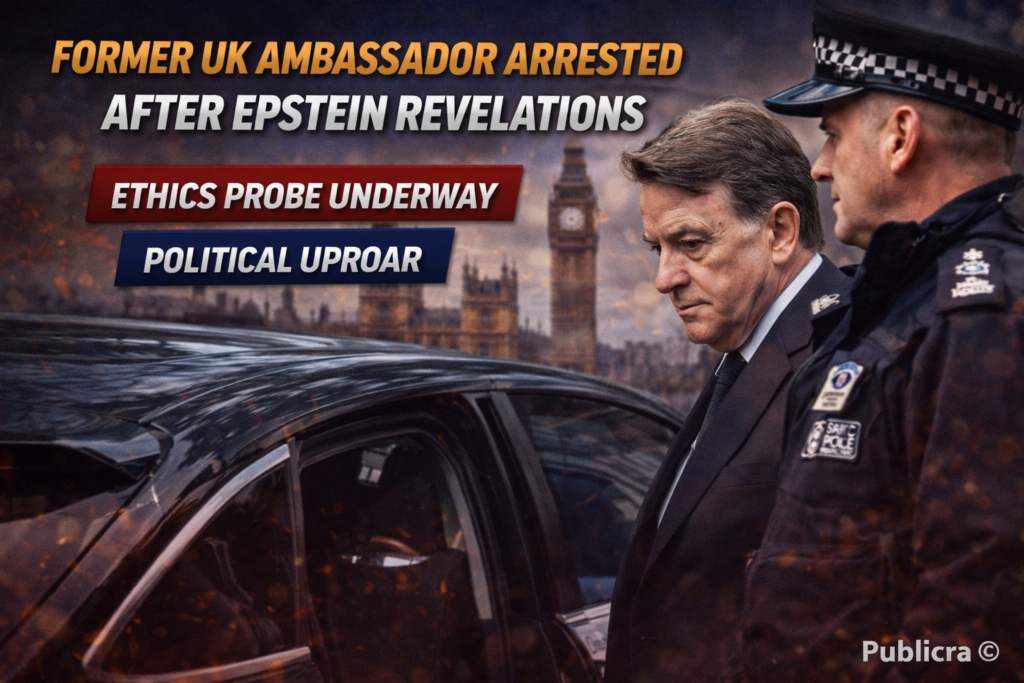
Misconduct probe into Peter Mandelson intensifies scrutiny of elite networks, accountability, and public office ethics
The arrest of former British ambassador to the United States Peter Mandelson has sent shockwaves through UK politics, reopening difficult questions about accountability at the highest levels of public office and the lingering fallout from revelations linked to the late financier Jeffrey Epstein. The investigation centers on allegations of misconduct in public office, following the release of previously undisclosed communications that reportedly detail a closer-than-acknowledged relationship between Mandelson and Epstein during Mandelson’s time in government.
The case has quickly become a flashpoint in debates over political ethics, elite networks, and the responsibilities of public officials. While the legal process is in its early stages, the political consequences are already significant, with renewed scrutiny of how senior figures are vetted, monitored, and held accountable.
Who Is Peter Mandelson and Why His Arrest Matters
Peter Mandelson is one of the most prominent figures in modern British politics, known for his influential role in shaping political strategy and holding some of the most prestigious positions in public service. His career spanned decades, encompassing cabinet-level responsibilities, senior party leadership roles, and diplomatic representation abroad.
As ambassador to the United States, Mandelson occupied a highly sensitive post, tasked with managing one of Britain’s most important international relationships. The arrest of such a senior figure on suspicion of misconduct in public office is rare and underscores the gravity of the allegations. For many observers, the case represents a test of whether Britain’s legal and political systems are prepared to scrutinize powerful individuals with the same rigor applied to ordinary citizens.
The Epstein Revelations and Their Political Impact
The renewed focus on Mandelson follows the release of documents that shed light on communications between him and Epstein. These disclosures have reignited global interest in the networks surrounding Epstein and the extent to which influential figures interacted with him after his criminal conduct became widely known.
The revelations have prompted difficult questions: What did public officials know, when did they know it, and did any interactions cross ethical or legal boundaries? In Mandelson’s case, the concern is not merely personal association but whether information or influence linked to his public role was improperly shared.
The Epstein case has had a cascading effect on political and business elites worldwide, with each new disclosure triggering fresh calls for transparency and accountability. The arrest marks a pivotal moment in how such associations are being examined within the UK legal framework.
Understanding the Charge of Misconduct in Public Office
Misconduct in public office is a serious offense that involves a public official willfully neglecting their duties or abusing their position for improper purposes. The charge is designed to protect public trust by ensuring that those entrusted with authority act within the bounds of law and ethical standards.
In this context, investigators are examining whether Mandelson’s interactions and communications constituted a breach of his responsibilities as a public official. The legal threshold for such cases is high, requiring evidence of deliberate wrongdoing rather than mere poor judgment.
Legal experts caution that arrest does not equate to guilt, and the case will hinge on whether prosecutors can establish that any actions materially compromised the integrity of public office.
Political Fallout and Party Repercussions
The arrest has reverberated across the political landscape. Mandelson’s recent resignation from party affiliations and public roles reflects the immediate reputational damage caused by the allegations. Political leaders now face renewed pressure to demonstrate that ethical standards apply uniformly, regardless of status or seniority.
Opposition figures have called for a broader review of how high-profile appointments are scrutinized, while government officials emphasize the independence of law enforcement and the need to allow investigations to proceed without political interference. The episode risks eroding public trust in political institutions at a time when confidence in leadership is already fragile.
Elite Networks and the Question of Influence
One of the most troubling dimensions of the Epstein revelations is the light they cast on elite networks that transcend national borders. Epstein’s social circle included individuals from politics, finance, academia, and entertainment, raising concerns about how power, privilege, and access can intersect in opaque ways.
The Mandelson case has become emblematic of broader anxieties about whether such networks operate with insufficient transparency and oversight. Critics argue that informal relationships between powerful individuals can blur ethical boundaries, creating environments where accountability is weakened.
Reform advocates are calling for stricter disclosure requirements and clearer guidelines on interactions between public officials and private individuals with controversial backgrounds.
The Role of Transparency and Public Trust
At the heart of the controversy lies the issue of transparency. Democratic systems rely on public confidence that officials act in the public interest and disclose relationships that could create conflicts of interest.
The delayed emergence of communications between Mandelson and Epstein has fueled perceptions that powerful figures are shielded from scrutiny. Restoring trust will require not only legal accountability but also institutional reforms that enhance transparency around communications, lobbying, and external relationships of senior officials.
Legal Process and What Comes Next
As the investigation unfolds, Mandelson is entitled to the presumption of innocence and due process under UK law. The case will proceed through established legal channels, with prosecutors assessing evidence and determining whether formal charges are warranted.
Observers note that the complexity of the allegations—spanning personal relationships, professional conduct, and the broader Epstein network—means the investigation could take considerable time. Regardless of the legal outcome, the process itself will likely shape future standards for how allegations against senior figures are handled.
Implications for UK–US Relations and Diplomatic Norms
While the case centers on domestic legal issues, it also touches on diplomatic norms. As a former ambassador, Mandelson represented British interests abroad, and any suggestion of compromised conduct raises concerns about how diplomatic roles are insulated from personal relationships.
The episode may prompt reviews of vetting procedures for senior diplomatic appointments, as well as guidelines governing personal associations that could create conflicts of interest. Maintaining the integrity of diplomatic service is critical for sustaining trust between nations and within international institutions.
Media, Public Debate, and the Epstein Shadow
The Epstein scandal continues to cast a long shadow over global public life. Media coverage of each new revelation fuels public debate about privilege, exploitation, and the accountability of elites.
In the UK, the Mandelson case has reignited conversations about how media scrutiny interacts with legal processes. While investigative journalism plays a crucial role in uncovering wrongdoing, there is also concern about trial by media and the potential for reputational harm before legal conclusions are reached.
Balancing transparency with fairness remains a central challenge in high-profile cases.
Toward Stronger Ethical Safeguards
The arrest has intensified calls for stronger ethical safeguards in public life. Proposals include clearer conflict-of-interest rules, mandatory disclosure of contacts with controversial figures, and enhanced oversight mechanisms for senior officials.
Some advocates argue that existing codes of conduct are insufficiently enforced, while others emphasize the need for cultural change within political institutions to prioritize ethical integrity over personal networks and informal influence.
A Defining Test for Accountability
The arrest of Peter Mandelson marks a defining moment in Britain’s ongoing struggle to reconcile elite power with democratic accountability. Whether the case results in charges or not, it underscores the enduring impact of the Epstein revelations and the demand for transparency at the highest levels of public service.
For the public, the episode is a reminder that trust in institutions depends on the consistent application of ethical standards. For political leaders, it is a call to reinforce systems that ensure no individual is beyond scrutiny. As the investigation proceeds, the outcome will shape not only Mandelson’s legacy but also the broader conversation about accountability, power, and public office in the modern era.