
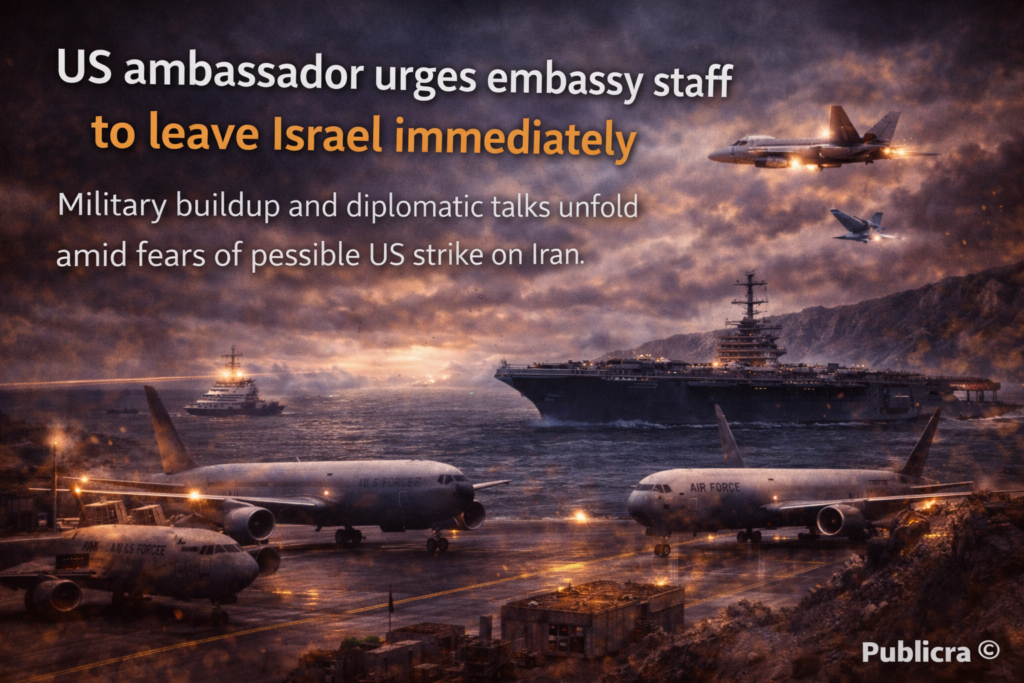
Military buildup and diplomatic talks unfold amid fears of possible us strike on iran
The US State Department’s decision allows non-essential government employees and family members stationed in Israel to leave the country due to safety risks. Travel advisories now recommend that Americans reconsider travel to Israel amid concerns over terrorism and civil unrest.
Such authorizations are not unprecedented but typically indicate elevated threat assessments. While not an evacuation order, the move suggests serious consideration of potential regional instability.
Ambassador Huckabee’s internal message reportedly stressed logistical urgency, noting that airline demand could spike quickly if broader evacuation measures are enacted.
Military buildup raises speculation of potential strike
The advisory coincides with a visible US military buildup in and around Israel. The USS Gerald R. Ford, one of the world’s largest aircraft carriers, is expected to position off Israel’s northern coast. The carrier group includes advanced aircraft capable of long-range strike missions.
Additionally, refueling tankers have reportedly arrived at Ben Gurion Airport, suggesting logistical preparations for sustained air operations. Satellite imagery has also shown F-22 stealth fighter jets at Israeli airbases, a deployment considered rare outside of joint training exercises.
While US officials have not confirmed operational intentions, the scale and positioning of assets have intensified speculation about potential military action targeting Iranian nuclear infrastructure.
Diplomatic efforts continue behind the scenes
Despite the military posturing, diplomatic efforts are ongoing. A third round of indirect talks regarding Iran’s nuclear program recently concluded, mediated by Oman’s foreign minister.
Oman has historically played a role in facilitating dialogue between Washington and Tehran. Reports indicate that Omani officials are meeting US leadership to maintain channels of communication and avert open conflict.
Iranian officials have publicly stated that progress requires realism and the removal of what they describe as excessive demands. The US position, however, continues to emphasize strict limits on uranium enrichment.
The dual-track strategy of diplomacy alongside military deterrence underscores the complexity of the current moment.
Iran’s nuclear program remains central issue
The crisis centers on Iran’s nuclear activities. Tehran maintains that its program is peaceful, while Western governments argue that enrichment levels and missile capabilities raise serious proliferation concerns.
Iran has enriched uranium to levels that exceed typical civilian requirements, drawing international scrutiny. Meanwhile, ballistic missile development and regional proxy networks remain additional sources of tension.
Negotiators face difficult questions about acceptable enrichment thresholds, inspection mechanisms, and long-term compliance structures.
Regional and international responses intensify
Several governments have urged their citizens to leave parts of the region. Travel advisories from Canada, China, Australia, and European nations highlight widespread concern about potential escalation.
Airlines have adjusted flight schedules and suspended routes, reflecting operational caution. These commercial decisions often serve as indirect indicators of perceived risk levels.
Meanwhile, the United Nations has urged restraint, warning of the severe humanitarian consequences of renewed regional conflict.
Middle east security landscape shifts rapidly
The Middle East security environment remains highly fluid. Proxy groups aligned with Iran have signaled readiness to respond if hostilities begin. Armed factions in neighboring countries have issued warnings that they would not remain neutral in the event of strikes.
Such statements increase the risk that any confrontation could expand beyond bilateral US-Iran dynamics, potentially drawing in multiple actors.
The deployment of advanced aircraft and naval assets sends a strong deterrent signal but also narrows room for miscalculation.
Economic and humanitarian stakes grow
Escalation could have far-reaching economic implications. Energy markets remain sensitive to disruptions in the region, particularly around strategic maritime routes.
Humanitarian organizations warn that civilian populations would bear the brunt of renewed conflict. Urban centers across the region remain densely populated, raising concerns about collateral damage.
The balance between deterrence and diplomacy remains fragile.
Israeli military posture remains steady
Israeli defense officials have stated that while they are prepared to defend against any strike, there have been no changes to public safety guidelines.
This measured tone suggests that while Israel remains alert, authorities are not yet signaling imminent threat to the general population.
Military coordination between the United States and Israel appears to be ongoing at high levels.
Calculating risks and consequences
For Washington, the challenge lies in maintaining pressure on Iran without triggering a wider war. Military readiness serves as leverage in negotiations but also carries escalation risks.
For Tehran, resistance to demands must be balanced against economic pressures and domestic considerations.
Both sides face strategic calculations shaped by domestic politics, regional alliances, and global power competition.
diplomacy at a crossroads
The authorization for embassy staff departures underscores the seriousness of the current security environment. While diplomatic talks continue, visible military deployments reflect preparedness for alternative scenarios.
The coming days will be pivotal. Whether diplomacy prevails or tensions spiral will depend on the ability of both sides to navigate a narrow corridor between deterrence and confrontation.
The international community watches closely, aware that the consequences of miscalculation could extend far beyond the region.