
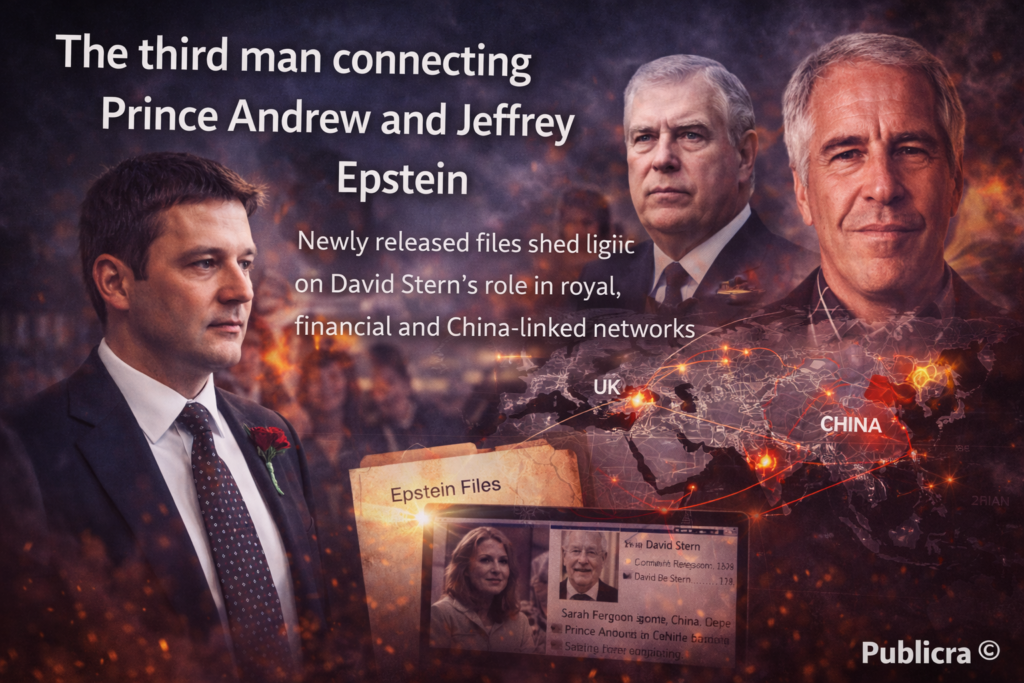
Newly released files shed light on david stern’s role in royal, financial and china-linked networks
When millions of pages of documents connected to Jeffrey Epstein were released by the US Department of Justice, attention once again turned to the network of individuals who interacted with the convicted American financier. Among the thousands of names appearing in those files was a comparatively little-known figure: David Stern.
While Prince Andrew’s association with Epstein has been widely scrutinized for years, the files suggest that Stern played a significant intermediary role between Epstein and the Duke of York, as well as Sarah Ferguson. The documents portray Stern as a facilitator—someone who introduced contacts, forwarded messages, discussed financial matters, and helped cultivate opportunities in China during a period when the country’s economic rise attracted global interest.
The emerging picture raises questions about influence, reputation management, financial vulnerability, and cross-border networking that extended far beyond social acquaintance.
Who is david stern
According to corporate filings and biographical information referenced in released documents, David Stern is a German businessman who studied law and Chinese law in London and later built professional ties in China. His early career reportedly included work in investment banking and the founding of a Beijing-based healthcare IT venture.
The files suggest Stern positioned himself as well connected within Chinese business and political circles, offering access to investors and high-net-worth individuals. His fluency in Mandarin and long-term engagement with China appear to have been central to his value proposition.
Public records show that Stern later served in advisory and director roles connected to Prince Andrew’s entrepreneurial initiative, Pitch@Palace, and was associated with charitable institutions linked to the royal family.
Yet despite these connections, Stern maintained a low public profile, rarely appearing in media coverage until the document releases brought renewed attention to his role.
How stern entered the orbit of epstein
The earliest documented exchanges between Stern and Epstein date back to 2008. The communications suggest Stern initially approached Epstein with investment proposals related to China-focused funds.
Over time, the relationship appears to have evolved into mentorship-style correspondence. Emails reportedly show Stern addressing Epstein in deferential terms and seeking advice on business strategies. Epstein, significantly older and more established in elite financial networks, appears in the correspondence as the senior figure.
The content of many emails included investment ideas, discussions of potential deals, and references to international contacts. The tone of the exchanges, as described in reporting, ranged from professional to inappropriate, reflecting the controversial character of Epstein’s documented communications.
There is no suggestion in the released files that Stern was implicated in Epstein’s criminal conduct. However, the breadth of communication underscores the depth of their association.
The introduction to prince andrew and sarah ferguson
According to correspondence within the documents, Stern was introduced to Sarah Ferguson through Epstein. An email attributed to Ferguson references Stern attending dinner at Royal Lodge and assisting with advice and contacts related to China.
Around this period, Ferguson was reportedly dealing with significant financial pressures. Emails suggest Stern became involved in discussions about her debts and possible financial restructuring strategies.
Private communications cited in reporting describe Stern and Epstein discussing Ferguson’s financial situation in blunt and sometimes disrespectful language. Those exchanges have drawn renewed scrutiny regarding judgment and discretion within these circles.
Prince Andrew also appears in the correspondence, with Stern acting as a conduit for information and opportunities. Stern allegedly proposed business ventures that would discreetly involve Andrew’s “aura and access,” according to the email language described in the files.
While some proposals did not materialize, Stern’s role as intermediary appears consistent across multiple years.
China as the central pillar of the network
China emerges repeatedly in the files as the strategic backdrop to Stern’s connections. During the late 2000s and early 2010s, China’s economic expansion made it an attractive market for Western investors and entrepreneurs.
Stern presented himself as uniquely positioned to open doors within Chinese corporate and political networks. Emails suggest he claimed connections to senior figures within major Chinese companies and families linked to political leadership.
There is no evidence those individuals were aware of Epstein or involved in any wrongdoing. However, the perceived value of China-based access appears to have strengthened Stern’s standing with both Epstein and Prince Andrew.
Andrew’s official visits to China as a UK trade envoy reportedly intersected with Stern’s facilitation efforts. Stern claimed in one email that he organized meetings for Andrew during a China visit, excluding only certain high-level government officials.
The role of Pitch@Palace’s China arm later added another layer of complexity, especially after controversies involving figures associated with the initiative.
Pitch@palace and institutional appointments
Stern’s involvement extended beyond informal networking. He reportedly became a director of Pitch@Palace and served on the board of St George’s House, an institution connected to the late Duke of Edinburgh.
These appointments demonstrate a degree of trust and institutional acceptance. Yet some board members, according to press reports, later expressed unease regarding background clarity and associations.
Such concerns illustrate how reputational risk can evolve gradually—initially obscured by business optimism and diplomatic engagement, only to become visible after broader controversies surface.
Financial ambitions and unrealized deals
The documents portray Stern as persistently entrepreneurial. Among reportedly discussed initiatives were:
- A China-focused investment office in London
- Attempts to connect Chinese property interests with UK real estate ventures
- Co-investments in technology and electric vehicle startups
- Conversations about large-scale banking acquisitions
Many of these ideas did not come to fruition. Some ventures later collapsed or failed to materialize.
The pattern suggests a network driven by opportunity exploration, with Stern often positioning himself at the center of cross-border financial ambitions.
The broader context of the epstein files
It is important to clarify that appearing in the Epstein files does not imply criminal wrongdoing. The US Department of Justice documents include communications from a wide range of individuals whose names appear due to contact or correspondence.
However, the files illuminate how Epstein maintained relationships across business, academic, political, and social spheres long after his 2008 conviction. The persistence of these connections continues to generate public scrutiny.
For Prince Andrew, the revelations add another layer to a relationship that already resulted in his withdrawal from public royal duties and lasting reputational consequences.
Public accountability and unanswered questions
Several questions remain unanswered:
- What due diligence processes were applied to Stern’s appointments?
- How deeply were financial proposals evaluated?
- To what extent were reputational risks considered during these associations?
Stern has reportedly not responded to requests for comment regarding the document revelations. Prince Andrew has consistently denied wrongdoing in connection to Epstein. Sarah Ferguson has not issued new public statements related to Stern’s involvement.
As more files are analyzed, public understanding of these relationships may continue to evolve.
Why this story still matters
The Stern connection highlights a broader issue: how influence networks operate at the intersection of politics, royalty, finance, and international business.
It also illustrates how informal intermediaries—figures who “stay in the background,” as Stern reportedly described himself—can play outsized roles in shaping introductions, transactions, and strategic directions.
The case underscores the importance of transparency and governance safeguards in elite networks, particularly when they intersect with public institutions and diplomatic representation.
The ongoing impact on royal reputation
For the British monarchy, the Epstein association has already had significant consequences. The emergence of Stern as a connecting figure reinforces scrutiny of how external advisers and intermediaries gain access to high-profile individuals.
While the monarchy has sought to distance itself from the controversy, renewed document releases ensure that past decisions remain subject to public evaluation.
In an era of digital transparency and archival permanence, even background figures can quickly move to the forefront of public discourse.
The release of millions of pages of documents has re-illuminated connections once operating largely outside public view. David Stern’s role as an intermediary linking Jeffrey Epstein with Prince Andrew and Sarah Ferguson adds complexity to an already controversial chapter.
Though no new criminal allegations have emerged against Stern in the released materials, the communications raise questions about judgment, oversight, and the dynamics of elite access.
As investigations and archival analyses continue, the story reflects a broader truth about power networks: those who claim to remain in the background often leave the most revealing trails.