
regional anger over khamenei’s killing spreads across pakistan, iraq and kashmir amid fears of wider instability
Meta Description:
At least nine people killed in violent pro-Iran protests outside the US consulate in Karachi after the assassination of Iran’s Supreme Leader Ayatollah Ali Khamenei. Demonstrations spread across Pakistan, Iraq and Kashmir as regional tensions escalate.
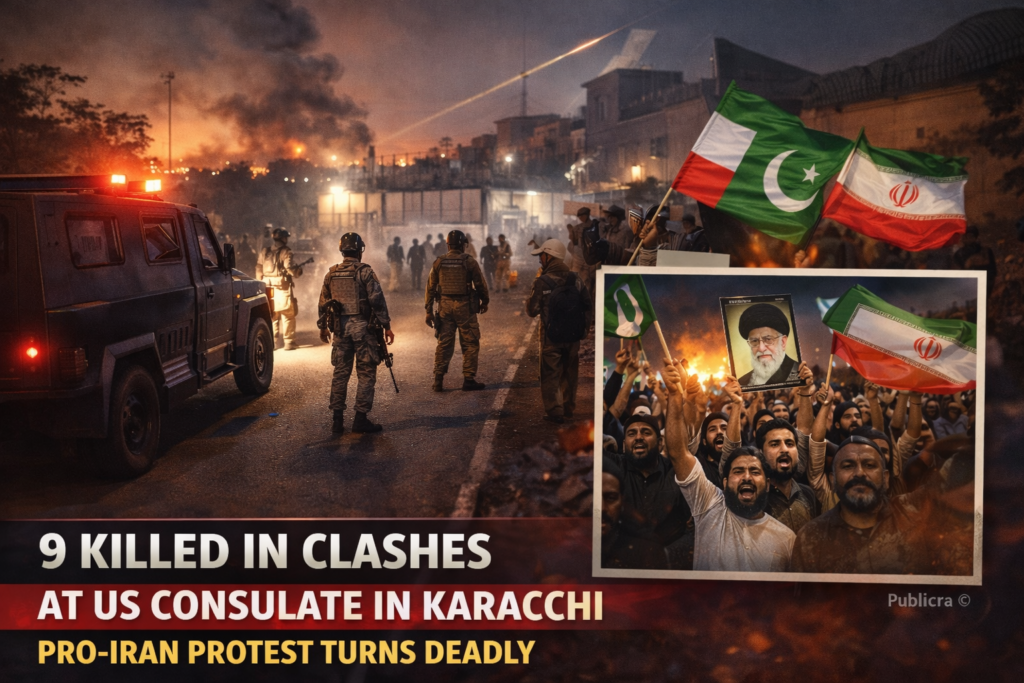
Nine Killed As Protest Turns Violent Outside US Consulate In Karachi
At least nine people were killed and several others injured after violent clashes erupted outside the United States consulate in Karachi, Pakistan, during a large pro-Iran protest. The unrest followed the reported assassination of Iran’s Supreme Leader Ayatollah Ali Khamenei in joint US-Israeli military strikes.
According to medical officials at Karachi’s Civil Hospital, multiple bodies were brought in after security forces opened fire to disperse hundreds of demonstrators attempting to storm the diplomatic compound early Sunday morning.
The incident marks one of the deadliest protest-related events in Pakistan in recent years and reflects the widening regional anger following developments in Iran.
How The Protest Escalated Into Violence
Witnesses reported that hundreds of demonstrators gathered near the heavily secured US consulate on Mai Kolachi Road shortly after dawn. Protesters reportedly attempted to breach security barriers and approach the main gates of the diplomatic facility.
Security personnel deployed in the area used tear gas and warning shots to disperse the crowd. However, as tensions intensified, live ammunition was allegedly fired to prevent protesters from entering restricted zones.
Video footage circulating on social media showed injured individuals being carried away by bystanders amid chaos and smoke. Paramilitary vehicles were seen positioned along key roads surrounding the diplomatic compound.
Authorities have not yet released a full official casualty breakdown, but hospital sources confirmed at least nine fatalities and multiple injuries.
Karachi Incident Highlights Growing Regional Fallout
The deadly protest in Karachi underscores the expanding geopolitical impact of Iran’s internal developments. Public demonstrations erupted following reports of the killing of Ayatollah Ali Khamenei, who had served as Iran’s Supreme Leader since 1989.
In Pakistan, strong sectarian and political ties between segments of the population and Iran have historically fueled emotional responses to developments affecting Shia leadership.
Karachi, Pakistan’s largest city and financial hub, has witnessed politically charged protests in the past. However, Sunday’s violence near a foreign diplomatic mission has raised serious diplomatic and security concerns.
Unrest Spreads Across Pakistan
Beyond Karachi, protests also erupted in multiple cities across Pakistan:
Skardu (Gilgit-Baltistan Region)
In Pakistan’s northern Shia-majority region of Gilgit-Baltistan, protesters reportedly set fire to a United Nations office building in Skardu. Local officials confirmed that the building was burned but no casualties were reported.
The incident reflects deep emotional reactions in regions with strong sectarian affiliations and religious solidarity.
Lahore
In Lahore, hundreds gathered outside the US consulate in a demonstration that remained largely peaceful. While some protesters reportedly attempted to damage outer security gates, police intervened without using force, preventing escalation.
Islamabad
Authorities anticipate demonstrations near the diplomatic enclave in Islamabad, where the US embassy is located. Security has been heightened in the capital in preparation for potential gatherings.
Demonstrations Spread Beyond Pakistan
The unrest has not been confined to Pakistan. Protests linked to Khamenei’s killing have been reported in:
Iraq
In Baghdad, hundreds attempted to approach the heavily fortified Green Zone, which houses the US embassy. Protesters carried portraits of the late Iranian leader and demanded the withdrawal of American forces from Iraq.
Iraq’s influential Shia clerical establishment has called for unity and calm, while the government declared a three-day mourning period.
Indian-Administered Kashmir
Thousands of Shia Muslims marched through Srinagar in emotionally charged demonstrations. While largely peaceful, protesters chanted anti-US and anti-Israel slogans.
The coordinated spread of demonstrations indicates that the geopolitical shockwave from Iran’s leadership crisis is resonating deeply across regions with strong religious and political ties to Tehran.
Diplomatic Missions On High Alert
The violence in Karachi raises serious diplomatic security concerns.
Diplomatic compounds worldwide operate under strict security protocols, especially during geopolitical crises. Following the unrest:
- Security around US diplomatic facilities in South Asia has been reinforced.
- Consular services may face temporary suspension.
- Travel advisories could be updated in affected regions.
Governments often reassess risk levels after incidents involving embassies or consulates, particularly when fatalities occur.
Sectarian Sensitivities And Political Dynamics
Pakistan’s complex sectarian landscape adds further sensitivity to the situation. The country has a significant Shia minority population, and developments affecting Iran — a major Shia-majority nation — often trigger emotional responses.
At the same time, Pakistan maintains diplomatic relations with both Iran and the United States, placing Islamabad in a delicate geopolitical balancing position.
The government now faces multiple challenges:
- Preventing further unrest
- Maintaining diplomatic stability
- Managing sectarian tensions
- Protecting foreign missions
Security analysts warn that unchecked escalation could inflame existing sectarian divides.
Broader Regional Implications
The protests demonstrate how geopolitical conflict can rapidly spill across borders.
Key concerns include:
- Risk of copycat demonstrations in other countries
- Potential retaliatory attacks on diplomatic missions
- Increased radicalization among fringe groups
- Escalating anti-Western sentiment in volatile regions
If unrest continues, regional stability could face further strain.
Global Reactions And Calls For Restraint
International leaders have urged calm and called for diplomatic solutions to prevent further escalation.
Human rights observers are closely monitoring reports of security forces using lethal force against demonstrators. Authorities will likely face scrutiny over crowd-control measures.
Meanwhile, diplomatic backchannels may intensify as governments seek to prevent the crisis from widening further.
Economic And Market Concerns
Political instability often impacts financial markets and investor confidence.
Pakistan’s stock market and currency may face pressure if unrest spreads. Insurance premiums for diplomatic and commercial facilities could rise.
Foreign investors typically monitor:
- Political stability
- Security risks
- Diplomatic relations
- Infrastructure resilience
Sustained unrest could weigh on Pakistan’s economic recovery efforts.
What Happens Next?
Several developments will determine the trajectory of the situation:
- Government response to ongoing protests
- Security investigations into the Karachi fatalities
- Diplomatic engagement between Pakistan and the United States
- The regional response to Iran’s evolving leadership crisis
Authorities in Pakistan are expected to maintain heightened security in major cities over the coming days.