
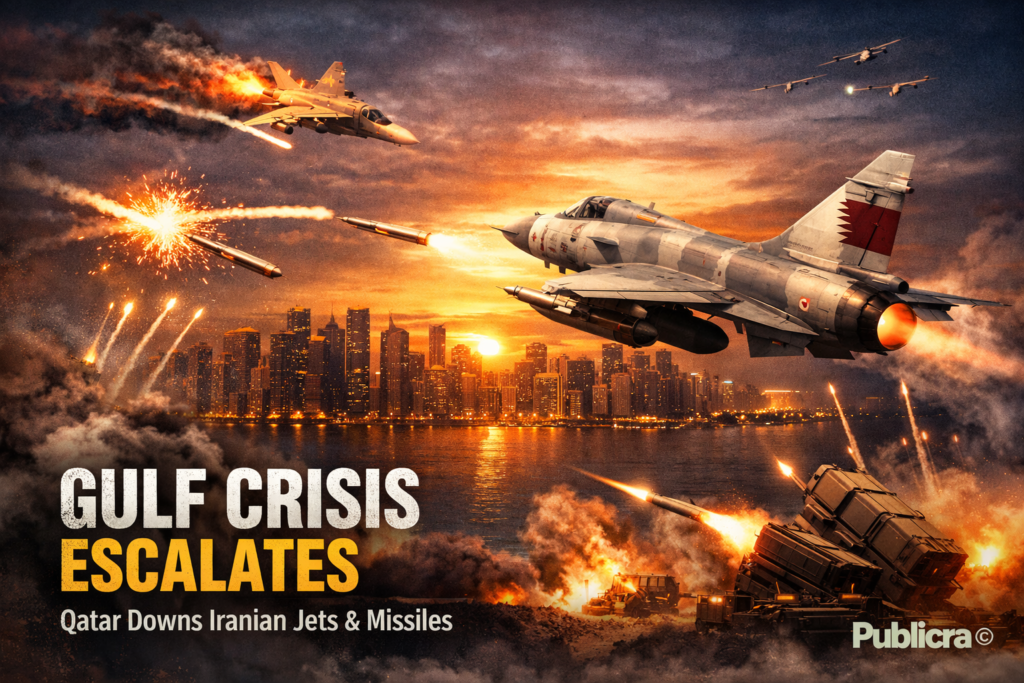
Air-to-air combat signals dramatic escalation after missile and drone interceptions over Doha
Qatar has announced that its air force successfully shot down two Iranian SU-24 fighter jets and intercepted seven ballistic missiles and five drones, marking what analysts describe as one of the most serious escalations in the Gulf region in recent years.
According to the Qatari Defence Ministry, the aircraft and projectiles were neutralized before reaching their targets. The development comes amid rapidly widening tensions following joint United States-Israel strikes on Iran and subsequent Iranian retaliation across multiple Middle Eastern states.
The reported downing of Iranian jets introduces a new and highly volatile dimension to the conflict: direct air-to-air combat between regional powers.
WHAT QATAR SAYS HAPPENED
The Qatari Defence Ministry stated that two Iranian SU-24 aircraft were detected entering operational engagement zones and were “successfully shot down” in accordance with defensive protocols. In addition, seven ballistic missiles and five drones allegedly launched by Iran were intercepted before reaching Qatari territory.
Officials emphasized that:
- All projectiles were destroyed mid-air
- No confirmed civilian casualties were reported
- Defensive systems responded immediately upon detection
The ministry described the Iranian targeting of Qatari territory as “reckless and irresponsible,” especially amid already heightened regional instability.
Iran has not immediately confirmed or denied the loss of aircraft.
THE BROADER REGIONAL CONTEXT
The escalation follows reported US-Israeli military strikes targeting Iranian strategic sites and senior officials. In retaliation, Iran has launched missile and drone strikes across the Gulf, including:
- Qatar
- Kuwait
- United Arab Emirates
- Saudi Arabia
The conflict now appears to be shifting from proxy confrontations toward direct state-on-state engagements.
Defense analysts say that the introduction of fighter jet engagements dramatically increases the risk of uncontrolled escalation.
WHY THE DOWNING OF SU-24 JETS MATTERS
Sukhoi Su-24 is a supersonic, all-weather attack aircraft developed by the Soviet Union. It is designed primarily for strike missions rather than air superiority.
The reported destruction of two SU-24 jets is significant for several reasons:
- It marks one of the first confirmed instances of air-to-air combat in the current crisis.
- It raises questions about airspace control in the Gulf.
- It increases the likelihood of retaliatory escalation.
Air-to-air engagements are considered a major military threshold because they represent direct confrontation between sovereign armed forces, rather than missile exchanges alone.
AIR DEFENSE SYSTEMS UNDER PRESSURE
Qatar is known to operate advanced air defense systems capable of intercepting ballistic missiles and drones. The successful interception of seven ballistic missiles suggests that:
- Early detection systems were active
- Missile defense batteries were fully operational
- Regional airspace monitoring was heightened
Ballistic missile defense remains one of the most complex forms of military technology, requiring rapid tracking, targeting, and interception within minutes.
The interception of five drones also indicates increasing use of unmanned systems in regional warfare — a trend seen in conflicts across the Middle East over the past decade.
REGIONAL AND GLOBAL REACTIONS
Several Gulf countries, alongside the United States, issued joint statements condemning what they described as indiscriminate missile and drone attacks on sovereign territories.
Concerns now include:
- Civilian safety
- Oil and gas infrastructure security
- Air travel disruptions
- Global energy markets
Energy analysts warn that instability in the Gulf — a critical energy corridor — could trigger sharp increases in oil and gas prices, affecting economies worldwide.
IMPACT ON ENERGY AND LNG MARKETS
Qatar is one of the world’s largest exporters of liquefied natural gas (LNG). Any sustained conflict involving Qatari airspace or infrastructure could:
- Disrupt LNG production
- Affect global gas supply chains
- Drive energy price volatility
The Gulf region accounts for a significant share of global hydrocarbon exports. Markets remain highly sensitive to geopolitical shocks.
If missile exchanges continue, insurance costs for shipping and aviation could rise sharply.
RISK OF WIDER WAR
Military analysts caution that the conflict could expand further if:
- Additional aircraft engagements occur
- Critical infrastructure is hit
- Casualties escalate
- External powers intervene more directly
The phrase “spiraling conflict” is increasingly used by observers, as retaliatory cycles intensify.
Air-to-air combat significantly increases the risk of miscalculation, especially in congested Gulf airspace.
IRAN’S POSITION
Iranian officials have previously stated that the country reserves the right to defend itself “with all might” following attacks attributed to US and Israeli forces.
Iran frames its actions as defensive retaliation against aggression targeting its sovereignty.
However, missile strikes across multiple neighboring states have drawn strong regional condemnation.
If Iran confirms aircraft losses, domestic political pressure may increase, potentially influencing its next steps.
STRATEGIC IMPLICATIONS FOR THE GULF
The Gulf Cooperation Council (GCC) states now face a delicate balancing act:
- Supporting collective defense
- Avoiding full-scale war
- Protecting energy corridors
- Maintaining diplomatic channels
Qatar’s involvement elevates the situation because it hosts significant regional and international strategic interests.
Airspace stability in the Gulf is essential for both commercial aviation and military operations.
CIVILIAN AND HUMANITARIAN CONCERNS
Although Qatari authorities reported successful interceptions, the use of ballistic missiles and drones over populated areas raises serious concerns.
Potential risks include:
- Falling debris
- Accidental impacts
- Panic and disruption
- Air travel delays
Regional governments may increase civil defense readiness and emergency alert systems.
POSSIBLE SCENARIOS AHEAD
Experts outline several possible developments:
Controlled Escalation
Limited strikes followed by diplomatic intervention.
Retaliatory Cycle
Further air engagements and infrastructure targeting.
Broader Regional War
Direct involvement of additional states.
Diplomatic De-escalation
Backchannel negotiations reduce hostilities.
The coming days are likely to determine which path the region takes.
GLOBAL GEOPOLITICAL CONSEQUENCES
Beyond the Middle East, the escalation could affect:
- Global financial markets
- Shipping through strategic waterways
- Aviation routes
- Defense alliances
Major global powers are monitoring developments closely, as the conflict touches strategic trade corridors and energy supply chains.
The reported downing of two Iranian SU-24 jets by Qatar represents a pivotal moment in an already volatile crisis. With ballistic missiles, drones, and now air-to-air combat involved, the conflict has entered a significantly more dangerous phase.
While Qatar asserts that all threats were neutralized before impact, the strategic and political consequences are still unfolding.
Whether this episode becomes the start of sustained aerial warfare or a catalyst for urgent diplomacy remains uncertain.
The Gulf region stands at a crossroads — between escalation and containment.