
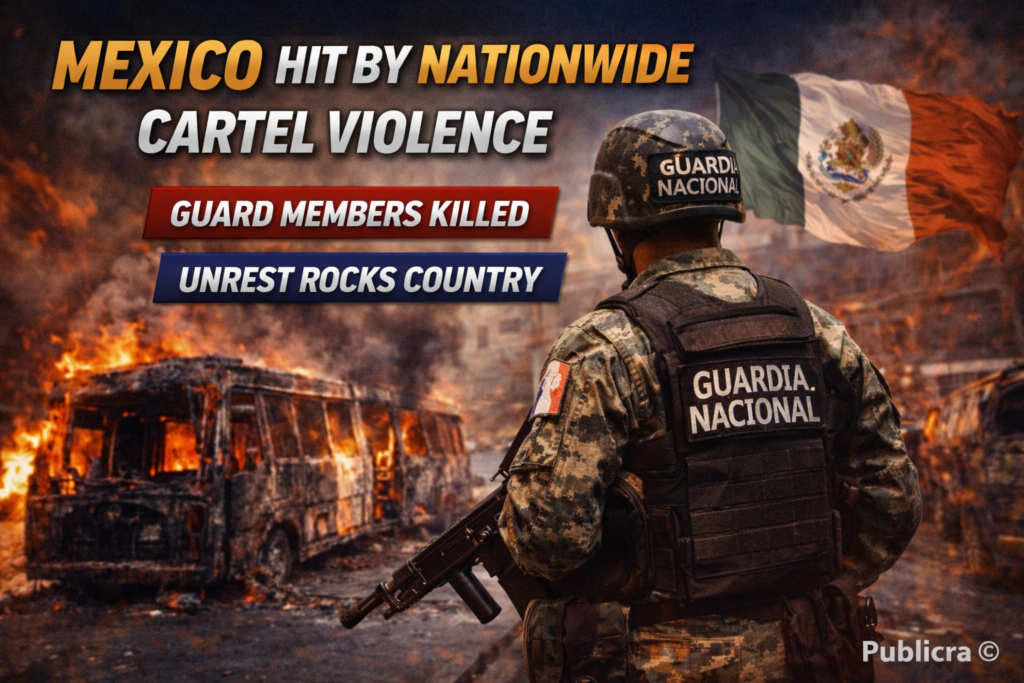
At least 25 National Guard members killed as unrest spreads nationwide following capture and death of feared drug lord
Mexico has been plunged into one of its most intense waves of cartel violence in recent years following the capture and death of Nemesio Oseguera Cervantes, widely known as “El Mencho.” The aftermath has been marked by widespread arson attacks, road blockades, and targeted assaults on security forces, with at least 25 members of the National Guard confirmed dead in multiple incidents across the country.
The scale and coordination of the violence underline the power wielded by the Jalisco New Generation Cartel (CJNG), which El Mencho led for years. As authorities move to reassert control, the crisis has once again exposed deep-rooted challenges in Mexico’s long-running battle against organised crime.
Who Was El Mencho and Why His Death Matters
El Mencho rose from relative obscurity to become the most powerful drug lord in Mexico, transforming the CJNG into one of the most ruthless and expansive criminal organizations in the country. Under his leadership, the cartel diversified into drug trafficking, extortion, fuel theft, and territorial control, building a sophisticated network that rivaled older criminal syndicates.
His death marks a significant symbolic victory for Mexican authorities. However, history suggests that removing a cartel leader often triggers violent power struggles and retaliatory campaigns. For the CJNG, El Mencho’s death represents both a blow to its leadership and a catalyst for demonstrating continued strength through violence.
How the Capture Operation Unfolded
The operation that led to El Mencho’s capture involved elite military units and coordinated intelligence efforts. Authorities tracked his movements and intercepted him during a covert operation. A firefight erupted between his armed security detail and military commandos, resulting in multiple casualties on both sides.
El Mencho sustained critical injuries during the encounter and later died while being transported under military custody. While the operation was framed as a major security success, it also unleashed a violent backlash that has tested the government’s ability to contain cartel retaliation.
Nationwide Unrest and the Scale of Retaliation
Following news of El Mencho’s death, coordinated attacks erupted across numerous states. Cartel operatives set vehicles ablaze, erected roadblocks using hijacked buses, and attacked public infrastructure. Entire towns were effectively paralyzed as highways were blocked with burning vehicles and spiked barriers.
The violence extended beyond Jalisco, reflecting the CJNG’s nationwide reach. Banks, shops, and municipal buildings were damaged or destroyed, leaving communities in fear. In many areas, residents were instructed to remain indoors as authorities worked to restore order.
The Human Cost: National Guard and Civilian Casualties
At least 25 members of the National Guard have been confirmed killed in the violence, making this one of the deadliest episodes for Mexican security forces in recent memory. Additional casualties include local officials, law enforcement personnel, and civilians caught in the crossfire.
Beyond the numbers, the human toll is profound. Families of fallen officers face sudden loss, while communities struggle with trauma and economic disruption. The deaths underscore the dangers faced daily by those tasked with confronting organised crime in Mexico.
Government Response and Military Deployment
In response to the unrest, the Mexican government rapidly deployed thousands of additional troops to affected regions. Military convoys and National Guard units were mobilized to dismantle roadblocks, secure transport routes, and protect key infrastructure.
The president praised the security forces for their actions, emphasizing the state’s determination to maintain order. Officials stressed coordination between federal and state authorities, seeking to present a united front against cartel violence. However, critics argue that repeated cycles of violence reveal structural weaknesses in Mexico’s security strategy.
CJNG’s Power and Organisational Structure
The CJNG is not a loosely organized gang but a highly structured criminal enterprise with regional commanders, logistics networks, and paramilitary capabilities. Its ability to mobilize coordinated attacks across multiple states demonstrates operational sophistication.
El Mencho’s leadership style emphasized aggressive territorial expansion and confrontation with rivals and authorities alike. Even after his death, the cartel’s decentralized structure allows it to continue operating. Analysts warn that internal succession battles within the CJNG could fuel further violence as factions vie for control.
The Broader Context of Mexico’s Drug War
Mexico’s struggle with organised crime spans decades, shaped by shifting cartel alliances, fragmented criminal networks, and evolving drug markets. While high-profile arrests or killings of cartel leaders are often celebrated as breakthroughs, they frequently lead to short-term spikes in violence.
The underlying drivers of cartel power—such as corruption, poverty, demand for illicit drugs, and limited economic opportunities—remain largely unaddressed. Without systemic reforms, the cycle of leader removal followed by violent retaliation is likely to continue.
Impact on Daily Life and Local Economies
The unrest has severely disrupted daily life in affected regions. Businesses closed, transport routes were severed, and residents were confined to their homes. Tourism, a key economic driver in many parts of Mexico, faces renewed challenges as images of burning vehicles and armed clashes circulate globally.
Local economies suffer long-term damage when violence deters investment and erodes trust in public safety. Small business owners face rebuilding costs, while workers lose income during prolonged shutdowns. The social fabric of communities frays under the strain of constant insecurity.
International Implications and Cross-Border Concerns
The CJNG’s activities have international dimensions, with trafficking routes extending beyond Mexico’s borders. The death of its leader and the ensuing violence raise concerns among neighboring countries about potential spillover effects.
Foreign governments monitor developments closely, particularly regarding the security of trade routes and the safety of their nationals in affected regions. The episode highlights the transnational nature of organised crime and the need for international cooperation in combating drug trafficking and related violence.
Media, Messaging, and Public Perception
Public communication plays a critical role in crises of this scale. Authorities have sought to reassure citizens that order is being restored, while also emphasizing the severity of the threat posed by criminal organizations.
At the same time, cartel messaging—often spread through social media and local intimidation—aims to project power and deter cooperation with authorities. Managing information flows and countering fear-based narratives remain key challenges for the government.
Long-Term Strategies: Beyond High-Profile Takedowns
Security experts increasingly argue that long-term solutions must go beyond targeting cartel leaders. While leadership removals disrupt criminal networks, they do not dismantle the economic and social ecosystems that sustain them.
Effective strategies may include strengthening local institutions, combating corruption, expanding economic opportunities in vulnerable regions, and reforming justice systems to ensure accountability. Community-based prevention programs and youth engagement initiatives could also reduce recruitment into criminal groups over time.
A Turning Point or Another Cycle of Violence
The death of El Mencho represents a pivotal moment in Mexico’s fight against organised crime, but the violent backlash illustrates the limits of leader-focused strategies. The immediate priority is restoring security and protecting civilians, yet the broader challenge lies in addressing the root causes that allow cartels to flourish.
As Mexico mourns fallen security personnel and communities begin the slow process of recovery, the question remains whether this moment will catalyze meaningful change—or simply mark another chapter in the country’s long struggle with cartel violence.