
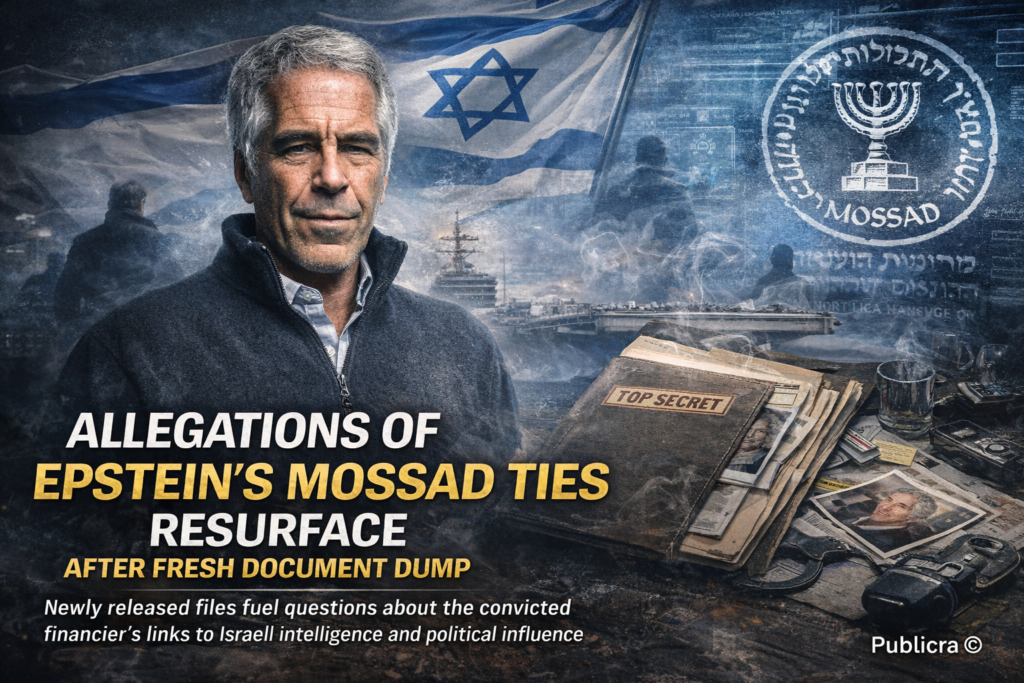
Fresh DOJ releases revive questions over Jeffrey Epstein’s elite connections, intelligence rumors, and the unresolved power networks behind his crimes
Why the Epstein Story Refuses to Fade
More than five years after the death of disgraced financier Jeffrey Epstein in a New York jail cell, the global debate around his network of power, influence, and alleged facilitators continues to resurface. In early 2026, the US Justice Department released millions of additional pages of documents connected to Epstein-related investigations and civil litigation. Although the documents do not introduce definitive proof of intelligence agency involvement, they have once again ignited online speculation and renewed public interest in Epstein’s connections to global political, financial, and technological elites.
The resurfacing of claims linking Epstein to foreign intelligence agencies, including Israel’s Mossad, has drawn widespread attention across social media platforms, alternative media outlets, and political commentary programs. These claims, however, remain unproven and continue to be disputed by governments, former officials, and mainstream investigative journalists. Still, the latest document releases have deepened concerns about the broader system of elite protection, secrecy, and accountability failures that surrounded Epstein for decades.
This article examines what the newly released documents actually reveal, why intelligence-related rumors persist, and what current investigations and public debates tell us about the unresolved legacy of one of the most disturbing scandals of the modern era.
What the Newly Released Files Contain
The January release of millions of pages of Epstein-related records stems from court-ordered disclosures tied to civil lawsuits, past federal investigations, and sealed exhibits from long-running legal proceedings. The documents include:
- Emails and correspondence between Epstein and high-profile figures
- Travel records and scheduling information
- Financial arrangements and contractual discussions
- Notes and communications referencing political and business leaders
- Previously undisclosed redactions in civil cases involving Epstein’s associates
While the materials provide new insight into Epstein’s extensive social and professional network, they do not establish proof that Epstein formally worked for any intelligence agency. Many of the claims circulating online rely on interpretation, inference, or statements by third parties, rather than verifiable documentation.
Why Intelligence Allegations Persist
The idea that Epstein may have had intelligence connections has circulated for years. Several factors contribute to the persistence of such speculation:
1. Epstein’s Unusual Access to Power
Epstein, despite lacking transparent business credentials, cultivated relationships with:
- Politicians
- Billionaire financiers
- Technology executives
- Academic institutions
- Royal and diplomatic circles
This pattern of elite access has fueled theories that Epstein acted as a “fixer,” influence broker, or intermediary—roles sometimes associated in popular imagination with intelligence services.
2. The Nature of Blackmail Allegations
Survivors and investigators have long suggested Epstein used kompromat—compromising material—against influential individuals. Blackmail is a tactic historically associated with espionage, leading some commentators to speculate about foreign intelligence involvement. However, no official investigative body has substantiated claims that Epstein’s activities were coordinated by any intelligence agency.
3. The Maxwell Family Legacy
Public scrutiny of Ghislaine Maxwell’s family background—particularly the controversial legacy of her father, Robert Maxwell—has contributed to broader theories linking Epstein’s circle to international intelligence networks. Historians and journalists continue to debate aspects of Robert Maxwell’s past, but there is no confirmed evidence tying Jeffrey Epstein’s criminal activities to state intelligence operations.
Political Figures and Global Power Networks
The newly disclosed records reference interactions with current and former political leaders, business executives, and international investors. Among those mentioned in various emails and scheduling documents are former government officials and high-ranking business leaders from the US, Europe, and the Middle East.
However, inclusion in Epstein’s contact records does not imply wrongdoing. Legal experts emphasize that many individuals listed in the files may have had professional, philanthropic, or social contact with Epstein before his crimes were publicly known. The documents illustrate how Epstein positioned himself as a connector in elite circles, often offering introductions, investment ideas, or access to private gatherings.
Media Coverage and Public Polarization
The Epstein case continues to divide public opinion, particularly between mainstream investigative outlets and alternative media platforms. Major international news organizations such as BBC, CNN, The New York Times, and Reuters have consistently emphasized the lack of verified evidence for intelligence agency involvement. These outlets focus on:
- Institutional failures
- Prosecutorial misconduct
- Lenient plea deals
- The role of enablers and facilitators
- Ongoing civil litigation against Epstein’s associates
By contrast, alternative media and political commentators frequently highlight intelligence-related theories, often citing former intelligence officers or whistleblowers whose claims remain controversial or disputed.
The Role of Disinformation in High-Profile Scandals
Experts in media literacy and cybersecurity warn that high-profile scandals like Epstein’s case are particularly vulnerable to disinformation. Social media algorithms amplify sensational claims, and fragmented information ecosystems allow speculative narratives to gain traction quickly.
Current trends include:
- AI-generated “leaks” and fake documents
- Misattributed quotes and edited screenshots
- Viral video clips taken out of context
- Coordinated online campaigns pushing geopolitical narratives
As a result, audiences are increasingly encouraged to rely on verified sources, cross-check claims, and differentiate between allegations and confirmed facts.
What Investigations Are Still Ongoing?
Despite Epstein’s death, legal and investigative processes continue. These include:
Civil Litigation
Victims are pursuing civil cases against Epstein’s estate and alleged enablers, seeking financial compensation and institutional accountability.
Institutional Reviews
Several financial institutions and universities linked to Epstein have launched internal investigations into:
- Donation vetting procedures
- Due diligence failures
- Compliance lapses
Policy Reforms
Lawmakers in the US and Europe are debating reforms related to:
- Non-prosecution agreements
- Victim compensation frameworks
- Transparency in plea deal negotiations
- Statutes of limitations for sexual abuse crimes
The Broader Question: How Did Epstein Operate for So Long?
Perhaps the most important question is not whether Epstein had intelligence ties, but how he managed to operate for decades despite repeated warnings and complaints. Analysts point to systemic failures including:
- Weak oversight of financial intermediaries
- Political influence shielding wealthy individuals
- Gaps in cross-border law enforcement cooperation
- Underreporting of abuse due to power imbalances
This systemic breakdown continues to be the subject of parliamentary hearings, investigative documentaries, and academic research into elite accountability.
Digital Forensics and the Search for Truth
Modern forensic techniques are now being applied to Epstein-related evidence, including:
- Metadata analysis of emails
- Financial transaction tracing
- Network mapping of associates
- Archival reconstruction of deleted records
Experts believe digital forensics may uncover new insights into Epstein’s operational methods, even if it does not substantiate intelligence agency involvement.
What This Means for the Future of Accountability
The renewed focus on Epstein’s network reflects growing global demands for transparency and justice in cases involving powerful elites. Public pressure has already influenced:
- The reopening of certain investigations
- Greater scrutiny of sealed court records
- Increased protections for whistleblowers
- Reforms in how prosecutors handle high-profile defendants
The Epstein case has become emblematic of a broader crisis of trust in institutions tasked with protecting vulnerable populations from abuse by powerful individuals.
A Delicate Line Between Investigation and Speculation
While public curiosity around intelligence links is understandable, legal scholars caution against drawing conclusions without verifiable evidence. Defamation laws, ethical journalism standards, and the rights of individuals named in documents require careful, responsible reporting.
At the same time, transparency advocates argue that secrecy surrounding elite misconduct enables abuse to persist. The challenge lies in balancing investigative scrutiny with factual integrity.
Final Takeaway: The Case That Keeps Testing Global Trust
The latest release of Epstein-related files has once again reopened global debate—not because it proves new theories, but because it highlights how much remains unresolved about elite protection networks, prosecutorial failures, and systemic blind spots. While intelligence agency claims remain unproven, the broader lesson is clear: when power, secrecy, and wealth intersect without accountability, abuse can flourish unchecked.
For journalists, policymakers, and the public alike, the Epstein case remains a stark reminder that justice delayed often becomes justice denied—and that transparency is the only antidote to speculation.