
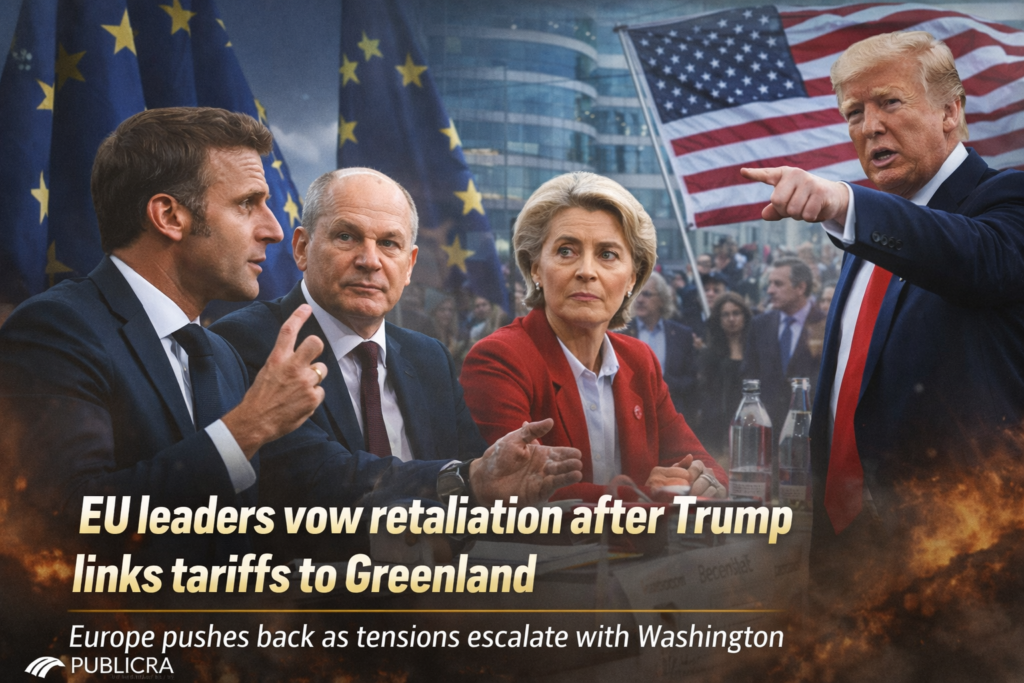
European leaders warn of retaliation after Trump links tariffs to Greenland sale
France pushes emergency economic tools as EU unity hardens against U.S. pressure
European Union heavyweights, including Germany and France, on Sunday rejected U.S. President Donald Trump’s threat to impose new trade tariffs linked to Greenland. Leaders warned that Europe would not bow to economic pressure and was ready to defend its interests.
Trump said he would impose steadily rising tariffs on Denmark, Sweden, France, Germany, the Netherlands and Finland. Britain and Norway would also be targeted. He said the measures would remain until the United States is allowed to buy Greenland.
The remarks sharply escalated tensions between Washington and its European partners.
EU governments said the threat could seriously damage transatlantic relations. They warned that using tariffs as leverage risked triggering a wider trade confrontation. European leaders stressed that Greenland remains under Danish sovereignty.
They also said recent security activity on the Arctic island was defensive and transparent.
Danish Prime Minister Mette Frederiksen welcomed the strong show of support from EU partners. She said Europe would respond with unity, not fear. Leaders in Germany and Sweden echoed her message.
The Dutch foreign minister accused Washington of using trade as a political weapon.
As tensions rose, Cyprus, which holds the EU’s rotating presidency, called an emergency meeting of ambassadors in Brussels. The goal was to coordinate a common European response.
France pushed for tougher action. Officials urged the use of the EU’s Anti-Coercion Instrument. The tool could limit U.S. access to European public contracts, financial services and digital trade. Ireland warned, however, that moving too quickly could worsen the standoff.
Italy struck a softer tone. Prime Minister Giorgia Meloni said she spoke directly with Trump and called the tariff threat a mistake. She added that he appeared open to dialogue.
Britain urged restraint. Ministers warned against escalating rhetoric but said Greenland’s status was not open to negotiation.
The dispute has also clouded recent trade agreements between the United States, the EU and Britain. Those deals were already criticized for favoring Washington by keeping U.S. tariffs in place while Europe made concessions.
In Brussels, lawmakers are now expected to delay approval of the EU-U.S. trade framework. Some politicians have suggested symbolic pressure, including reconsidering participation in U.S.-hosted global events.
The episode highlights growing unease in Europe over Washington’s use of tariffs as leverage. It also exposes deepening strains in the transatlantic alliance.