
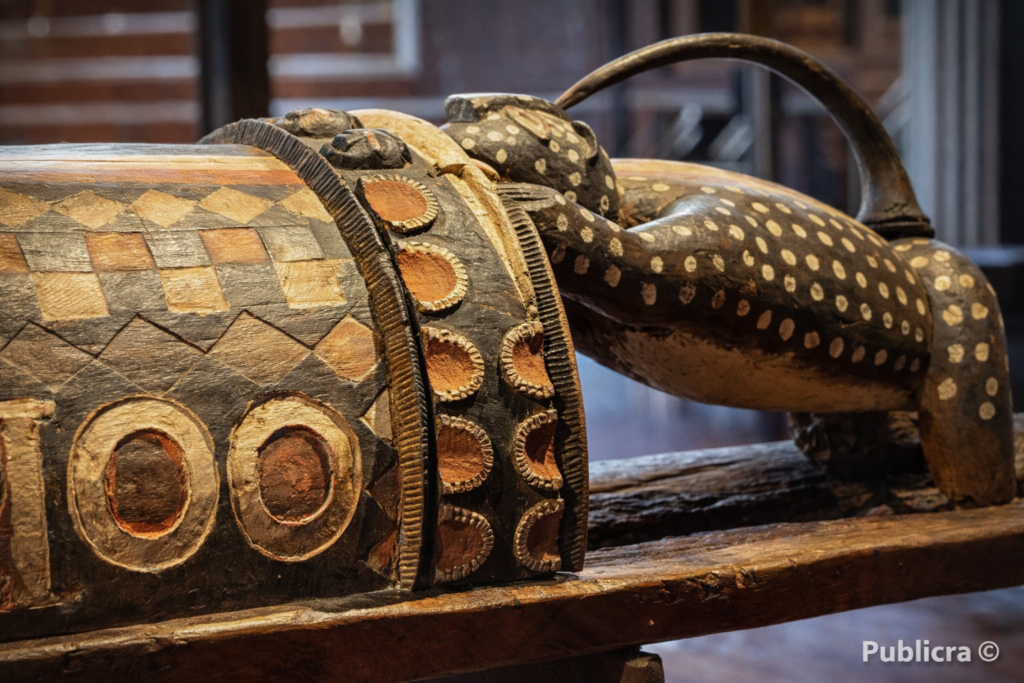
The repatriation of the Djidji Ayokwe highlights growing momentum to return colonial-era artifacts to Africa
France has officially returned the Djidji Ayokwe, a sacred “talking drum” taken from Ivory Coast during the colonial era, in a move widely hailed as a landmark step in the global campaign to restore African cultural heritage. The return of the artifact, nearly a century after it was confiscated by colonial authorities, carries deep symbolic meaning for communities in Ivory Coast and for broader debates about the ownership of cultural property held in European museums.
The Djidji Ayokwe is more than a musical instrument. For the Ebrie people, it represents memory, communication, authority, and resistance. Its return has reignited conversations about how colonial-era looting shaped museum collections across Europe and how those historical injustices can be addressed today.
The Story of the Djidji Ayokwe and Its Cultural Significance
The Djidji Ayokwe, often referred to as a “talking drum,” holds a central place in the cultural and spiritual life of the Ebrie people of southern Ivory Coast. Traditionally used to transmit messages across villages, the drum served as an early communication system, warning of danger, calling people together for ceremonies, and mobilizing communities in times of conflict.
Beyond its practical role, the drum symbolized collective identity and continuity. It was embedded in rituals, storytelling, and governance, acting as a bridge between generations. The removal of such an artifact from its community did not merely deprive the people of an object; it disrupted cultural transmission and spiritual connection.
How the Drum Was Taken During Colonial Rule
The confiscation of the Djidji Ayokwe in 1916 occurred during a period of heightened colonial repression. French colonial authorities seized the drum as part of efforts to suppress resistance among local communities. Removing symbols of communication and unity was a strategic tactic designed to weaken collective organization.
The drum was later transported to France, where it became part of museum collections. Over the decades, it was displayed as an ethnographic artifact, detached from its living cultural context. For descendants of the Ebrie people, the drum’s presence in a foreign museum stood as a reminder of the broader dispossession experienced under colonial rule.
Why Repatriation Matters to Ivory Coast
For Ivory Coast, the return of the Djidji Ayokwe is not merely a ceremonial gesture. It represents the restoration of a vital piece of national and communal heritage. Cultural leaders in the country have emphasized that such artifacts carry living meaning and must be reconnected with the communities that created and sustained them.
Repatriation is also seen as a step toward cultural healing. The return of sacred objects helps restore dignity to communities whose histories were marginalized or erased under colonial systems. In practical terms, the drum’s return provides opportunities for cultural education, museum exhibitions within Ivory Coast, and renewed interest among younger generations in traditional heritage.
The Growing Global Movement for Restitution
The repatriation of the Djidji Ayokwe is part of a broader global movement demanding the return of cultural artifacts taken during colonial rule. Across Africa, Asia, and Latin America, governments and cultural institutions have called for the restitution of objects that were removed without consent.
This movement reflects changing attitudes within Europe and North America. Museums that once viewed themselves as neutral custodians are now confronting the ethical implications of how their collections were acquired. Public pressure, scholarly research, and activism have pushed institutions to acknowledge that many artifacts were obtained under coercive or unequal conditions.
France’s Changing Stance on Colonial-Era Collections
France has been at the center of debates about restitution due to the vast number of African artifacts held in its museums. In recent years, French leaders have signaled a shift in policy, acknowledging that the presence of looted objects in European collections is incompatible with modern values of cultural equity and justice.
The return of the Djidji Ayokwe follows earlier high-profile restitutions and signals a willingness to move from symbolic promises to concrete actions. While critics argue that progress remains slow, cultural officials view each repatriation as a building block toward a more equitable relationship between former colonial powers and African nations.
The Role of UNESCO and International Cooperation
International organizations have played a crucial role in facilitating repatriation efforts. By providing technical expertise, funding for conservation, and platforms for dialogue, they help ensure that returned artifacts are preserved and accessible to the public in their countries of origin.
In the case of the Djidji Ayokwe, international support has been directed toward preservation and public engagement, ensuring that the drum will be displayed and cared for in a manner that respects its cultural significance. Such cooperation highlights the importance of global partnerships in addressing the legacy of colonial-era cultural displacement.
Museum Ethics and the Future of Collections
The return of sacred artifacts raises fundamental questions about the role of museums. Traditionally, Western museums have positioned themselves as universal spaces for global heritage. Critics counter that this narrative often masks histories of exploitation and extraction.
Museums are now grappling with how to balance educational missions with ethical responsibilities. Some institutions are developing shared custodianship models, long-term loans, or collaborative exhibitions that involve source communities. Others are undertaking provenance research to identify objects that were acquired under questionable circumstances.
The future of museum collections may increasingly involve dialogue with communities of origin, transforming museums from sites of unilateral display into spaces of cross-cultural partnership.
Economic and Educational Impacts of Repatriation
Beyond symbolic value, repatriation can have tangible economic and educational benefits for African countries. Returned artifacts can become focal points for cultural tourism, drawing visitors to local museums and heritage sites.
Educationally, these objects provide invaluable resources for teaching history, art, and cultural identity. For young people in Ivory Coast, encountering the Djidji Ayokwe in a local context offers a powerful connection to their heritage that cannot be replicated by viewing the object in a distant foreign museum.
Critics and Challenges of Restitution
Despite broad support for restitution, the process is not without controversy. Some critics argue that museums provide better conservation conditions than institutions in countries with limited resources. Others worry about the legal complexities of ownership and the precedent that large-scale restitution could set for museum collections worldwide.
Supporters counter that these concerns often reflect outdated assumptions about capacity in African countries. Many nations have invested in modern museums, conservation facilities, and professional training. The return of artifacts can also catalyze further investment in cultural infrastructure.
The Political Dimensions of Cultural Return
Repatriation is inherently political. It intersects with debates about historical responsibility, post-colonial relations, and soft power diplomacy. For France, returning artifacts can be seen as an effort to recalibrate relationships with African nations, acknowledging past injustices while fostering contemporary cultural partnerships.
For African governments, restitution strengthens national narratives of sovereignty and cultural pride. It also serves as a platform for asserting agency in international cultural policy, challenging long-standing power imbalances in the global heritage sector.
What Comes Next for Restitution Efforts
The return of the Djidji Ayokwe is unlikely to be the final chapter in restitution debates. Many African nations continue to seek the return of thousands of artifacts housed in European museums. The challenge lies in creating transparent, fair, and scalable frameworks for restitution that balance legal, ethical, and practical considerations.
Future efforts may focus on collaborative models that combine repatriation with knowledge exchange, capacity building, and joint research. Digital technologies, such as 3D documentation and virtual exhibitions, may also play a role in making heritage accessible across borders while respecting ownership claims.
Restoring Heritage, Redefining Relationships
The return of the Djidji Ayokwe to Ivory Coast represents more than the physical movement of an object. It symbolizes a broader reckoning with the legacies of colonialism and the ethical responsibilities of cultural institutions.
As restitution efforts gain momentum, they offer an opportunity to redefine relationships between former colonial powers and African nations—moving from a history of extraction toward a future of partnership, respect, and shared stewardship of humanity’s cultural heritage.