
European markets face fresh energy shock as shipping through strait of Hormuz stalls and Qatar halts LNG output
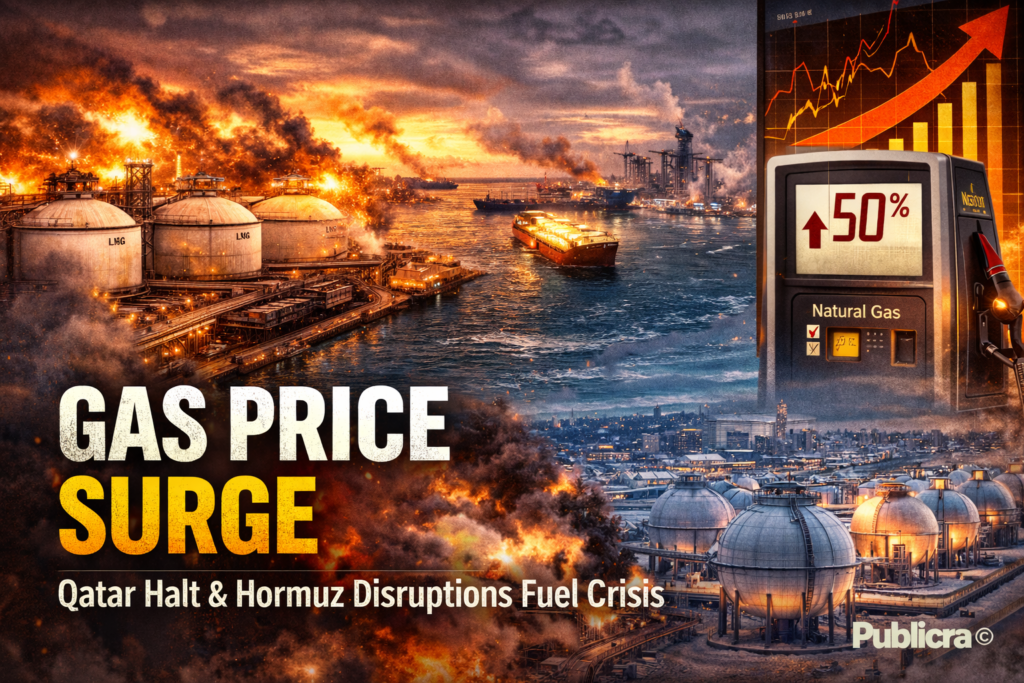
Global gas markets were shaken after European benchmark natural gas prices jumped nearly 50% in a single trading session — the largest surge since the 2022 energy crisis. The rally follows heightened military tensions in the Middle East that have disrupted LNG shipments through the Strait of Hormuz and forced production halts at Qatar’s flagship gas complex.
The sudden spike has reignited fears of a prolonged supply shock, with analysts warning that energy markets could face their most serious disruption in years if shipping routes remain unsafe.
STRAIT OF HORMUZ: THE WORLD’S ENERGY CHOKEPOINT
Strait of Hormuz is one of the most strategically important waterways in the world. Roughly 20% of global oil and gas shipments pass through this narrow channel between Iran and Oman.
Over the weekend, LNG tankers reportedly slowed or halted transit through the strait due to escalating military risks and concerns over insurance coverage. Maritime insurers are reviewing or suspending war-risk policies for vessels entering the Persian Gulf, dramatically increasing shipping uncertainty.
If shipping remains stalled, global supply chains for both oil and liquefied natural gas (LNG) could experience sustained disruptions.
QATAR’S RAS LAFFAN LNG COMPLEX HALTED
QatarEnergy confirmed that operations at its major LNG hub in Ras Laffan Industrial City were halted following a reported drone strike.
Ras Laffan is one of the world’s largest LNG production and export centers. A halt at this facility has immediate global consequences because:
- Qatar is one of the top LNG exporters worldwide
- Europe depends heavily on Qatari LNG shipments
- Global LNG markets are already tight
The production stoppage compounded fears already building from shipping disruptions through the Strait of Hormuz.
EUROPEAN GAS PRICES: BIGGEST MOVE SINCE 2022
European benchmark gas futures surged by approximately 50%, marking the sharpest single-day increase since March 2022 — during the peak of the post-Ukraine conflict energy crisis.
Europe remains especially vulnerable because:
- It reduced Russian pipeline gas imports after 2022
- It increased reliance on LNG from Qatar and the US
- Storage levels are lower than usual for this time of year
- Summer restocking is essential ahead of winter
With LNG shipments now under threat, traders are rapidly pricing in worst-case supply scenarios.
OIL MARKETS FOLLOW GAS HIGHER
The ripple effects extended beyond gas markets. Brent crude futures climbed to multi-month highs as traders assessed risks to broader Gulf energy flows.
The Middle East accounts for a substantial share of global crude exports. Even temporary shipping interruptions can send prices sharply higher due to tight global balances.
Energy analysts warn that:
- A one-month shipping halt could drive dramatic price spikes
- Extended conflict could strain refinery output
- Insurance and freight costs will increase
Markets are reacting not just to current supply losses, but to the growing probability of prolonged instability.
EUROPE’S POST-RUSSIAN ENERGY STRATEGY UNDER PRESSURE
Following the escalation of the Ukraine conflict in 2022, the European Union scaled back imports of Russian oil and pipeline gas. This policy shift significantly reshaped Europe’s energy mix.
Europe’s strategy relied heavily on:
- LNG imports from the United States
- LNG imports from Qatar
- Increased renewable energy deployment
- Diversified pipeline suppliers
However, LNG is inherently more volatile because it depends on shipping lanes and global spot pricing.
Now, with shipping risks rising in the Gulf, Europe faces renewed exposure to external shocks.
ANALYST PROJECTIONS: COULD PRICES DOUBLE AGAIN?
Major financial institutions have begun issuing warnings. Analysts estimate that a prolonged shutdown of shipping through the Strait of Hormuz could send European gas prices up by as much as 130% from current levels.
That would mean:
- Higher household heating bills
- Increased electricity costs
- Industrial production slowdowns
- Inflationary pressures across Europe
Energy-intensive industries — including chemicals, steel, fertilizers, and manufacturing — would be especially affected.
POLITICAL AND GEOPOLITICAL DIMENSIONS
US President Donald Trump has signaled that military operations involving Iran could continue for several weeks, increasing uncertainty in energy markets.
Meanwhile, regional tensions have widened, with multiple Gulf states affected by strikes and retaliatory operations.
The geopolitical landscape now includes:
- Direct military exchanges
- Disrupted energy infrastructure
- Maritime insurance suspensions
- Strategic positioning by global powers
The longer the conflict continues, the more deeply embedded these disruptions could become.
RUSSIA’S RESPONSE AND STRATEGIC POSITIONING
Kirill Dmitriev, head of Russia’s sovereign wealth fund, argued that the current spike highlights Europe’s vulnerability after moving away from Russian fuel supplies.
His remarks suggest Moscow may seek to position itself as a “stable alternative supplier,” especially if Europe’s LNG supply remains constrained.
However, re-establishing large-scale pipeline dependency would require major political shifts within the European Union — a scenario that remains uncertain.
LNG SHIPPING AND INSURANCE CRISIS
Maritime insurers play a critical role in energy transport. Without war-risk insurance:
- Tankers may refuse to enter conflict zones
- Freight costs can surge dramatically
- Shipping schedules become unreliable
If insurers fully withdraw coverage, even available LNG cargoes may struggle to reach European ports.
Shipping routes through alternative pathways are limited, and pipeline substitutes cannot fully replace LNG volumes from the Gulf.
ENERGY SECURITY VS ENERGY TRANSITION
The crisis underscores a broader dilemma: balancing energy security with long-term energy transition goals.
Europe has aggressively pursued decarbonization, but fossil fuels — particularly natural gas — remain essential for:
- Grid stability
- Industrial production
- Heating
Sudden supply shocks complicate both climate and economic planning.
Renewable energy expansion cannot instantly compensate for disrupted LNG flows.
WHAT HAPPENS NEXT?
The trajectory of gas prices will depend on:
- Whether shipping through the Strait of Hormuz resumes
- The duration of Qatar’s production halt
- Diplomatic intervention
- Military escalation levels
Short-term volatility is almost certain. Medium-term stabilization will depend on security guarantees for shipping lanes.
Markets remain highly sensitive to headlines and operational updates.
The 50% surge in European gas prices reflects more than immediate supply losses — it signals deep anxiety about systemic energy vulnerabilities in a geopolitically fragile region.
With LNG shipments stalled, production halted in Qatar, and insurance coverage in doubt, the global energy market faces renewed uncertainty.
If shipping disruptions persist, Europe could experience another severe energy crunch reminiscent of 2022 — with far-reaching economic and political consequences.
The Strait of Hormuz once again stands at the center of global stability.