
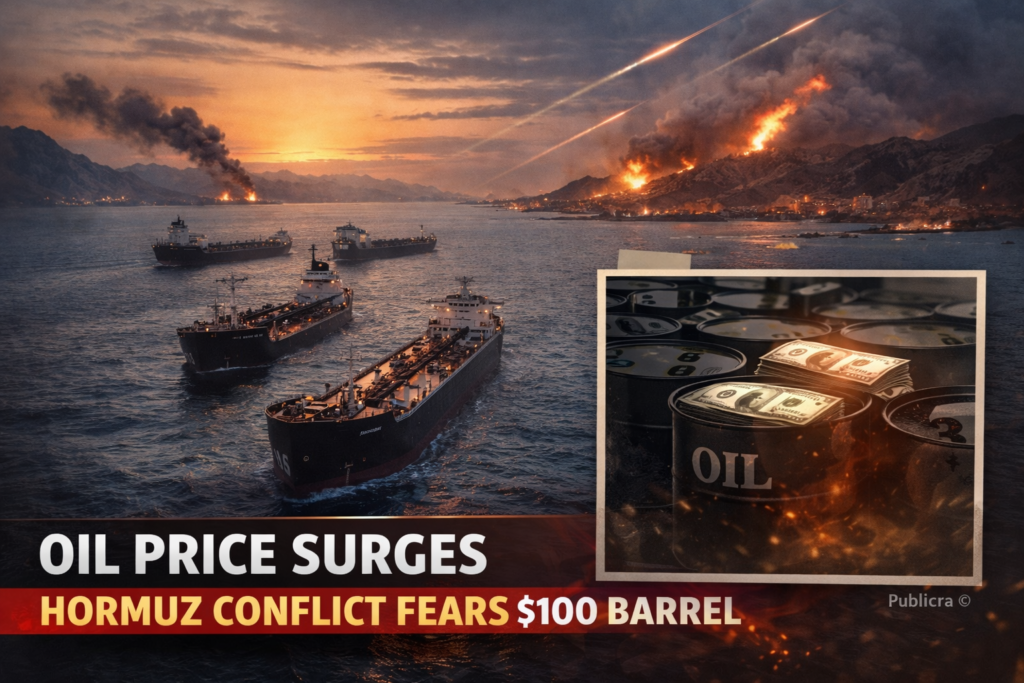
Energy markets brace for $100 crude as middle east war disrupts global shipments and fuels economic uncertainty
Brent Crude Spikes 10% Amid Escalating Iran Conflict
Global oil markets reacted sharply after renewed military conflict in the Middle East triggered fears of supply disruptions. Brent crude surged approximately 10% in over-the-counter trading to around $80 per barrel, with analysts warning prices could spike to $100 or beyond if tensions escalate further.
The surge follows U.S. and Israeli strikes on Iranian targets, prompting warnings from Tehran and raising serious concerns about the potential closure of the Strait of Hormuz — one of the most critical oil transit chokepoints in the world.
While futures markets were closed over the weekend, energy traders and analysts expect strong upward momentum when trading resumes, potentially pushing prices significantly higher.
Why The Strait Of Hormuz Is Critical To Global Energy
The Strait of Hormuz is a narrow waterway linking the Persian Gulf with the Arabian Sea and global markets. It handles more than 20% of the world’s oil shipments daily — roughly 20 million barrels per day.
Key Risk Factors:
- Tehran has warned vessels against moving through the strait.
- Several tanker owners and trading firms have reportedly suspended shipments.
- Insurance costs for vessels are likely to rise sharply.
- Liquefied natural gas (LNG) shipments are also at risk.
If the strait were to close even temporarily, analysts estimate between 8 to 10 million barrels per day of crude supply could be removed from global markets — even after rerouting through alternative pipelines in Saudi Arabia and the UAE.
Energy strategist Ajay Parmar of ICIS noted that the market’s real concern is not just military strikes, but the disruption of oil flow through Hormuz.
Could Oil Reach $100 Per Barrel? Analysts Weigh In
Several energy analysts believe oil prices could rapidly climb toward $100 per barrel if the situation worsens.
Market Forecasts:
- RBC Capital Markets suggests crude could exceed $100 if the Strait is closed.
- Rabobank analysts project near-term prices above $90.
- Rystad Energy forecasts a jump toward $92 upon market reopening.
- Traders anticipate extreme volatility once futures trading resumes.
The geopolitical premium — the additional cost markets assign due to instability — is rising quickly.
If prolonged disruption occurs, oil-importing nations across Asia and Europe could face significant inflationary pressure, while emerging markets may struggle with energy affordability.
OPEC+ Moves To Increase Production
In response to market instability, OPEC+ agreed to raise oil output by 206,000 barrels per day starting in April.
While the move signals an attempt to calm markets, the increase represents less than 0.2% of global demand — a relatively modest boost compared to the potential supply loss if Hormuz disruptions continue.
Saudi Arabia and the United Arab Emirates are reportedly increasing exports through alternative routes, including:
- Saudi Arabia’s East-West pipeline
- Abu Dhabi’s Fujairah pipeline
However, experts caution that these alternatives cannot fully compensate for a prolonged Strait closure.
Impact On Asian And European Energy Security
Asian nations — particularly India, China, Japan, and South Korea — are closely monitoring developments.
India, one of the largest importers of Middle Eastern crude, may increase purchases from Russia to offset potential supply losses. Analysts at Kpler suggest Asian refiners are reviewing stockpiles and contingency plans.
European nations, already navigating energy diversification efforts following earlier geopolitical shocks, could also face renewed supply stress.
The crisis underscores how interconnected global energy markets remain.
Inflation And Global Economic Implications
Oil price spikes historically drive:
- Higher transportation costs
- Rising food prices
- Increased manufacturing expenses
- Elevated airline fuel costs
A sustained move above $100 per barrel could reignite inflation pressures worldwide.
Central banks, including the U.S. Federal Reserve and European Central Bank, may face renewed challenges balancing inflation control with economic growth.
For developing economies dependent on oil imports, fiscal pressure could intensify quickly.
Shipping And Insurance Markets React
Maritime insurers are reassessing risk premiums for vessels operating in the Persian Gulf.
Shipping companies are:
- Delaying departures
- Reviewing alternative sea routes
- Recalculating risk assessments
Freight costs are expected to rise sharply if tensions persist.
Energy traders warn that even psychological fear can tighten supply before physical disruption occurs.
Could This Trigger A Broader Energy Crisis?
The current conflict introduces multiple uncertainties:
- Potential retaliatory strikes
- Escalation involving regional powers
- Cyber attacks on energy infrastructure
- Expanded sanctions
If geopolitical instability spreads beyond Iran, the global energy market could experience sustained volatility.
The situation also places strategic petroleum reserves (SPR) under scrutiny. Governments may consider coordinated releases to stabilize markets.
Investors Seek Safe Havens
Historically, geopolitical crises push investors toward safe-haven assets such as:
- Gold
- U.S. Treasury bonds
- The U.S. dollar
Energy stocks may initially benefit from higher prices, but broader equity markets could face downward pressure if inflation fears grow.
Long-Term Energy Transition Questions
This crisis also raises renewed debate over energy diversification and sustainability:
- Should nations accelerate renewable energy investments?
- How vulnerable is the global economy to chokepoints like Hormuz?
- Will geopolitical instability speed up electrification efforts?
While fossil fuels remain dominant, geopolitical shocks often accelerate policy shifts toward alternative energy sources.
What Happens Next?
Markets are awaiting:
- Confirmation of shipping routes reopening
- Diplomatic efforts to de-escalate
- Official trading activity when futures reopen
- Statements from major oil producers
Volatility is expected to remain elevated in the coming days.
Much depends on whether the Strait of Hormuz remains operational or faces sustained disruption.