
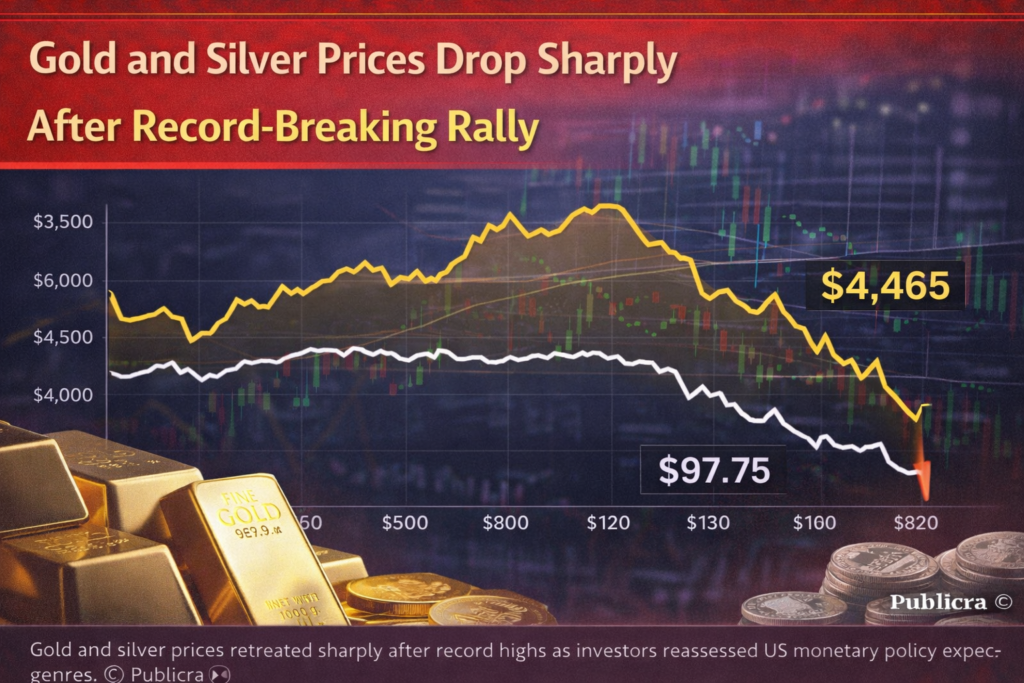
Precious metals retreat sharply from historic highs as investors reassess interest-rate expectations following Donald Trump’s Federal Reserve chair nomination.
From Euphoria to Shock in Precious Metals
Global precious metals markets were jolted this week as gold and silver prices extended a sharp sell-off, reversing a spectacular rally that had pushed both metals to historic highs only days earlier.
Gold plunged nearly 8% in a single session, while silver continued its steep decline after suffering one of its biggest drops on record. The abrupt reversal followed news that US President Donald Trump plans to nominate former Federal Reserve Governor Kevin Warsh to succeed current Fed Chair Jerome Powell, triggering a rapid repricing of interest-rate expectations.
The episode underscores how sensitive commodities markets have become to shifts in monetary policy outlooks, speculative positioning, and geopolitical financial flows.
What Happened: A Violent Market Reversal
On Monday:
- Gold fell to around $4,465 per ounce, down sharply from record levels near $5,600 reached last week
- Silver dropped another 7%, compounding a 30% collapse on Friday
- Trading volumes surged as leveraged positions were unwound
The declines marked one of the fastest reversals in precious metals history, ending a rally that had captivated investors worldwide.
Trump’s Fed Chair Pick Triggers Repricing
The catalyst for the sell-off was President Trump’s announcement that he intends to nominate Kevin Warsh, a former Federal Reserve governor, as the next Fed chair when Jerome Powell’s term ends in May.
Although Trump emphasized that he did not demand rate cuts from Warsh, the announcement calmed fears that the central bank would pivot aggressively toward ultra-loose monetary policy.
Markets had previously priced in:
- Rapid interest-rate cuts
- A weaker US dollar
- Stronger inflation hedging demand
Once those assumptions were questioned, gold and silver prices retreated violently.
Why Interest Rates Matter for Gold and Silver
Gold and silver do not generate yield. Their appeal rises when:
- Interest rates fall
- Inflation accelerates
- Currency values weaken
Conversely, higher or stable interest rates increase the opportunity cost of holding non-yielding assets.
The Warsh nomination signaled:
- A potentially more orthodox Fed stance
- Less political pressure for aggressive easing
- A slower path toward rate cuts
That shift alone was enough to unwind weeks of speculative buying.
Speculative Excess Amplified the Crash
Market analysts say the sell-off was worsened by overcrowded speculative positions, particularly from Asian traders.
According to Bloomberg:
- Chinese investors poured “hot money” into metals futures
- Prices were pushed far beyond historical norms
- Leverage magnified both gains and losses
Mohit Kumar of Jefferies described the move as a classic “crowded trade unwind,” noting that positioning levels had reached extreme territory.
Silver’s Collapse Highlights Volatility Risks
Silver’s decline was even more dramatic than gold’s.
After reaching above $120 per ounce, silver suffered:
- A 30% crash in one day
- Continued losses as margin calls forced liquidations
Unlike gold, silver’s industrial use makes it more sensitive to:
- Global growth expectations
- Manufacturing demand
- Risk sentiment
As traders exited speculative positions, silver’s volatility was brutally exposed.
Russia’s Windfall From the Rally
One of the most striking consequences of the metals surge was its impact on Russia’s finances.
During the rally:
- Russia’s gold reserves gained value comparable to $300 billion
- That figure roughly matches the value of Russian sovereign assets frozen in the West
Unlike frozen assets, gold reserves:
- Can be sold
- Used as collateral
- Provide liquidity
Analysts say the rally temporarily strengthened Moscow’s financial position, even as prices have since retreated.
Deutsche Bank Still Bullish on Gold
Despite the sharp correction, major banks remain optimistic about gold’s longer-term outlook.
Analysts at Deutsche Bank said they still expect gold to:
- Reach $6,000 per ounce later this year
- Benefit from structural inflation risks
- Attract central-bank buying
They described the pullback as a reset rather than a collapse.
2025: A Historic Year for Precious Metals
Even after the correction, 2025 remains exceptional for metals.
Gold:
- Posted its biggest annual gain since 1979
- Benefited from geopolitical instability
- Saw record central-bank purchases
Silver:
- Outperformed most asset classes earlier in the year
- Attracted speculative and industrial demand
The recent sell-off does not erase those gains—but it does highlight the risks of momentum-driven markets.
What Happens Next?
Market participants are now watching:
- Senate confirmation hearings for Kevin Warsh
- US inflation and employment data
- Federal Reserve guidance on rate cuts
- China’s demand trends
If expectations for lower rates return, gold could resume its climb. If not, consolidation may continue.
Investor Lessons From the Metals Shock
The episode offers key takeaways:
- Overcrowded trades unwind quickly
- Political signals matter as much as economic data
- Safe havens are not immune to volatility
For long-term investors, the fundamentals remain intact. For short-term traders, the warning signs were clear.
A Market Reset, Not the End of the Story
Gold and silver’s sharp retreat marks one of the most dramatic reversals in modern commodity history. Yet beneath the volatility lies a deeper truth: precious metals remain central to global finance, geopolitics, and inflation protection.
Whether the rally resumes or stabilizes, the forces driving demand—uncertainty, debt, and currency risk—have not disappeared.