
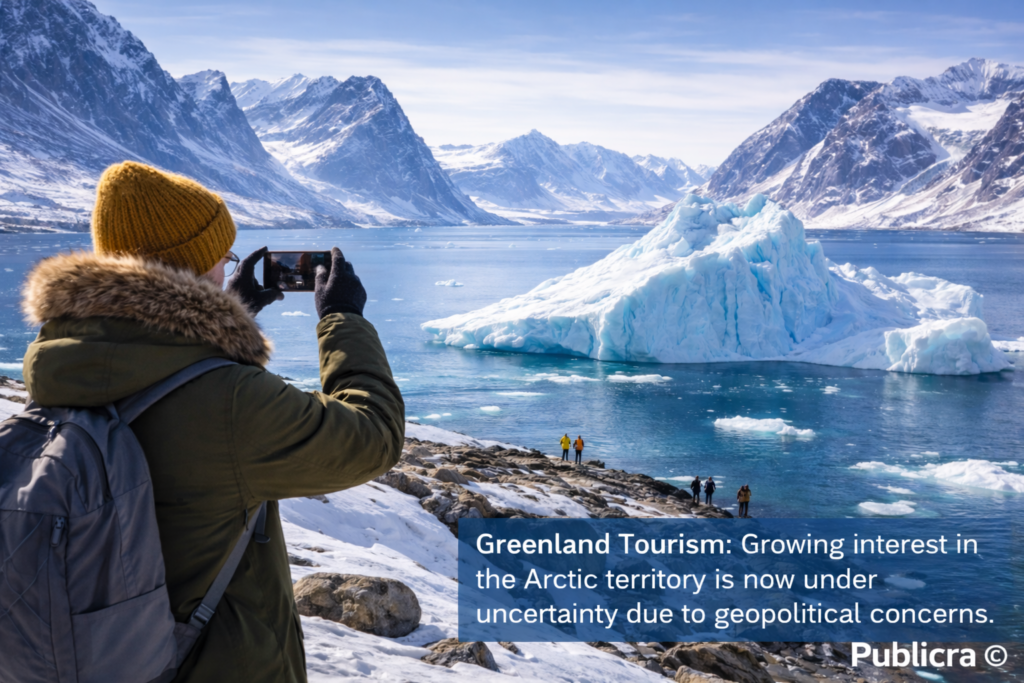
A scenic view of Greenland’s icy coastline highlighting the Arctic landscapes that have drawn rising numbers of international tourists amid growing geopolitical attention.
Greenland’s tourism industry, once buoyed by growing global curiosity about the Arctic, is now navigating an unexpected challenge: geopolitical uncertainty. Renewed interest from U.S. President Donald Trump in acquiring the island has shifted international attention from glaciers and whale safaris to questions of sovereignty, security, and stability—raising concerns among local tourism operators.
For years, Greenland had been quietly transforming itself into one of the world’s most intriguing emerging travel destinations. Now, business owners worry that political tensions could cool demand just as infrastructure improvements promise to unlock the island’s full potential.
From Global Curiosity to Global Concern
When President Trump revived his long-standing interest in Greenland early in his second term, the attention initially proved beneficial for tourism. Adventure operators, hoteliers, and tour guides reported a surge in bookings as international travelers became curious about the Arctic territory.
“Last year, the attention helped us,” said Casper Frank Møller, co-founder of Raw Arctic, an adventure tourism company offering fly-fishing trips and whale safaris. “People were curious. They wanted to see Greenland for themselves.”
The surge was so strong that Raw Arctic expanded its fleet and hired additional staff to meet demand. But that enthusiasm has faded in recent months as rhetoric around territorial acquisition intensified.
“Now we’re getting questions about whether Greenland is safe to visit,” Møller said. “That’s a very different kind of attention.”
Tourism Growth Meets Political Risk
Greenland, a semiautonomous territory within the Kingdom of Denmark, has steadily promoted tourism as part of a broader effort to diversify its economy beyond fishing and resource extraction. Climate change has also played a role, opening new cruise routes and making previously inaccessible ports viable.
According to Greenland’s tourism board, 44 percent of tourism businesses reported higher peak-season bookings in 2025 compared with the previous year. Officials projected that 2026 could be even stronger, assuming continued improvements in infrastructure.
Those projections are now clouded by geopolitical uncertainty. Industry leaders fear that international media framing Greenland as a strategic asset rather than a travel destination could discourage risk-averse travelers.
New Airports Promise Connectivity—and Higher Stakes
A major pillar of Greenland’s tourism strategy has been improved connectivity. In late 2024, a new international airport in Nuuk began handling long-haul flights, transforming access to the island. In 2025, United Airlines launched direct seasonal flights from the United States, the first such service in nearly two decades.
Two additional airports are scheduled to open in 2026, expanding access to northern and eastern regions of the island and reducing dependence on small aircraft and ferries.
“These airports are game-changers,” said Avaaraq Olsen, mayor of Nuuk. “We used to see mostly Danish and Scandinavian visitors. Now tourists come from Asia, North America, and mainland Europe.”
Local artists, guides, and small businesses have benefited from the influx. Souvenir sales have risen, restaurants report higher foot traffic, and new guesthouses have opened to meet demand.
Balancing Opportunity and Anxiety
Despite the economic benefits, many Greenlanders are uneasy about the political spotlight. The island’s leaders have repeatedly emphasized that Greenland is not for sale, and public opinion strongly favors self-determination over foreign control.
Tourism operators worry that prolonged geopolitical tension could reverse years of progress.
“Travel depends on perception,” said one hotel owner in Ilulissat. “Even if nothing changes on the ground, uncertainty alone can make people choose another destination.”
An Arctic Future Still Unwritten
Greenland’s long-term tourism prospects remain strong. Interest in Arctic landscapes, Indigenous culture, and climate-focused travel continues to grow globally. However, experts warn that sustaining momentum will require careful messaging, political stability, and continued investment in infrastructure.
For now, Greenland’s tourism industry stands at a crossroads—caught between unprecedented opportunity and an uneasy geopolitical moment that could redefine how the world views the island.