
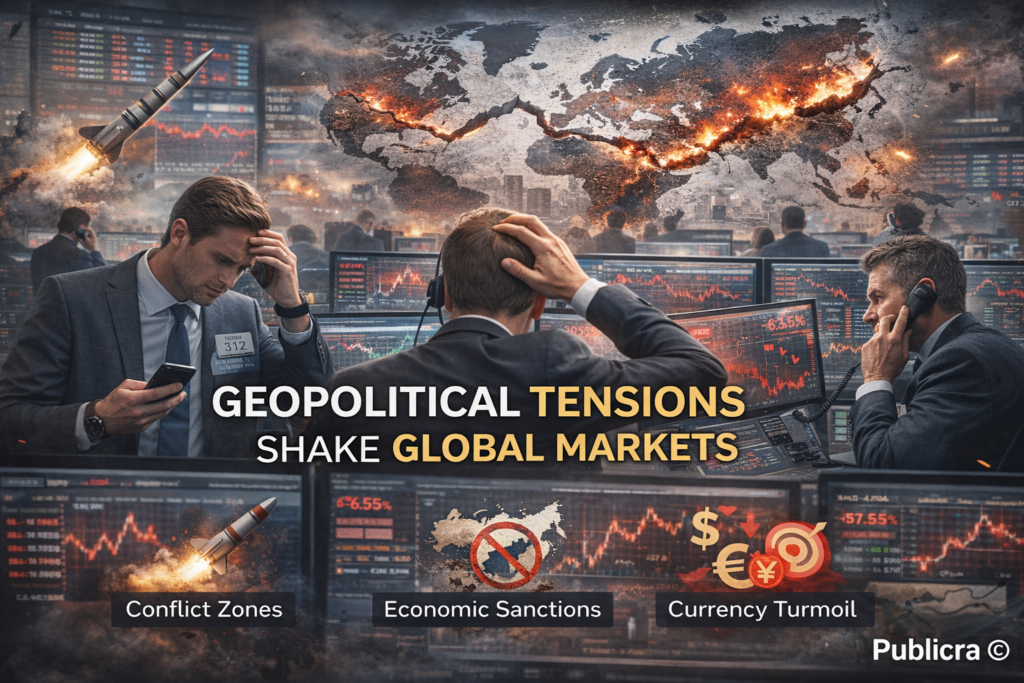
From wars and sanctions to trade disputes, political instability continues to shape financial markets worldwide
Global financial markets are increasingly driven not only by economic fundamentals but by geopolitics. In recent years, escalating geopolitical tensions—ranging from armed conflicts and diplomatic standoffs to sanctions and trade restrictions—have reshaped how investors assess risk, allocate capital, and price assets.
Even as inflation moderates in some economies and growth stabilizes in others, geopolitical uncertainty remains one of the most powerful forces influencing global markets. From stocks and currencies to commodities and bonds, no asset class is immune.
This article explores how geopolitical tensions affect global markets, why their impact has intensified in recent years, and what it means for investors, businesses, and everyday consumers.
1. Why Geopolitics Matters More to Markets Than Ever
Geopolitical events have always influenced markets, but their impact has grown significantly due to globalization. Today’s financial system is deeply interconnected, meaning a conflict or policy shift in one region can ripple across the world in seconds.
Several factors have amplified this effect:
- Highly integrated global supply chains
- Instant information flow and algorithmic trading
- Greater dependence on strategic resources like energy, semiconductors, and food
- Rising economic nationalism and protectionism
As a result, markets now react faster—and sometimes more sharply—to geopolitical developments than to traditional economic data.
2. Armed Conflicts and Market Volatility
Equity Markets
Wars and military conflicts typically trigger sharp volatility in stock markets. Investors tend to sell riskier assets and move toward safer alternatives when uncertainty rises.
Historically, equity markets often fall immediately after the outbreak of conflict, especially in regions directly affected. However, global indices can also decline as multinational companies face disruptions in production, logistics, and demand.
Defense-related stocks may benefit, but broader markets usually suffer from reduced investor confidence.
Investor Sentiment
Markets dislike uncertainty more than bad news. Prolonged conflicts increase unpredictability, making investors hesitant to commit capital. This often leads to:
- Reduced trading volumes
- Higher volatility indexes
- Short-term market sell-offs
3. Energy Markets: The First and Strongest Reaction
Energy markets are often the most sensitive to geopolitical tensions.
Oil and Gas Prices
Conflicts in energy-producing regions or near critical shipping routes can rapidly drive up oil and gas prices. Even the threat of supply disruption is enough to move prices higher, as traders price in risk premiums.
Higher energy prices affect global markets by:
- Increasing inflationary pressures
- Raising production and transportation costs
- Squeezing corporate profit margins
Impact on Energy-Dependent Economies
Countries that rely heavily on energy imports face currency weakness, rising trade deficits, and slower economic growth during geopolitical crises.
4. Sanctions and Their Market Consequences
Economic sanctions have become one of the most widely used geopolitical tools. While aimed at influencing political behavior, sanctions often have broad market consequences.
Stock and Bond Markets
Sanctions can:
- Freeze assets
- Restrict access to international capital markets
- Cut companies off from global banking systems
This can lead to:
- Falling stock prices in targeted countries
- Higher borrowing costs
- Downgrades of sovereign and corporate debt
Global Spillover Effects
Sanctions rarely affect only one country. Businesses in third-party nations may lose export markets, face compliance costs, or experience supply shortages, all of which can weigh on global markets.
5. Currency Markets and Safe-Haven Flows
Currencies are highly sensitive to geopolitical risk.
Flight to Safety
During periods of heightened geopolitical tension, investors often move capital into perceived safe-haven currencies such as:
- The U.S. dollar
- Swiss franc
- Japanese yen
This leads to currency volatility, particularly for emerging markets and countries close to conflict zones.
Emerging Market Pressure
Geopolitical instability often triggers capital outflows from emerging markets, weakening local currencies and increasing inflation through higher import costs.
6. Bond Markets and Interest Rate Expectations
Geopolitical tensions influence bond markets through changing risk perceptions and monetary policy expectations.
Government Bonds
Investors often buy government bonds from stable economies during geopolitical crises, pushing yields lower. This reflects a desire for capital preservation rather than high returns.
Central Bank Dilemmas
Geopolitical shocks—especially those affecting energy or food prices—can complicate central bank decisions. Policymakers may face a trade-off between:
- Fighting inflation
- Supporting economic growth
This uncertainty adds further volatility to interest rate markets.
7. Trade Disruptions and Supply Chain Risks
Trade routes, shipping lanes, and manufacturing hubs are vulnerable during geopolitical tensions.
Supply Chain Fragmentation
Recent years have shown how quickly global supply chains can fracture. Conflicts, sanctions, and diplomatic disputes have encouraged companies to:
- Diversify suppliers
- Shift production closer to home
- Reduce dependence on single countries
While this may improve long-term resilience, it increases costs in the short term, affecting corporate earnings and market valuations.
Impact on Global Trade
Reduced trade flows can slow global growth, weakening equity markets and increasing recession risks in trade-dependent economies.
8. Commodity Markets Beyond Energy
Geopolitics also affects agricultural and industrial commodities.
Food Prices
Conflicts in major agricultural regions can disrupt exports of grains, cooking oils, and fertilizers. This pushes food prices higher globally, contributing to inflation and social instability.
Critical Minerals
Competition over rare earths, lithium, and other strategic minerals has intensified. Restrictions on exports or access can disrupt industries such as electric vehicles, renewable energy, and technology—sectors heavily represented in global stock indices.
9. Corporate Strategy and Market Valuations
Geopolitical risks increasingly influence corporate decisions, which in turn affect markets.
Companies now factor geopolitics into:
- Investment planning
- Location of factories
- Supply chain design
- Capital expenditure
Higher geopolitical risk often leads to:
- Lower valuation multiples
- Increased risk premiums
- Delayed mergers and acquisitions
Markets reflect these changes through weaker stock performance and reduced investor appetite for long-term projects.
10. Technology, Cybersecurity, and Financial Markets
Geopolitical rivalry has expanded into cyberspace.
Cyberattacks on financial institutions, infrastructure, or corporations can:
- Disrupt trading systems
- Leak sensitive data
- Trigger regulatory scrutiny
Technology and cybersecurity stocks may benefit from increased demand, but broader markets often react negatively to fears of systemic risk.
11. Long-Term Market Implications
While markets often recover from short-term geopolitical shocks, persistent tensions can have lasting effects:
- Slower global growth
- Higher structural inflation
- Reduced cross-border investment
- Increased market fragmentation
These trends reshape global markets over time, influencing where capital flows and which regions outperform.
12. What This Means for Investors and Consumers
For investors:
- Geopolitical risk is now a core part of market analysis
- Diversification across regions and asset classes is more important than ever
- Volatility is likely to remain elevated
For consumers:
- Geopolitical tensions can raise costs of energy, food, and imported goods
- Currency fluctuations affect purchasing power
- Financial markets’ instability can influence pensions and savings
Conclusion: Markets in a Geopolitically Charged World
Geopolitical tensions are no longer occasional shocks—they are a defining feature of today’s global economy. Markets must continuously adjust to conflicts, sanctions, trade realignments, and political uncertainty.
As the world becomes more fragmented, understanding the relationship between geopolitics and global markets is essential—not only for investors, but for policymakers, businesses, and consumers navigating an increasingly uncertain financial landscape.