
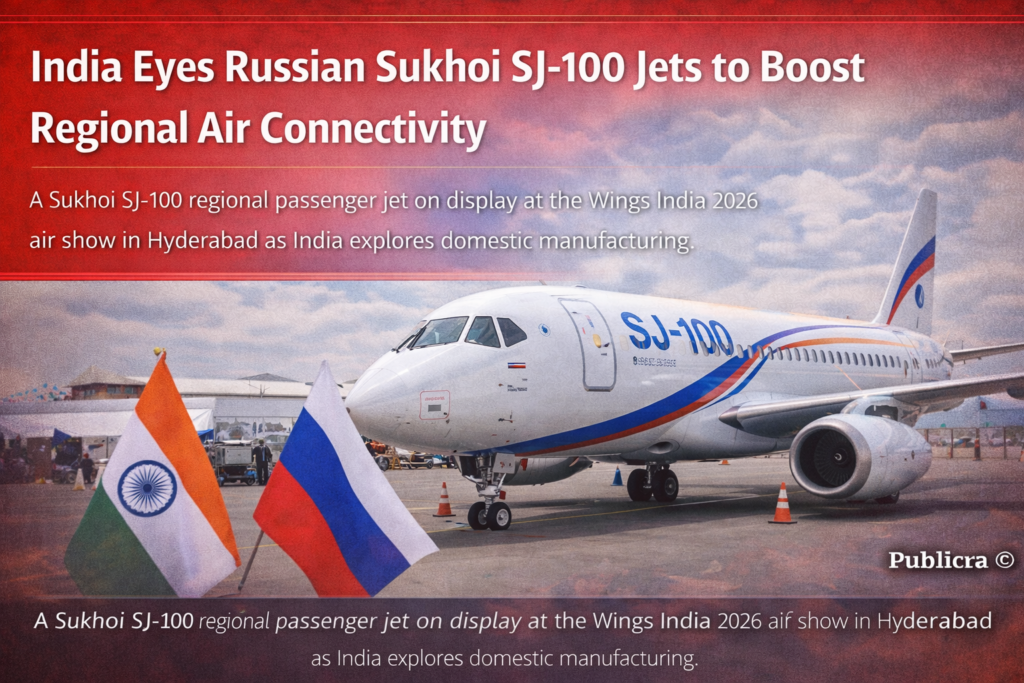
Hindustan Aeronautics Limited sees strong demand for Russian-built Sukhoi SJ-100 passenger aircraft as India accelerates regional aviation and domestic manufacturing under ‘Make in India’.
A New Chapter in India–Russia Aviation Ties
India’s aviation sector is entering a pivotal phase as domestic travel demand surges and global aircraft supply chains remain under strain. In this context, Hindustan Aeronautics Limited (HAL)—India’s state-owned aerospace giant—has signaled strong confidence in the market potential of Russian Sukhoi SJ-100 passenger jets, predicting demand for more than 200 aircraft in the regional category.
The announcement, made during the Wings India 2026 aerospace exhibition in Hyderabad, reflects a broader strategic alignment between India and Russia in civil aviation, manufacturing, and technology transfer. It also highlights India’s push to strengthen regional air connectivity while reducing dependence on Western aircraft makers facing production backlogs.
What Is the Sukhoi SJ-100?
The Sukhoi SJ-100 is a regional passenger jet designed to seat up to 103 passengers, making it well suited for short- to medium-haul routes.
Key features include:
- Optimized performance for regional airports
- Modern avionics and cabin design
- Compatibility with high-frequency regional operations
- Focus on cost efficiency for airlines
The aircraft is developed by Russia’s United Aircraft Corporation (UAC) and represents an updated, import-substituted version of the earlier Superjet program.
HAL–UAC Joint Venture: What Was Announced?
On the sidelines of Wings India 2026, HAL and UAC formalized a joint venture to manufacture the SJ-100 in India.
According to HAL Chairman and Managing Director D. K. Sunil, the project will follow a phased approach:
Phase 1: Assembly in Semi Knock-Down (SKD) Form
- Aircraft assemblies imported and integrated in India
- Roll-out target within three years
- Installation of testing, tooling, and certification facilities
Phase 2: Capability Expansion
- Gradual localization of components
- Increased Indian participation in assembly and systems
- Workforce training and infrastructure development
UAC will provide:
- Technical assistance
- Design and engineering support
- Specialist training for HAL teams
Why India Needs Regional Jets Now
1️⃣ Exploding Domestic Air Travel Demand
India is one of the world’s fastest-growing aviation markets. Passenger traffic on domestic routes has surged, especially in Tier-2 and Tier-3 cities.
2️⃣ UDAN & Regional Connectivity Push
The Indian government’s UDAN (Ude Desh ka Aam Naagrik) scheme aims to connect smaller cities with affordable flights. Aircraft like the SJ-100 are ideal for:
- Short runways
- Lower passenger volumes
- High route frequency
3️⃣ Global Aircraft Shortages
Airlines worldwide are facing delivery delays from major manufacturers due to:
- Supply chain disruptions
- Engine shortages
- Backlogs at Airbus and Boeing
HAL believes regional jets assembled in India can bridge this gap.
HAL’s Market Forecast: 200+ Aircraft
HAL’s leadership estimates demand for more than 200 aircraft in this category within India and nearby regions.
According to Sunil:
- India’s size and geography require strong regional fleets
- Smaller jets allow airlines to profitably serve new routes
- Fleet diversification reduces reliance on large narrow-body aircraft
This projection positions the SJ-100 as a potential backbone of India’s next-generation regional aviation network.
Leasing Before Manufacturing: A Transitional Strategy
Before full-scale manufacturing begins, HAL is exploring leasing SJ-100 aircraft to Indian operators.
Key points:
- Around 10 aircraft could enter service within 12–18 months
- Allows airlines to test operations before domestic production
- Helps build familiarity with the aircraft among pilots and maintenance crews
This approach reduces risk while accelerating adoption.
Make in India: Strategic Alignment
Manufacturing the SJ-100 domestically aligns closely with Prime Minister Narendra Modi’s “Make in India” initiative.
Benefits include:
- Strengthening domestic aerospace capabilities
- Creating skilled jobs
- Reducing import dependence
- Expanding India’s civil aviation ecosystem
HAL’s involvement ensures government backing and long-term continuity.
Russia’s Broader Aviation Push in India
The SJ-100 project is not an isolated effort.
At Wings India 2026, UAC also signed an agreement to supply six Ilyushin aircraft to an Indian firm. The deal includes:
- Assistance in aircraft assembly
- Maintenance, repair, and overhaul (MRO) development
- Infrastructure expansion
Together, these projects signal Russia’s intention to become a long-term aviation partner for India.
How Indian Airlines Could Benefit
Operational Advantages
- Right-sized aircraft for regional demand
- Lower operating costs compared to larger jets
- Improved route viability
Strategic Flexibility
- Reduced exposure to Western supply bottlenecks
- Fleet diversification
- Strong government support
For regional carriers and new entrants, the SJ-100 offers a practical alternative to turboprops and oversized narrow-body jets.
Challenges and Questions Ahead
Despite optimism, several challenges remain:
Certification & Global Acceptance
- Ensuring international safety certifications
- Building airline and passenger confidence
After-Sales Support
- Maintenance infrastructure
- Spare parts availability
- Training programs
Competition
- Embraer, ATR, and other regional aircraft makers remain strong competitors
HAL and UAC will need to demonstrate reliability, cost efficiency, and long-term support to succeed.
Geopolitical Context
India’s aviation cooperation with Russia reflects:
- Longstanding defense and industrial ties
- India’s multi-aligned foreign policy
- A pragmatic approach to supply chain resilience
While Western sanctions have reshaped global aviation trade, India continues to prioritize strategic autonomy in critical sectors.
What This Means for India’s Aviation Future
If successful, the SJ-100 program could:
- Transform regional air travel in India
- Establish India as a civil aircraft manufacturing hub
- Encourage further international aerospace partnerships
For HAL, it marks a significant step beyond defense aviation into large-scale commercial aircraft production.