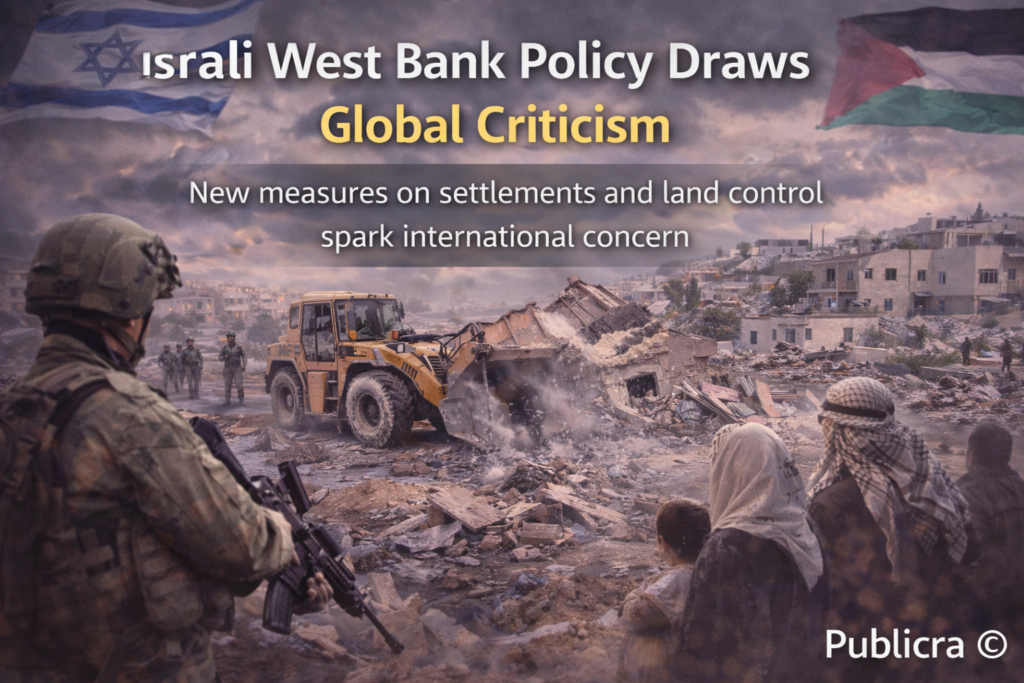
Policy overhaul on land purchases and enforcement powers fuels diplomatic backlash and renews debate over the future of the two-state solution
A Policy Shift with Regional Reverberations
Israel’s latest cabinet-approved measures affecting governance and land policies in the occupied West Bank have ignited fresh controversy across the Middle East and beyond. The policy overhaul, which includes changes to land purchase regulations and expanded enforcement authorities, has been welcomed by settler groups but criticized by Palestinian officials, regional governments, and European leaders who warn it could further entrench Israel’s control over disputed territory.
The developments come amid a fragile ceasefire framework and renewed international efforts to stabilize the Israeli–Palestinian conflict. While Israeli leaders frame the measures as administrative reforms and security necessities, critics argue they risk altering facts on the ground in ways that complicate any future negotiations over Palestinian statehood.
This article unpacks what the new measures entail, the historical and legal context of the West Bank, regional and international reactions, and what the policy shift means for prospects of peace.
Understanding the West Bank: Governance and Legal Framework
The West Bank has been under Israeli military occupation since 1967. Following interim agreements in the 1990s, the territory was divided into Areas A, B, and C:
- Area A: Administered by the Palestinian Authority (PA) with civil and security control.
- Area B: Palestinian civil administration with Israeli security oversight.
- Area C: Full Israeli civil and security control; contains most Israeli settlements and key land reserves.
This fragmented governance structure has long complicated daily life for Palestinians and made comprehensive political solutions difficult. Israel’s new measures primarily affect Area C and enforcement authorities in areas where the PA exercises limited self-rule.
What the New Measures Include
According to officials and local media reports, the policy overhaul approved by Israel’s cabinet includes several key elements:
1. Land Purchase Regulations
Longstanding rules restricting private land purchases by Israeli citizens in parts of the West Bank are set to be revised. Supporters argue this will normalize property transactions and reduce legal ambiguity. Opponents warn it could accelerate settlement growth and change demographic patterns in contested areas.
2. Expanded Enforcement Powers
Israeli authorities will gain broader oversight and enforcement capabilities in certain sectors, including environmental regulation, water usage, and protection of archaeological sites. Critics argue these powers could be applied unevenly, further limiting Palestinian administrative autonomy.
3. Oversight of Religious and Heritage Sites
Provisions reportedly allow Israeli authorities greater supervisory roles over selected religious and historical sites. Such measures often carry symbolic weight in a region where control of sacred spaces is deeply intertwined with national identity and political claims.
Israeli Government’s Rationale
Israeli leaders have defended the reforms as practical steps to improve governance, safety, and environmental protection. Officials argue that regulatory gaps and jurisdictional ambiguities in the West Bank have hindered effective law enforcement and land management.
From the government’s perspective, the measures aim to:
- Improve regulatory consistency
- Enhance public safety and infrastructure protection
- Address environmental hazards and illegal construction
Supporters within Israel contend that stronger administrative control in Area C is necessary to maintain order and prevent security risks.
Palestinian Response: Fears of De Facto Annexation
The Palestinian Authority has strongly condemned the measures, describing them as unlawful and harmful to Palestinian sovereignty claims. Palestinian leaders argue that expanding Israeli civil authority and facilitating settler land purchases amounts to a creeping annexation of occupied territory.
Militant groups have also condemned the policy shift, calling for intensified resistance and urging regional allies to take diplomatic action. Palestinian civil society organizations warn that the reforms could further restrict Palestinian development in Area C, where building permits for Palestinians are already limited.
Regional and International Reactions
The policy changes have drawn criticism from multiple international actors:
- European Union: Officials reiterated that settlement expansion and unilateral changes to the status of the West Bank undermine prospects for a negotiated two-state solution.
- Arab and Muslim-majority states: Several governments issued statements warning that the measures risk destabilizing the region and violating international norms.
- United Nations officials: Repeated calls for restraint and adherence to international law have followed similar policy moves in the past, and renewed scrutiny is expected.
International partners emphasize that any lasting peace must be achieved through negotiations, not unilateral actions that alter conditions on the ground.
The Two-State Solution: Still Viable?
For decades, the two-state solution—envisioning an independent Palestinian state alongside Israel—has been the cornerstone of international diplomacy. Critics argue that continued settlement expansion and administrative changes in the West Bank are steadily eroding the territorial contiguity required for such a state.
Key challenges include:
- Fragmentation of Palestinian-controlled areas
- Expansion of settlements and related infrastructure
- Declining public confidence in negotiations
Some analysts suggest that the political window for a negotiated two-state outcome is narrowing, while others maintain that diplomatic frameworks remain viable if backed by sustained international engagement.
Security Considerations and Local Impact
Israel maintains that security imperatives necessitate strong control in parts of the West Bank, citing concerns over attacks and militant activity. However, security-driven policies often have profound impacts on civilian life, including:
- Restrictions on movement
- Delays in development projects
- Heightened tensions between communities
Humanitarian organizations caution that increased enforcement powers could exacerbate humanitarian challenges in already vulnerable communities.
Diplomacy in a Shifting Regional Landscape
The policy shift occurs against a backdrop of evolving regional dynamics, including ceasefire efforts, changing alliances, and international attempts to stabilize Gaza and the broader region. Diplomatic initiatives emphasizing technocratic governance in Gaza and renewed dialogue have not resolved the deeper questions surrounding the West Bank’s future status.
Regional mediators stress that sustainable peace will require addressing both immediate security concerns and the long-term political framework governing Israeli–Palestinian relations.
What Comes Next: Possible Scenarios
Several scenarios could unfold in the wake of Israel’s policy changes:
- Diplomatic Pressure Intensifies: International partners may push for reversals or confidence-building measures.
- Legal Challenges: The measures could face domestic or international legal scrutiny.
- Escalation on the Ground: Local tensions may rise, particularly around settlement expansion and enforcement actions.
- Renewed Negotiations: External pressure could catalyze renewed diplomatic efforts, though prospects remain uncertain.
Policy Changes with Long-Term Consequences
Israel’s latest West Bank measures underscore the enduring complexity of the Israeli–Palestinian conflict. While framed domestically as administrative and security reforms, the policies carry significant political implications that resonate far beyond the region. As international criticism grows and local tensions simmer, the future of the West Bank—and the broader peace process—hangs in a delicate balance. Whether these developments harden divisions or prompt renewed diplomatic engagement will shape the trajectory of the conflict in the years ahead.