
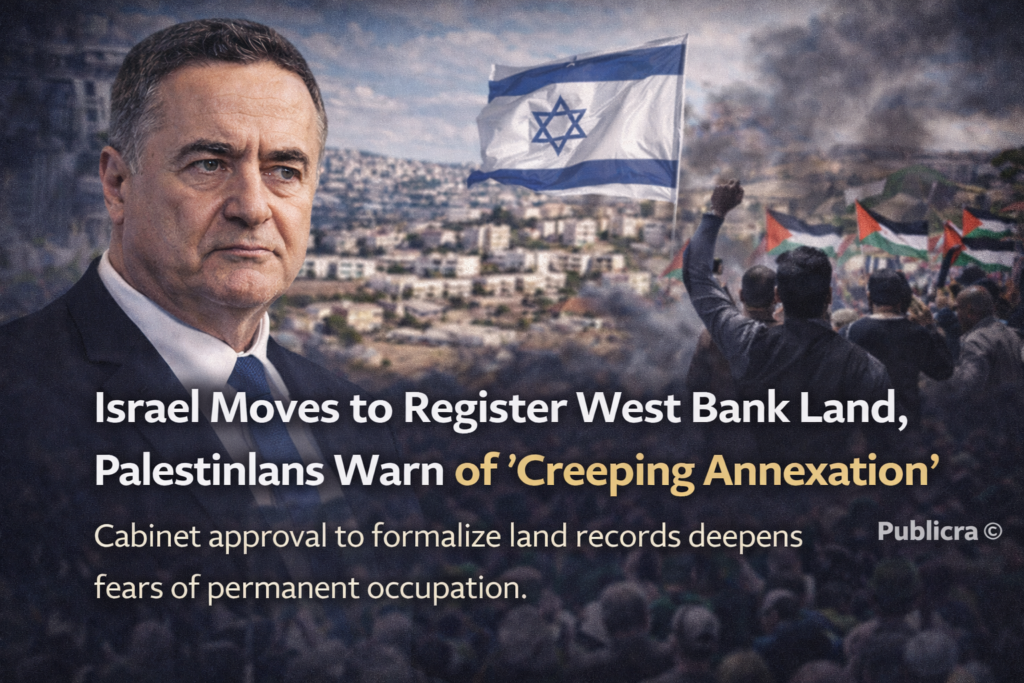
Cabinet approval to formalize land records deepens fears of permanent occupation as settlement expansion, security policy, and diplomacy collide.
Israel’s cabinet has approved a policy to initiate land registration across parts of the occupied West Bank, a move that Israeli officials frame as a legal and security measure but which Palestinians condemn as a step toward de-facto annexation. The decision marks the first comprehensive push to formalize land records in the territory since 1967 and comes amid intensified settlement activity, political maneuvering ahead of national elections, and mounting international scrutiny of the occupation.
For Palestinians, land registration is not a neutral bureaucratic exercise. They argue it entrenches Israeli control, facilitates settlement expansion, and undermines the territorial basis for a future Palestinian state. For Israel’s governing coalition, the policy aligns with long-standing objectives to consolidate presence in the West Bank, resolve land disputes in favor of Israeli claims, and assert administrative authority over contested areas.
The clash over land registration underscores how legal instruments are increasingly being used to shape facts on the ground, with far-reaching implications for diplomacy, human rights, and the viability of any negotiated settlement.
The Policy Decision and What It Changes on the Ground
The cabinet’s approval authorizes the commencement of formal land registration processes across areas of the West Bank under Israeli military control. Supporters argue that registration will clarify ownership, reduce disputes, and improve governance and security enforcement. Officials contend that the move addresses what they describe as unregulated or competing land claims and seeks to standardize records after decades of administrative ambiguity.
In practice, critics warn that the registration framework favors settlers and Israeli state claims by applying Israeli administrative procedures in a territory internationally recognized as occupied. Once land is formally registered under frameworks aligned with Israeli legal norms, reversing or contesting those records becomes significantly more difficult. This creates durable legal realities that shape future negotiations before they even begin.
The Legal Architecture of Occupation and Land Control
The West Bank’s legal environment is a patchwork of Ottoman-era land laws, British Mandate regulations, Jordanian statutes, military orders, and Israeli administrative practices. Land registration within such a complex system is inherently political. Decisions about which legal framework prevails determine whose claims are recognized, how disputes are adjudicated, and which institutions exercise authority.
Palestinians argue that introducing or expanding registration under Israeli control erodes their legal standing and marginalizes Palestinian institutions. From their perspective, land registration is not merely record-keeping—it is an assertion of jurisdiction. Israeli officials counter that uniform registration enhances legal clarity and reduces conflict over land ownership. The dispute reflects deeper disagreements over sovereignty, jurisdiction, and the legal status of the territory itself.
Settlement Expansion and Incentives for Land Acquisition
The timing of the decision coincides with accelerated settlement activity. Settlement growth has been driven by a mix of ideological commitment, security arguments, and economic incentives. Land registration can streamline transactions and provide settlers with greater legal certainty when acquiring property, whether through purchases, leases, or state allocations.
For settler communities, formalized land records can unlock access to infrastructure funding, mortgages, and public services, embedding settlements more deeply into Israel’s administrative and economic systems. For Palestinians, this process is experienced as dispossession—reducing available land for housing, agriculture, and development, and fragmenting communities through zoning restrictions and access controls.
Security Rationales and the Politics of Control
Israeli officials frame land registration as a security measure designed to strengthen enforcement, protect citizens, and ensure freedom of action for security forces. From this perspective, clear land records facilitate law enforcement, infrastructure planning, and operational readiness. The security narrative resonates with a domestic audience concerned about attacks and instability.
However, critics argue that securitization of land policy blurs the line between security management and territorial consolidation. By embedding control within legal and administrative processes, the policy risks normalizing permanent occupation under the guise of security governance. This securitized framing also complicates international engagement, as security concerns are frequently invoked to justify measures that alter the territorial status quo.
Palestinian Authority Response and Political Ramifications
The Palestinian Authority has condemned the decision as a step toward annexation, warning that it undermines prospects for statehood and entrenches occupation. The move places additional strain on an already weakened PA, which faces declining legitimacy, economic pressures, and constraints on governance. The perception that diplomatic avenues are closing may fuel political polarization and undermine faith in negotiated solutions.
Within Palestinian society, reactions range from calls for intensified diplomatic pressure to renewed grassroots mobilization against settlement expansion. The land registration policy is seen not as an isolated administrative act but as part of a cumulative strategy that erodes Palestinian territorial claims incrementally.
International Law, Diplomacy, and Global Reactions
International legal frameworks broadly regard the West Bank as occupied territory, with settlements widely viewed as inconsistent with international law. Advisory opinions and resolutions have emphasized the obligation to avoid measures that alter the character or status of occupied territory. While such opinions are not always binding, they shape diplomatic narratives and influence international engagement.
The cabinet’s decision complicates diplomatic efforts to revive a political process. Allies that support Israel’s security needs face renewed pressure to address policies that appear to foreclose the two-state framework. Critics argue that incremental administrative changes can be as consequential as formal annexation, even if they stop short of explicit sovereignty declarations.
Elections, Coalition Politics, and Policy Momentum
Domestic politics play a central role in shaping West Bank policy. With elections looming, governing coalitions face incentives to signal resolve on territorial issues to mobilize their base. Pro-settlement factions exert significant influence within the coalition, framing land registration as part of a broader project to normalize Israeli governance across the territory.
This political dynamic can accelerate policy momentum. Once initiated, administrative processes develop bureaucratic constituencies that resist reversal. The entrenchment of land registration mechanisms thus reflects not only ideological preferences but also institutional inertia.
Economic Impacts and Developmental Consequences
Land registration has economic ramifications for both Israelis and Palestinians. For settlers and Israeli-linked developers, formalized records can unlock investment, construction, and infrastructure expansion. For Palestinians, constraints on land access hinder economic development, housing construction, and agricultural livelihoods.
Fragmented land ownership and zoning restrictions contribute to uneven development, reinforcing socioeconomic disparities. As land becomes more tightly regulated under Israeli-administered systems, Palestinian communities may face heightened barriers to obtaining permits, securing credit, and planning long-term development.
Human Rights Concerns and Daily Life Under Registration Regimes
Human rights organizations warn that land registration, when implemented under occupation, can exacerbate coercive environments. Disputes over documentation, access to legal remedies, and the burden of proof disproportionately affect Palestinians, many of whom lack formal records due to decades of disrupted governance.
On the ground, families face uncertainty over property rights, potential eviction risks, and limitations on building. These pressures compound existing challenges related to movement restrictions, access to services, and economic precarity, shaping daily life in profound ways.
The Two-State Framework and Its Shrinking Geography
The cumulative effect of settlement expansion, administrative consolidation, and land registration is a shrinking territorial basis for a viable Palestinian state. Fragmentation of land into enclaves connected by controlled corridors undermines contiguity—an essential requirement for statehood.
Supporters of the two-state framework argue that preserving the possibility of territorial compromise requires halting measures that entrench irreversible facts on the ground. Critics counter that the framework itself has become detached from political realities. The land registration decision thus feeds into a broader debate about whether the traditional diplomatic paradigm remains viable.
Regional Stability and Security Externalities
Policies in the West Bank reverberate across the region. Tensions can spill over into broader unrest, affecting neighboring states and regional security dynamics. Heightened friction risks inflaming public opinion, straining security coordination, and complicating regional normalization efforts.
From a regional perspective, stability depends not only on military deterrence but also on political pathways that address core grievances. Administrative measures that deepen perceptions of permanent occupation risk fueling cycles of escalation that undermine broader security objectives.
Possible Pathways Forward and Policy Options
Several policy options remain available, though each carries political costs. These include pausing or limiting registration in sensitive areas, establishing joint mechanisms to adjudicate disputes, enhancing transparency and legal safeguards for Palestinian claims, and linking administrative measures to renewed political negotiations.
International partners can encourage de-escalatory steps through diplomatic engagement, economic incentives, and support for confidence-building measures. Ultimately, durable stability will require aligning legal and administrative practices with a credible political horizon that addresses sovereignty, security, and rights.
Law as Power in a Contested Land
The decision to proceed with land registration in the West Bank illustrates how legal and administrative tools can reshape contested spaces. What appears as bureaucratic reform carries profound political consequences, redefining ownership, authority, and the prospects for peace. For Palestinians, the move symbolizes creeping annexation; for Israel’s governing coalition, it reflects consolidation of control under the banner of security and governance.
As the policy unfolds, its impacts will be measured not only in legal records but in altered landscapes, constrained choices, and shifting diplomatic realities. Whether land registration becomes a step toward administrative clarity or a milestone on the path to permanent occupation will depend on the political will to align governance with a just and sustainable resolution of the conflict.