
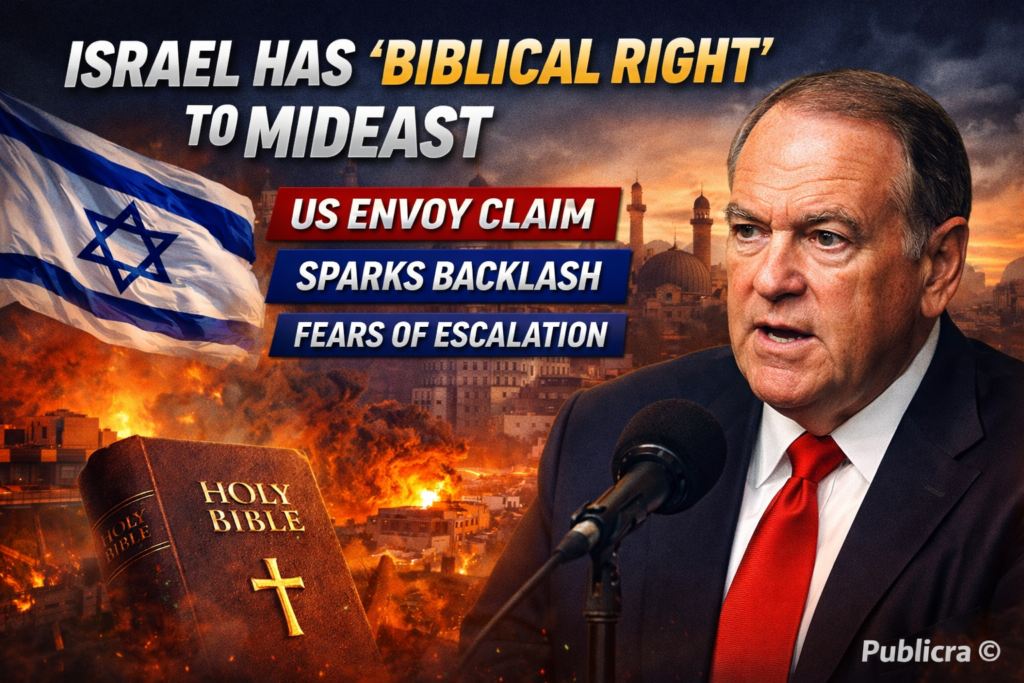
Comments by US ambassador Mike Huckabee reignite controversy over religion, borders, and Middle East geopolitics amid ongoing wars
The Middle East has once again become the center of intense geopolitical debate after the US ambassador to Israel, Mike Huckabee, made remarks suggesting that Israel has a biblical right to much of the region. His comments, delivered during a high-profile interview, have ignited controversy across diplomatic circles, religious communities, and international policy forums.
At a time when the region is already grappling with the aftermath of war in Gaza, heightened tensions with Iran-backed groups, ongoing settlement expansion in the occupied West Bank, and cross-border operations in Lebanon and Syria, Huckabee’s statements have added fuel to an already volatile situation.
Supporters of Israel view his words as a reaffirmation of long-held religious beliefs and political alliances. Critics argue that invoking scripture to justify territorial claims undermines international law, threatens regional stability, and risks legitimizing expansionism in a conflict-ridden region.
Who Is Mike Huckabee and Why His Words Matter
Mike Huckabee is not only a career politician and former governor but also a Baptist minister who openly identifies with Christian Zionist beliefs. As the official US envoy to Israel, his public statements carry diplomatic weight and are often interpreted as reflective of broader policy attitudes within Washington.
Unlike private religious leaders, diplomats represent state interests. When a sitting ambassador frames territorial claims in biblical terms, it blurs the line between faith-based ideology and modern international diplomacy. This has raised concerns among foreign policy experts who stress that contemporary borders and sovereignty are governed by international agreements, treaties, and legal frameworks rather than religious texts.
The controversy is heightened by the current geopolitical climate, in which words spoken by high-ranking officials can influence public sentiment, embolden hardline positions, and complicate fragile diplomatic efforts.
The Biblical Narrative and Modern Political Claims
The argument that Israel’s territorial rights stem from biblical scripture is rooted in interpretations of ancient religious texts that describe land promised to the descendants of Abraham. While such beliefs hold spiritual significance for many, translating them into modern political claims is deeply contentious.
International law, which governs relations between states today, does not recognize religious scripture as a legal basis for territorial sovereignty. Instead, borders are shaped by historical treaties, international recognition, and the principle of self-determination.
By referencing biblical claims, critics say the ambassador’s comments risk framing a complex political conflict in absolutist terms, leaving little room for negotiation, compromise, or peaceful resolution. This narrative may resonate with some religious communities but alienates others who view the Middle East conflict through the lens of human rights and international law.
The Impact on Palestinians and the West Bank
The comments come amid ongoing concerns over settlement expansion in the occupied West Bank, which many in the international community consider illegal under international law. Palestinians fear that rhetoric endorsing expansive territorial claims could legitimize further encroachments on their land and weaken prospects for a future Palestinian state.
For communities living under occupation, diplomatic language matters. Statements that appear to endorse sweeping territorial claims are perceived as dismissive of Palestinian historical presence, cultural ties, and political aspirations. This deepens mistrust and makes dialogue more difficult.
Human rights organizations warn that such rhetoric may normalize policies that contribute to displacement, restrictions on movement, and unequal access to resources, further entrenching a cycle of grievance and resistance.
Gaza War Fallout and Humanitarian Consequences
The ongoing humanitarian crisis in Gaza remains a central concern in global discussions about Israel’s actions in the region. With tens of thousands of casualties reported since the conflict escalated in late 2023, the human cost has been staggering.
Against this backdrop, remarks about biblical entitlement are seen by many as tone-deaf to the suffering on the ground. Critics argue that invoking religious justification in the midst of humanitarian catastrophe risks appearing indifferent to civilian suffering and undermines calls for ceasefires, humanitarian access, and accountability.
Aid agencies stress that long-term stability cannot be achieved through military dominance alone. Sustainable peace requires addressing humanitarian needs, rebuilding trust, and creating political pathways that recognize the rights and security of all people in the region.
Regional Tensions with Iran, Lebanon, Syria, and Yemen
The Middle East conflict is no longer confined to Israel and the الفلسطيني territories alone. Over the past several years, Israel has engaged in military actions involving Iran-backed groups, carried out operations in Lebanon, and conducted strikes in Syria and Yemen.
These actions reflect a broader regional confrontation involving multiple state and non-state actors. Comments that frame territorial ambitions in sweeping, religious terms risk inflaming these tensions further. Regional powers may interpret such rhetoric as confirmation of expansionist intent, justifying their own escalatory postures in response.
Security analysts warn that misinterpretations or provocations in this climate can rapidly spiral into wider regional conflict, drawing in multiple countries and destabilizing critical global trade and energy routes.
International Law Versus Religious Justification
A central theme in the backlash to Huckabee’s remarks is the tension between religious narratives and international law. The post-World War II international system is built on principles of sovereignty, territorial integrity, and peaceful resolution of disputes.
When senior diplomats appear to prioritize religious texts over legal frameworks, it raises questions about the consistency of foreign policy commitments to international norms. Allies may worry about the predictability of US positions, while adversaries may accuse Washington of double standards.
Legal scholars emphasize that invoking religion in territorial disputes undermines the universality of international law and risks setting dangerous precedents in other conflict zones worldwide, where religious or historical claims could be used to justify territorial expansion.
Domestic Political Reactions in the United States
Within the United States, Huckabee’s comments have sparked polarized reactions. Supporters within evangelical Christian communities see his remarks as affirming deeply held beliefs about Israel’s place in biblical prophecy. For them, the comments reinforce longstanding religious and political support for Israel.
Opponents, including many foreign policy experts and civil society groups, argue that such statements entangle religion with state policy in ways that complicate diplomacy and risk undermining America’s credibility as a neutral mediator.
The debate reflects broader divisions in US politics, where foreign policy toward the Middle East is often shaped by a complex mix of strategic interests, domestic political considerations, and religious influence.
The Role of Media and Public Discourse
The global reaction to Huckabee’s remarks has been amplified by media coverage and social media debate. In today’s information environment, controversial statements can rapidly shape narratives and mobilize public opinion across borders.
Media framing plays a crucial role in how such comments are interpreted. Some outlets emphasize the religious dimension, while others focus on legal and humanitarian implications. This divergence influences public understanding and political pressure on governments to respond.
The episode highlights the importance of careful diplomatic communication in an era where every statement can be instantly disseminated and scrutinized worldwide.
Implications for Peace Efforts and Two-State Prospects
The future of peace negotiations in the Middle East remains uncertain. Many international initiatives continue to support a two-state framework as a potential pathway to resolving the Israeli–Palestinian conflict.
Rhetoric suggesting expansive territorial entitlement complicates these efforts by reinforcing zero-sum narratives. Peace processes depend on mutual recognition, compromise, and trust-building. Statements that appear to dismiss the legitimacy of Palestinian claims risk hardening positions on both sides and weakening moderates who advocate negotiation.
Diplomats working behind the scenes emphasize that progress requires reframing the conflict away from absolute claims toward pragmatic arrangements that address security, sovereignty, and rights.
Global Diplomatic Repercussions
Allies of the United States in Europe, Asia, and the Middle East are closely watching how Washington responds to the controversy. Some governments may privately express concern that religiously framed diplomacy undermines international consensus on conflict resolution principles.
For countries in the Global South, where colonial-era borders and religious diversity remain sensitive issues, the rhetoric raises alarms about the potential misuse of historical or religious narratives to justify territorial claims. This could influence how these states engage with US-led initiatives on conflict mediation and international law.
Words That Resonate Beyond Borders
Mike Huckabee’s remarks about Israel’s biblical right to large parts of the Middle East have resonated far beyond the interview in which they were spoken. In a region already strained by war, humanitarian crisis, and geopolitical rivalry, such statements carry consequences.
Whether intended as personal belief or diplomatic signal, the comments highlight the delicate balance between religion and statecraft in one of the world’s most contested regions. As global leaders navigate ongoing conflicts, the episode serves as a reminder that words spoken by officials can shape perceptions, harden divisions, and influence the fragile prospects for peace.