
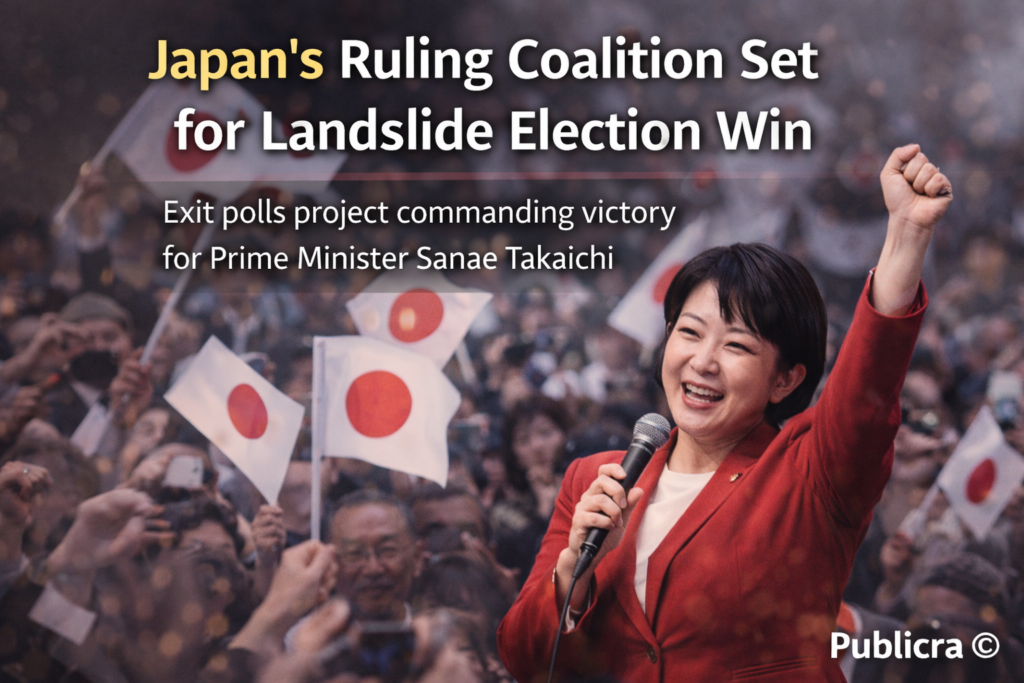
Exit polls point to two-thirds majority for the governing bloc, reshaping Japan’s political landscape amid economic worries and regional security tensions
A Turning Point in Japanese Politics
Japan appears set for a decisive political shift as exit polls indicate a commanding victory for the governing coalition led by Prime Minister Sanae Takaichi. The snap election, called just months after she assumed leadership of the ruling party, has delivered what many analysts describe as a clear public mandate. If confirmed by final results, the coalition’s projected two-thirds majority in the House of Representatives will grant the government significant legislative leverage at a time when Japan faces mounting economic pressures, demographic challenges, and evolving security dynamics in East Asia.
The outcome marks a striking reversal from recent years, when corruption scandals, policy gridlock, and public frustration eroded the ruling party’s dominance. Takaichi’s ascent and apparent electoral success signal a broader recalibration of Japanese politics, driven by voter appetite for stability, decisive leadership, and economic reassurance amid uncertain global conditions.
This article explores the drivers behind the projected landslide, the policy agenda likely to shape Japan’s next political chapter, and the domestic and international implications of a strengthened government.
From Political Setbacks to a Landslide Mandate
Just two years ago, Japan’s long-dominant ruling party faced its most serious electoral setbacks in decades, losing its majority amid public anger over governance scandals and rising living costs. The collapse of previous coalition arrangements underscored a broader erosion of trust in political institutions.
Takaichi’s rise to the premiership has altered that trajectory. Her decision to call a snap election was widely viewed as a gamble, but exit polls suggest the move paid off. Voters appear to have rallied around her leadership style, which blends assertive rhetoric with promises of economic relief and national renewal.
The projected majority would give the government unprecedented room to maneuver, potentially enabling constitutional debates, tax and spending reforms, and a recalibration of Japan’s security posture.
The Appeal of Leadership: Why Voters Backed Takaichi
Takaichi’s political brand has resonated with a broad segment of the electorate. Several factors appear to have contributed to her popularity:
1. Economic Messaging
Japan’s economy has struggled with sluggish growth, wage stagnation, and rising costs of living. Takaichi’s pledges to increase public spending and provide targeted tax relief appealed to voters anxious about household finances.
2. Communication Style
Her strong social media presence and direct engagement with voters have helped her connect with younger demographics, traditionally less engaged in Japanese politics. By presenting a more accessible and personable public image, she has broadened the party’s appeal beyond its traditional base.
3. National Identity and Security
Takaichi’s emphasis on national security and a more assertive foreign policy stance has resonated with voters concerned about regional tensions, particularly in relation to China and the Taiwan Strait.
Economic Challenges: Balancing Growth and Debt
Japan’s economic outlook remains one of the most pressing issues facing the new government. While the ruling coalition’s campaign promises focused on revitalizing growth and easing household burdens, critics warn that increased spending could exacerbate Japan’s already high public debt.
Key economic challenges include:
- Inflation and Cost of Living: Recent price increases have strained household budgets, challenging a society long accustomed to low inflation.
- Demographic Decline: An aging population and shrinking workforce threaten long-term growth prospects.
- Productivity Stagnation: Structural reforms aimed at boosting innovation and labor productivity remain incomplete.
The government’s ability to reconcile expansionary fiscal policies with long-term debt sustainability will be a critical test of its credibility.
Immigration, Social Policy, and Public Debate
Takaichi’s campaign included proposals to tighten immigration rules and strengthen oversight of foreign ownership of land and assets. Supporters argue that these measures protect national interests, while critics contend they risk stoking social division in a country where foreign residents make up a small share of the population.
Japan’s labor shortages have already prompted gradual relaxation of immigration rules in recent years. The tension between economic necessity and political caution highlights a broader debate over Japan’s future social model in an era of demographic decline.
Regional Security and Foreign Policy
The projected landslide victory strengthens Takaichi’s hand in foreign and security policy. Regional dynamics in East Asia have become increasingly volatile, with tensions involving China, North Korea, and the broader Indo-Pacific security architecture shaping Japan’s strategic calculus.
Key foreign policy priorities include:
- Strengthening Alliances: Japan’s alliance with the United States remains central to its security strategy, with increased defense spending and joint initiatives likely to continue.
- China Relations: As Japan’s largest trading partner, China remains economically vital, yet political relations are strained by security concerns in the region.
- Defense Policy Reform: With a supermajority, the government could pursue long-debated changes to Japan’s pacifist constitution, reshaping the legal framework for its defense forces.
These policy shifts carry significant implications for regional stability and Japan’s role on the global stage.
What a Two-Thirds Majority Means
If confirmed, a two-thirds majority would give the ruling coalition the power to push through major legislative changes and potentially initiate constitutional amendments. This level of dominance is rare in contemporary Japanese politics and could mark a turning point in how decisively the government can act.
However, such concentration of power also raises questions about checks and balances. Opposition parties have pledged to hold the government accountable, particularly on issues of fiscal responsibility, civil liberties, and social inclusion.
International Reactions and Market Response
Early reactions from international partners suggest cautious optimism about political stability in Japan. Markets typically favor continuity, and a strong mandate could reduce policy uncertainty in the short term.
At the same time, global investors will closely watch how the government manages fiscal policy, defense spending, and relations with major trading partners. Any sharp deviation from established economic orthodoxy could have implications for currency markets and investor confidence.
A Mandate That Brings Opportunity—and Responsibility
Japan’s projected landslide election result marks a pivotal moment for the country’s political trajectory. With a strengthened mandate, Prime Minister Sanae Takaichi now faces the challenge of translating electoral momentum into effective governance. The coming months will test whether the government can deliver economic relief, navigate sensitive social debates, and manage Japan’s complex regional relationships—all while maintaining public trust.
As Japan steps into this new political chapter, the balance between decisive leadership and inclusive governance will determine whether the landslide victory becomes a foundation for long-term stability or a fleeting moment of political dominance.