
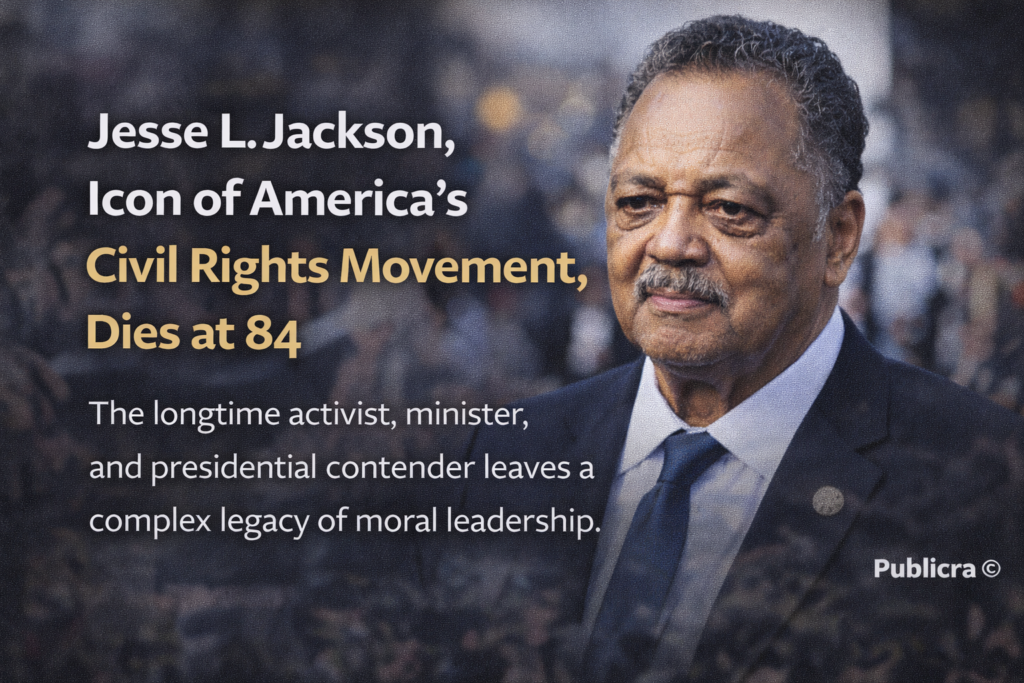
The longtime activist, minister, and presidential contender leaves a complex legacy of moral leadership, political ambition, and global advocacy.
Jesse L. Jackson, one of the most recognizable figures of the American civil rights movement and a tireless advocate for racial justice, economic equality, and political inclusion, has died at the age of 84. A close associate of Dr. Martin Luther King Jr. and a prominent national voice for decades, Jackson’s life traced the arc of modern Black political leadership in the United States—from the era of nonviolent protest to the age of electoral politics and global advocacy.
Jackson’s passing has prompted tributes across the political spectrum, reflecting the breadth of his influence and the complexity of his legacy. He leaves behind a record marked by moral conviction, ambitious political organizing, and a willingness to engage power at the highest levels of American life. For supporters, he embodied the persistence of the civil rights struggle beyond the 1960s. For critics, his confrontational style and controversial tactics sparked debate about methods and outcomes. Together, these elements define a life that reshaped the terrain of American politics and civil society.
From Segregated South to National Stage
Born in the segregated South in 1941, Jesse Jackson came of age at a time when racial inequality was codified into everyday life. His early experiences shaped a lifelong commitment to challenging structural injustice. As a student, he became active in civil rights organizing, joining sit-ins and voter registration efforts that placed him in the front lines of a movement redefining American democracy.
His association with Dr. Martin Luther King Jr. placed him at the heart of the Southern Christian Leadership Conference’s organizing efforts. The assassination of King in 1968 marked a turning point not only for the movement but for Jackson personally. In the years that followed, he sought to carry forward King’s vision while adapting it to a changing political landscape—one increasingly shaped by electoral participation, coalition-building, and policy advocacy.
Building Institutions for a New Phase of Civil Rights
After the 1960s, Jackson recognized that sustaining momentum required institutional power. He founded and led organizations that sought to translate moral demands into economic and political leverage. Through coalition-building among labor groups, faith communities, students, and minority entrepreneurs, he emphasized the idea that civil rights were inseparable from economic opportunity and political representation.
These institutions became vehicles for voter mobilization, corporate accountability campaigns, and community development initiatives. By framing civil rights as a broad-based struggle for inclusion, Jackson expanded the movement’s scope beyond desegregation to encompass healthcare access, educational equity, and fair employment practices. This institutional focus helped embed civil rights advocacy into the everyday fabric of American politics.
Presidential Campaigns and the Opening of Political Space
Jackson’s bids for the presidency in the 1980s marked a watershed moment for Black political participation at the national level. While his campaigns did not secure the nomination, they demonstrated that a candidate rooted in civil rights activism could mobilize a diverse, multiracial coalition across states and regions. His campaigns emphasized voter registration, grassroots organizing, and issue-based politics, laying groundwork for future candidates to build upon.
The symbolism of these campaigns mattered as much as their electoral outcomes. They challenged assumptions about who could seek the highest office and reframed national debates around poverty, peace, and social justice. Many political observers view this period as a precursor to later breakthroughs in Black political leadership, highlighting the cumulative nature of change within democratic systems.
Global Advocacy and Humanitarian Engagement
Beyond domestic politics, Jackson cultivated a role as an international mediator and humanitarian advocate. He traveled widely, engaging with leaders and communities in conflict zones and advocating for the release of detainees and hostages. His global activism underscored a belief that civil rights principles had universal relevance, extending beyond national borders to questions of human dignity and peace.
This international engagement enhanced his profile as a moral interlocutor, though it also drew scrutiny regarding the boundaries between official diplomacy and personal advocacy. Supporters praised his willingness to act where formal channels stalled; critics questioned the legitimacy and efficacy of such interventions. Regardless of perspective, his global engagement expanded the concept of civil rights into a broader human rights framework.
Controversies and Critiques of Method
Jackson’s career was not without controversy. His confrontational approach toward corporations and political institutions sparked debates over tactics. Critics accused him of leveraging public pressure campaigns to extract concessions, framing these actions as coercive. Supporters countered that such pressure was a necessary tool in confronting entrenched power structures resistant to reform.
These debates reflect enduring tensions within social movements: the balance between negotiation and confrontation, pragmatism and principle. Jackson’s willingness to engage powerful actors directly made him both effective and polarizing. His career illustrates how leadership in social change often invites scrutiny, particularly when strategies challenge established interests.
Health Struggles and Continued Public Presence
In later years, Jackson faced significant health challenges, including neurodegenerative conditions that affected his speech and mobility. Despite these difficulties, he remained a visible public figure, attending events and offering symbolic support to causes aligned with his life’s work. His continued presence underscored a commitment to advocacy even as physical capacity waned.
These final years also sparked broader conversations about disability, aging leadership, and the ways societies honor elder statespersons of social movements. Jackson’s perseverance highlighted the human dimension of long-term activism—the toll it takes and the resilience it demands.
The State of Civil Rights in Contemporary America
Jackson’s death comes at a moment of renewed debate over civil rights in the United States. Issues such as voting access, racial equity in healthcare and education, economic inequality, and policing remain central to national discourse. While the legal architecture of segregation has been dismantled, structural disparities persist, prompting a new generation of activists to reimagine strategies for change.
The legacy of leaders like Jackson informs these debates. His emphasis on coalition-building, voter mobilization, and institutional engagement continues to influence contemporary movements. At the same time, evolving contexts—digital activism, decentralized organizing, and global interconnectedness—are reshaping how civil rights advocacy unfolds in the 21st century.
Intergenerational Leadership and the Evolution of Movements
One of Jackson’s enduring contributions lies in bridging generations of activism. He connected the moral clarity of the 1960s with the pragmatic politics of later decades, demonstrating how movements adapt to changing political environments. Today’s organizers draw lessons from this evolution, blending street-level mobilization with policy advocacy and electoral engagement.
The intergenerational transmission of strategy is critical to sustaining social change. By mentoring younger leaders and building durable institutions, Jackson contributed to a continuum of activism that extends beyond any single figure. His life illustrates how leadership transitions shape the trajectory of movements over time.
Public Memory and the Complexity of Legacy
As the nation reflects on Jackson’s life, public memory will inevitably simplify a complex legacy. He will be remembered as a civil rights icon, a presidential contender, a global advocate, and a controversial tactician. These facets coexist, reminding us that transformative leaders are rarely unambiguous heroes or villains.
The task of historical assessment is to situate such figures within their contexts, acknowledging both achievements and shortcomings. Jackson’s career offers a lens through which to examine the evolution of American civil rights—from mass protest to institutional politics—and the ongoing challenges of translating moral vision into lasting structural change.
A Life That Shaped the Moral Landscape
Jesse L. Jackson’s life traced a journey from the segregated South to the center of American political life. He helped expand the boundaries of who could participate in national leadership, articulated a vision of justice that linked race, class, and peace, and sustained civil rights advocacy across decades of shifting political terrain.
As tributes pour in, his legacy invites renewed commitment to the unfinished work of equality. The questions that animated his activism—who belongs, who decides, and how justice is realized—remain central to contemporary debates. In that sense, his passing marks not an end, but a moment of reflection on the enduring struggle to align American ideals with lived realities.